

🌅Closer to the edge
Rudy Matondo - Memory and Negative Space
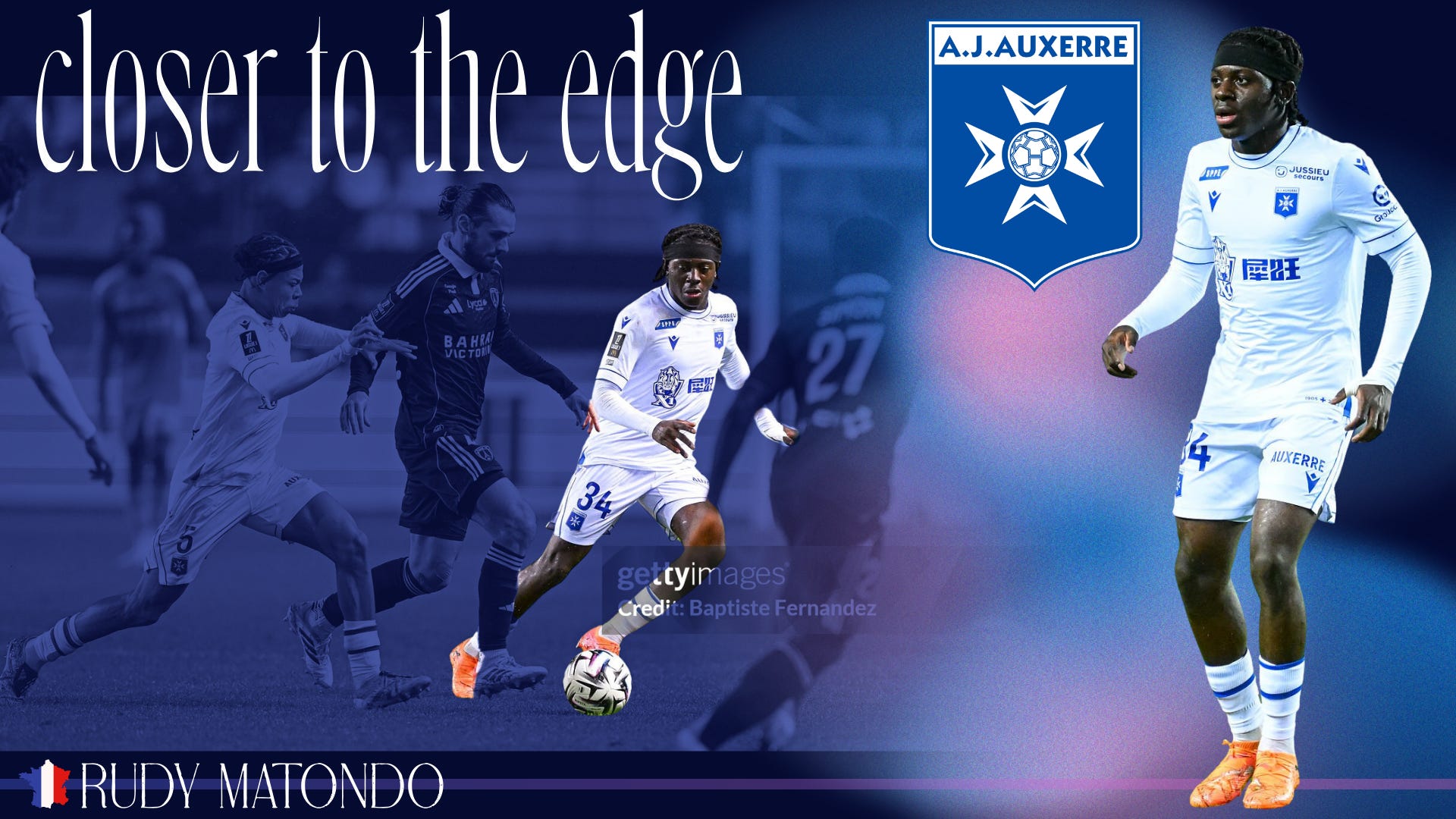
A quick look at a player I saw at the U17 Euros with France who I liked.


Thirty Seconds to Mars
When I started playing Football computer games (on PC, nerd forever), I had the FIFA series but then the EA Sport Championship Manager,
Which was a frankly under-rated universe where The Sims (for the Stadium and Town building) would meet FIFA (for a watered down version of the match engine) would meet Football Manager (for the database)
The matchday visuals were so powerful, and well thought


Matchday (whatever), but also previous results (not buried like on FM)
But more importantly, the lore : stadium facade, big badges, city and location.
Everytime I visit an English ground, I have goosebumps and genuinely get emotional like a snowflake seeing “the picture from the game” - less so when Alex Revell, Alex Neill or Kevin Lisbie’s name pops up, bringing back PTSD of the flashing face “goal alert”.
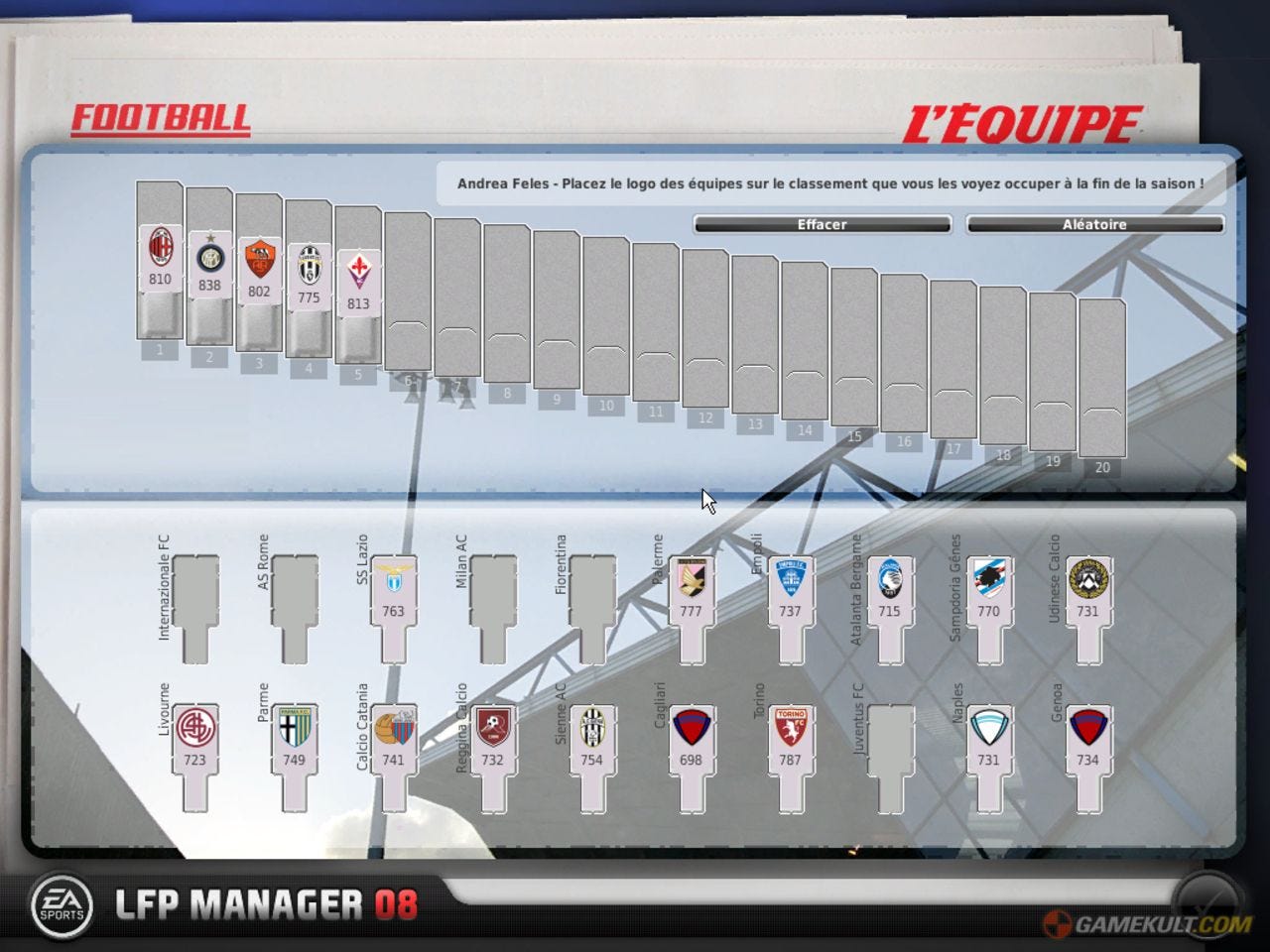
including these faux-realistic templates that kept me away from Football Manager for quite a bit : look at this, the shadows on the post-it, the paper clips, the aero design that would make interface upscale ; whilst the fabric (paper etc…) would make it real.
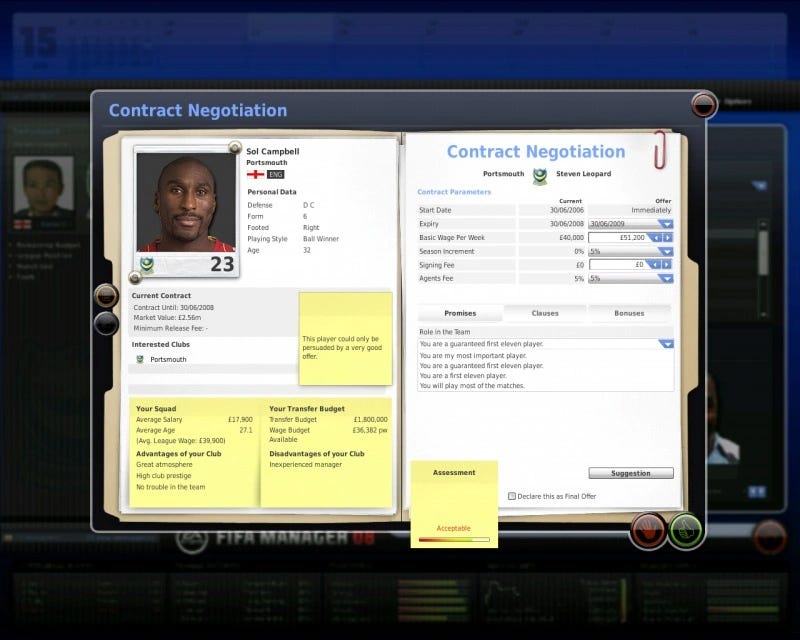
The game engine, for November 2007 was somewhat close to FIFA 05 and I played it on a semi discarded office IBM “thinkpad” laptop at the end of it’s (corporate) life (buckle up, machine, we’ll gonna make you work out like you never did - clo-ser to the eeeedge).
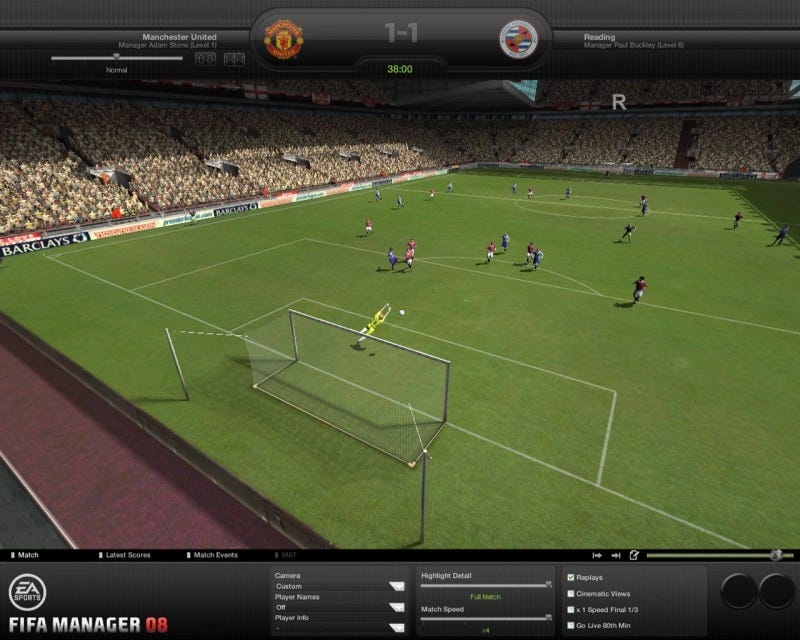
I never quite played with the match engine highlights, mostly with some kind of mixed teletext. Your imagination will fill in the negative space.
The main interface was the same email inbox thingy - exciting when you’re a kid, less so I’d imagine today since that’s another Outlook / Teams
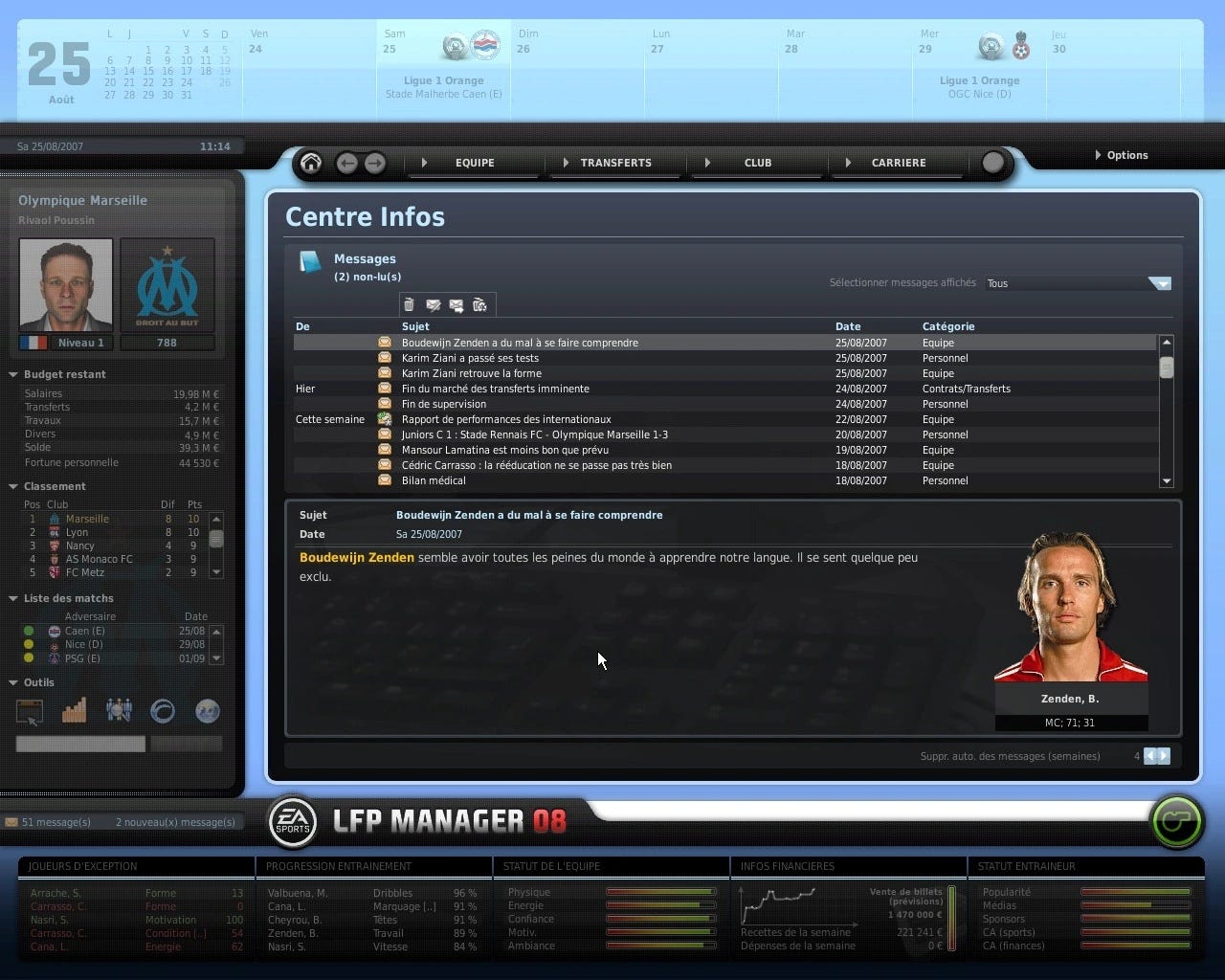
For sure, the Electronic Arts franchise was loaded with license rights, that made it feel real.
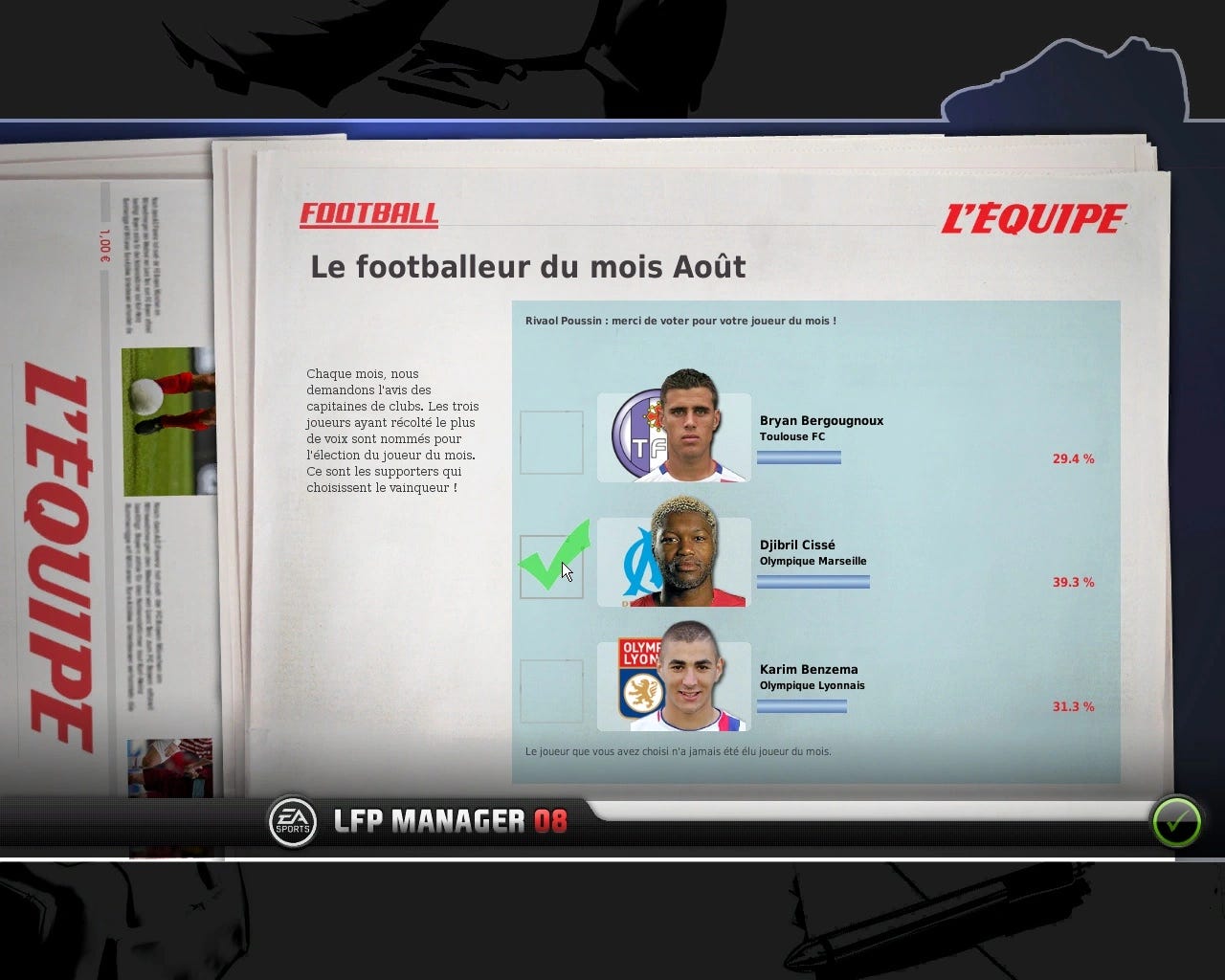
Competitions panels would make you think that’s actually it.
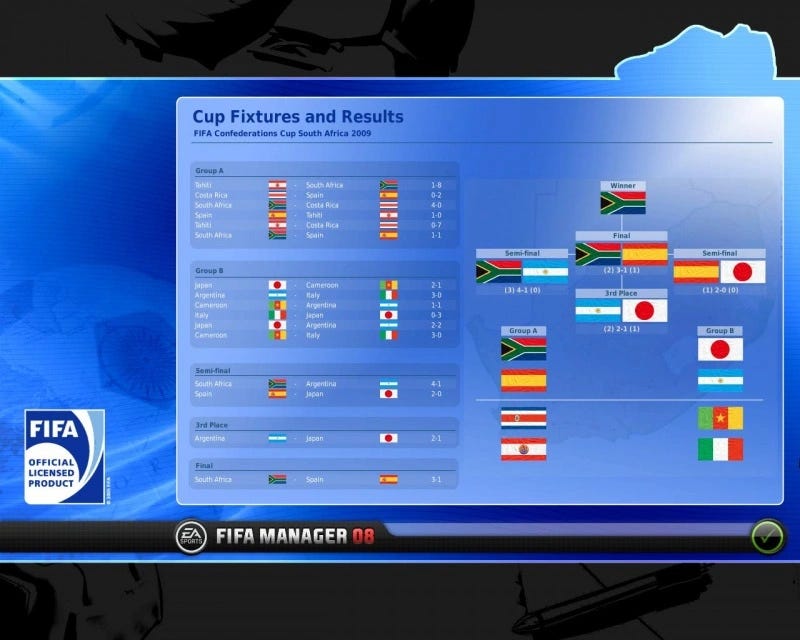
This is extraordinary faux-real
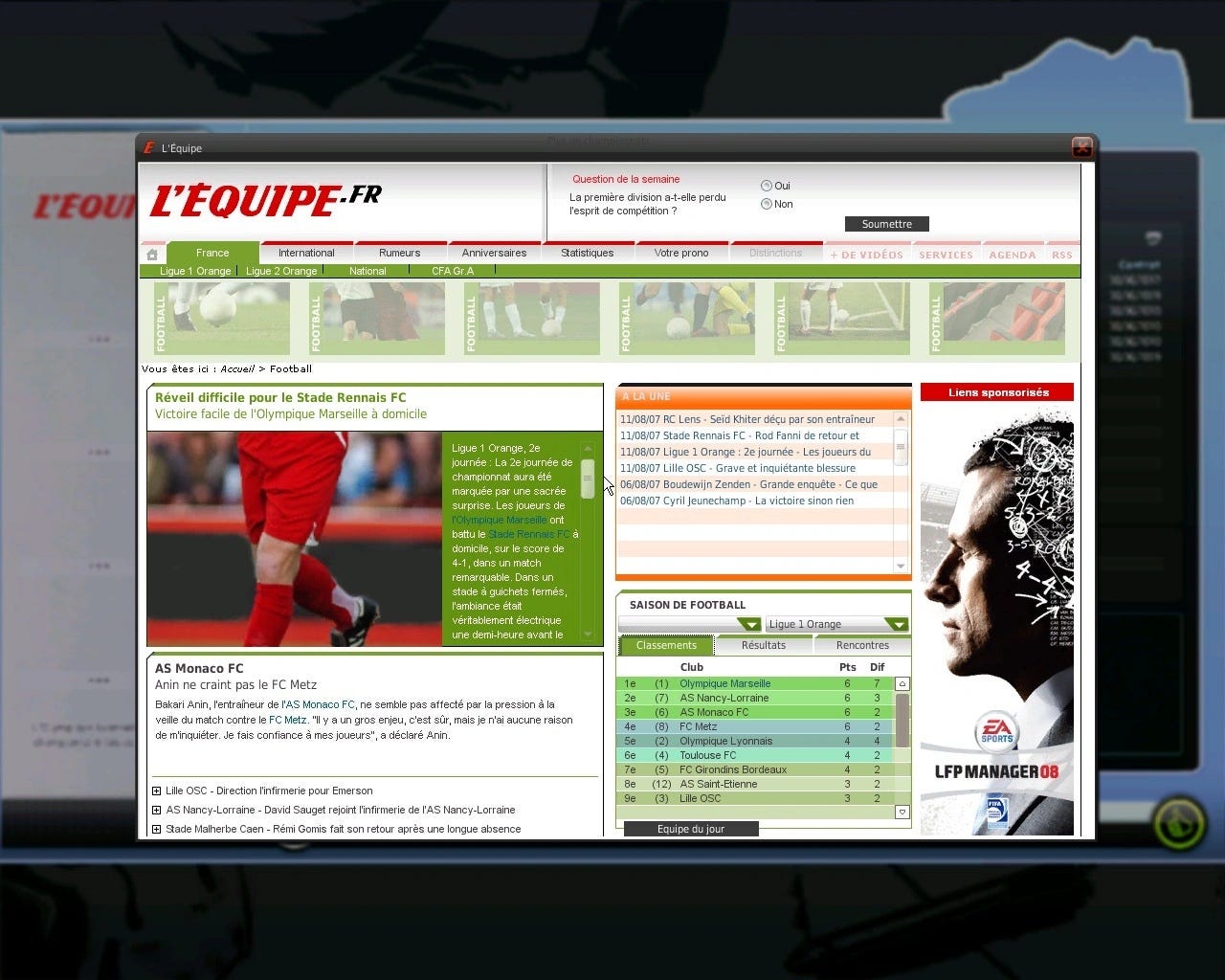
A mock L’Equipe website, identical to the real one back then
Transfer deadline day was a vibe
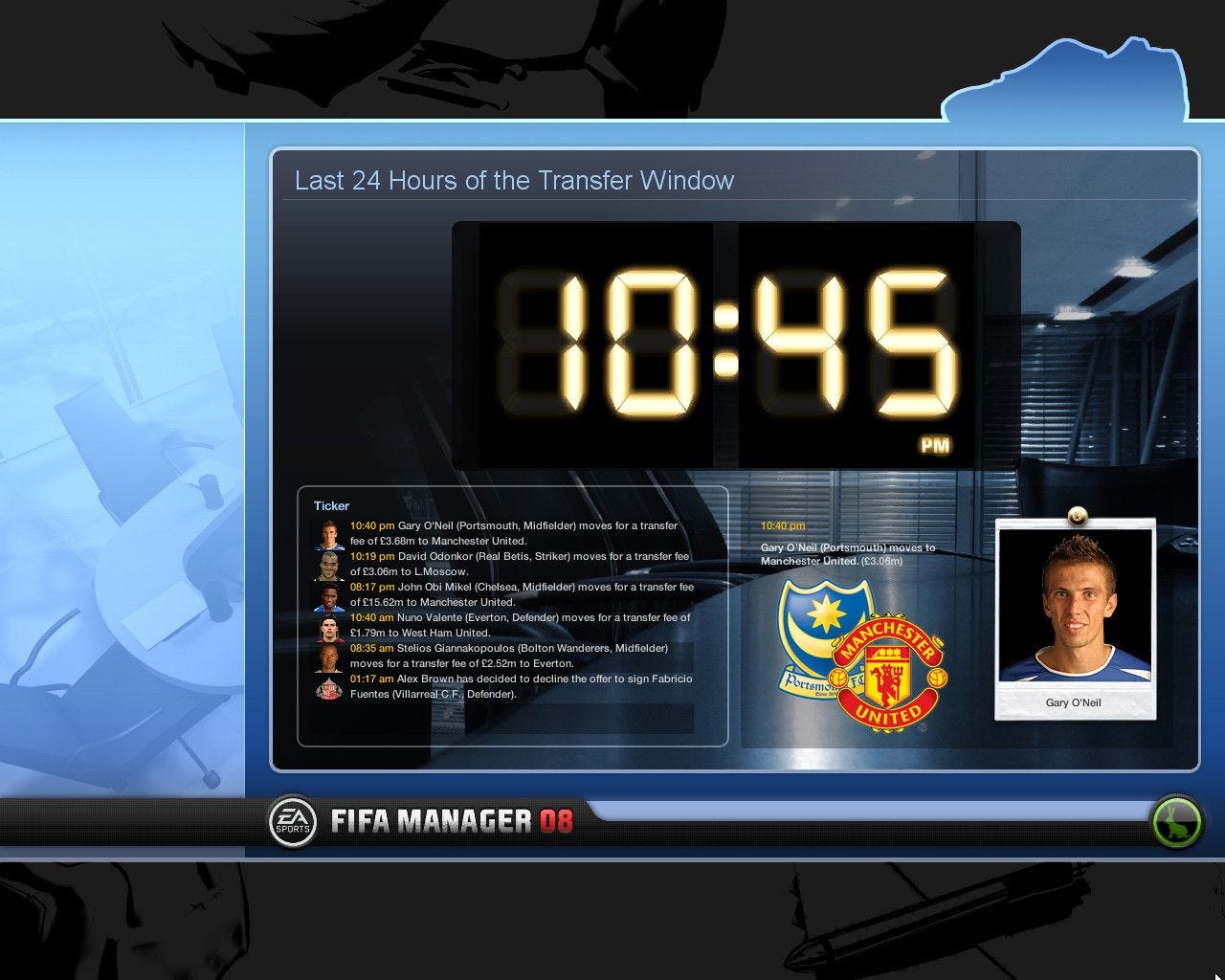
You could build a stadium from scratch, bit by bit. Unbeliable stuff Jeff.
IBM thinkpad was threatening to riot when I played with it, so I never quite did.
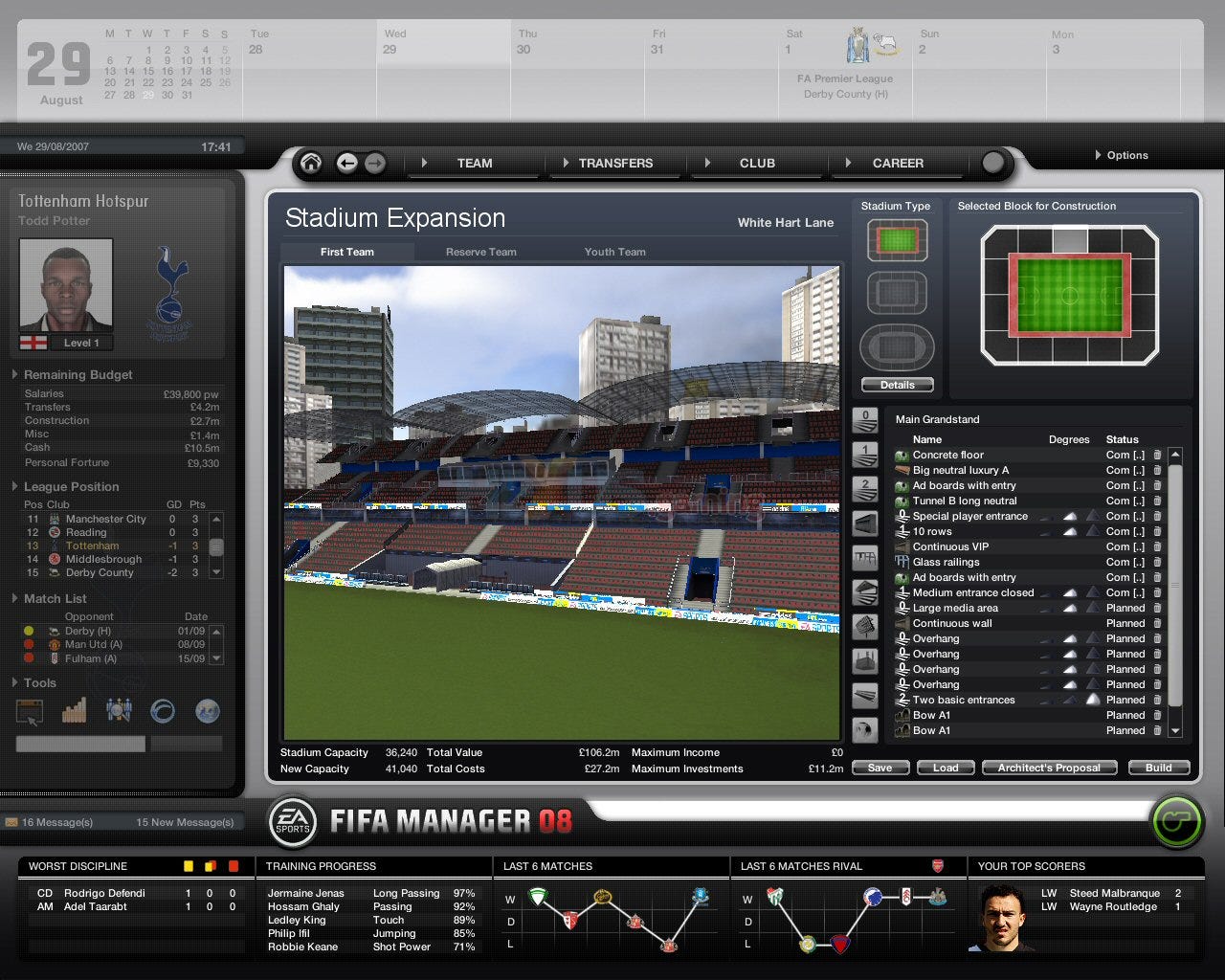
What in the Sims am I looking at

Hall of Fame was an actuall hall, with framed pictures
You could also have a family, go on holiday, buy things (just for the thrill to click on the button “purchase”)
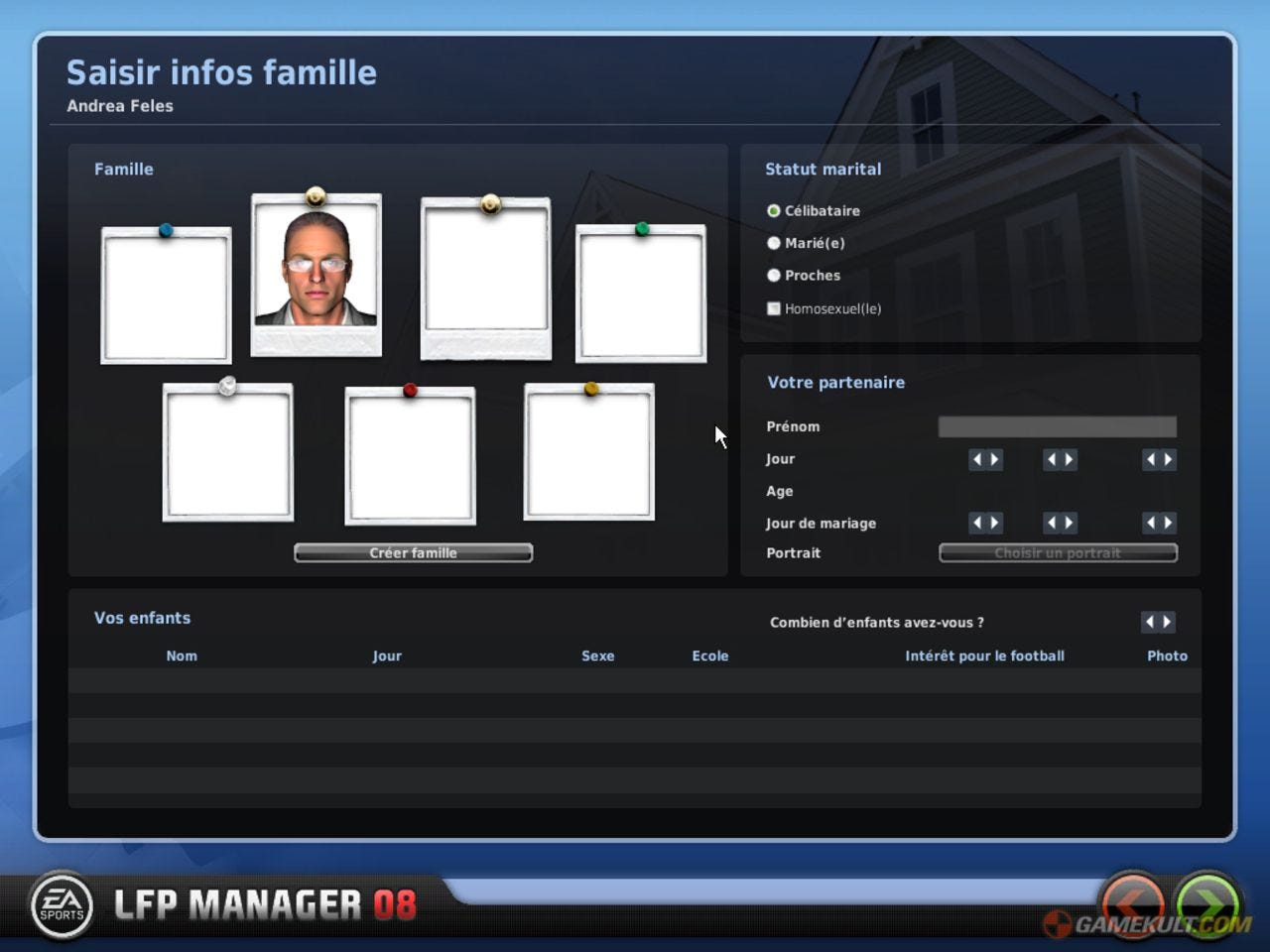
Immersive and useless, but now I think about it : yeah that was a video game.
There’s a metaphysical discussion to entertain here : have these games (who ironed out all the fun) created an extended and wider audience that improves the sport, or an “upside down” of “I know better” bunch increasingly growing out of touch with the reality of the sport.
EA were never quite open source, or easy to mod like FM has been (with facepacks etc…) - but what if the “let’s pretend I’m a twitter scout” was just a community of modders creating the craziest stadiums out there?
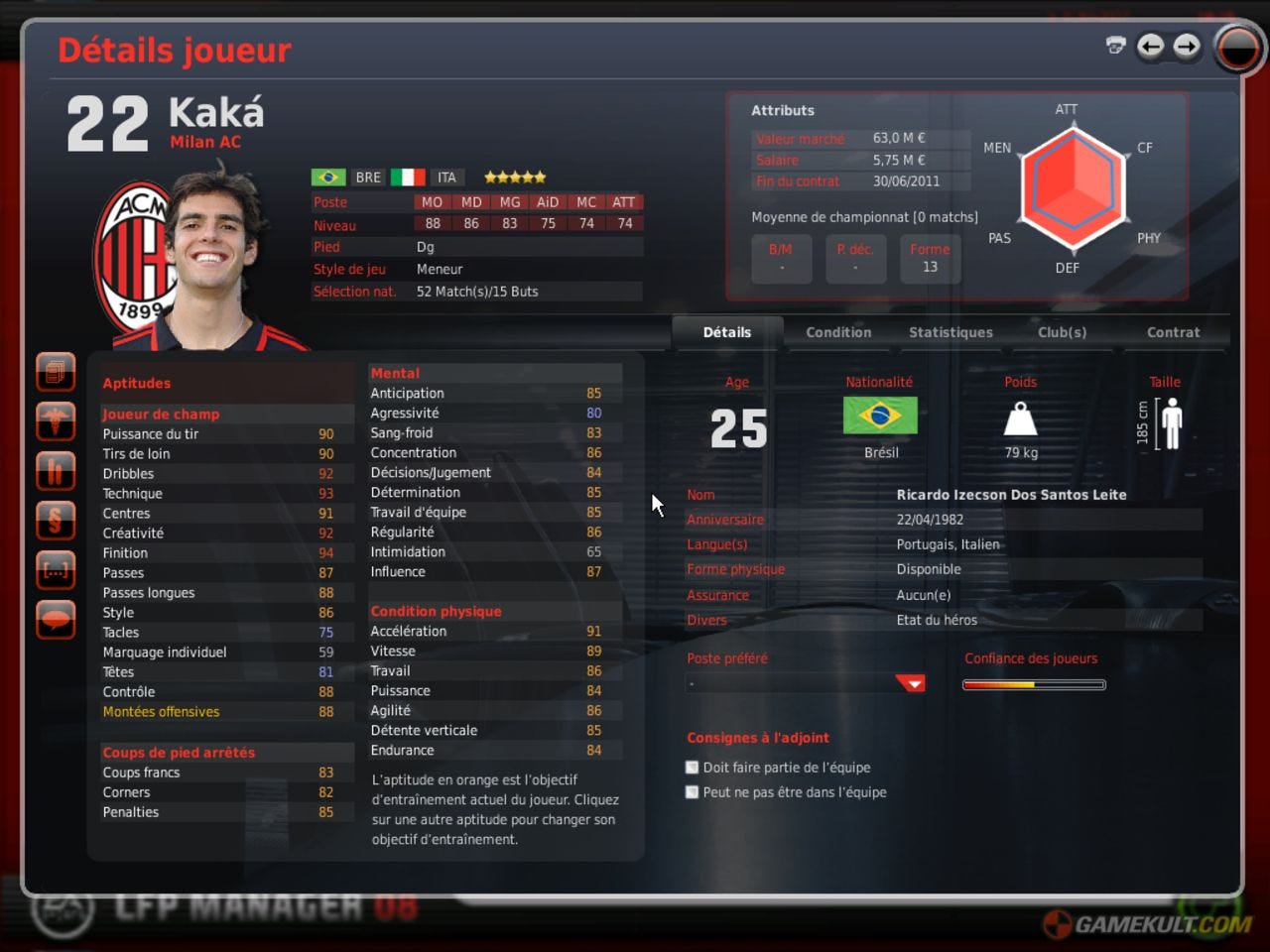
in EA Sports Championship Manager, at the difference from the SEGA Football Manager series, you’d have a number rating depending on their position
See Kaka; his rating would differ whether he was a AM but you could also play him elsewhere.
The game UI was incredibly advanced for a 2007 edition :
Aero vibe (from Microsoft Vista in 2006) is an obvious giveaway. Otherwise, well, radar and statistical trivia galore.
“IT worker” became “Data Scientist” but you’re still coding shit on a keyboard.
There’s a cutoff line in the mid 2000s where playing players in different positions would impact their ratings.
On FIFA 06 you could play Robben and Ballack at CB and they’d still be 90 and 85. After that, that would take a huge chunk of their “numerical "ability”
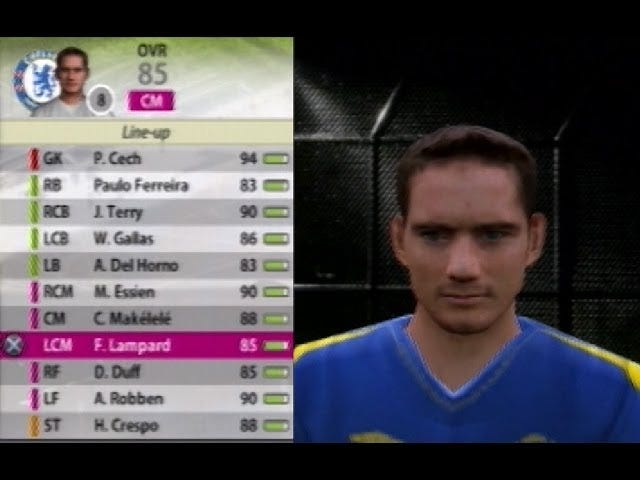
As my tactical understanding of the game as a kid was rivalling some of the most eminent Sporting Directors in the game now.
This is far fetched, but oh well, BlueCo wanted to sign Rudy Matondo.


Part of the appeal to play these games was to make Shevchenko and Malouda work out in my universe because I liked them very dearly. I got on Twitter to see if Yuri Zhirkov who I also liked, would actually quit Chelsea. These are my memories.
I was often playing Lampard as a lone CM, behind a front 4 of Malouda Ronaldinho, Drogba, Shevchenko and Messi.
Not less balanced than a Caicenzo midfield two mind.
Point is : there was also instances where I’d try to game the engine - having little idea how much my pixel-pinching was actually relevant - to put a winger as central as I could but not too much, otherwise his rating was tanked.
Or play Malouda as LW there, so he could account as a “winger” but also as a “CM”. Same for a back three of CBs, or trying to play John Terry flanked with Ashley Cole and Zambrotta.
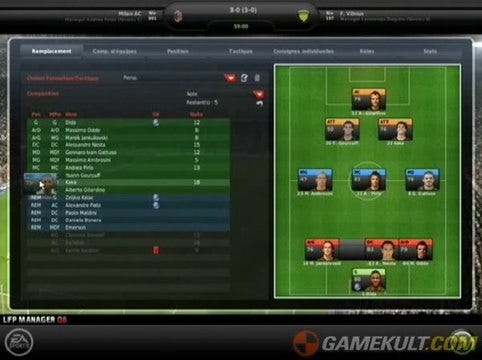
On (SEGA) Football Manager, because my autistic(k) was that I didn’t really like the shape of the 433 on the diagram (the DM is too deep, and the CMs are too close), I’d often play a flat midfield 3 with the deepest one with more “defensive responsibility”
Mirroring what I believe I understood from Willian’s use as an auxiliary midfielder, tucking inside and contributing to ball retention for Mourinho’s sides in the mid 2010s ; I often tried to play central midfielders out wide.
Josh Onomah, somewhat Roméo Lavia as well, Andrew Hjulsager from Brondby. Blor Blume the Lyngby Danish second division wide CM springs to mind, but also Timothée Cognat, Nathan Moriah-Welsh.
In real life, Mason Mount as a R10 for Tuchel’s double 10s. All midfielder / wide players I played between RM / RCM in a 3.
Good footballers play everywhere, who are you to pretend they can’t play there.
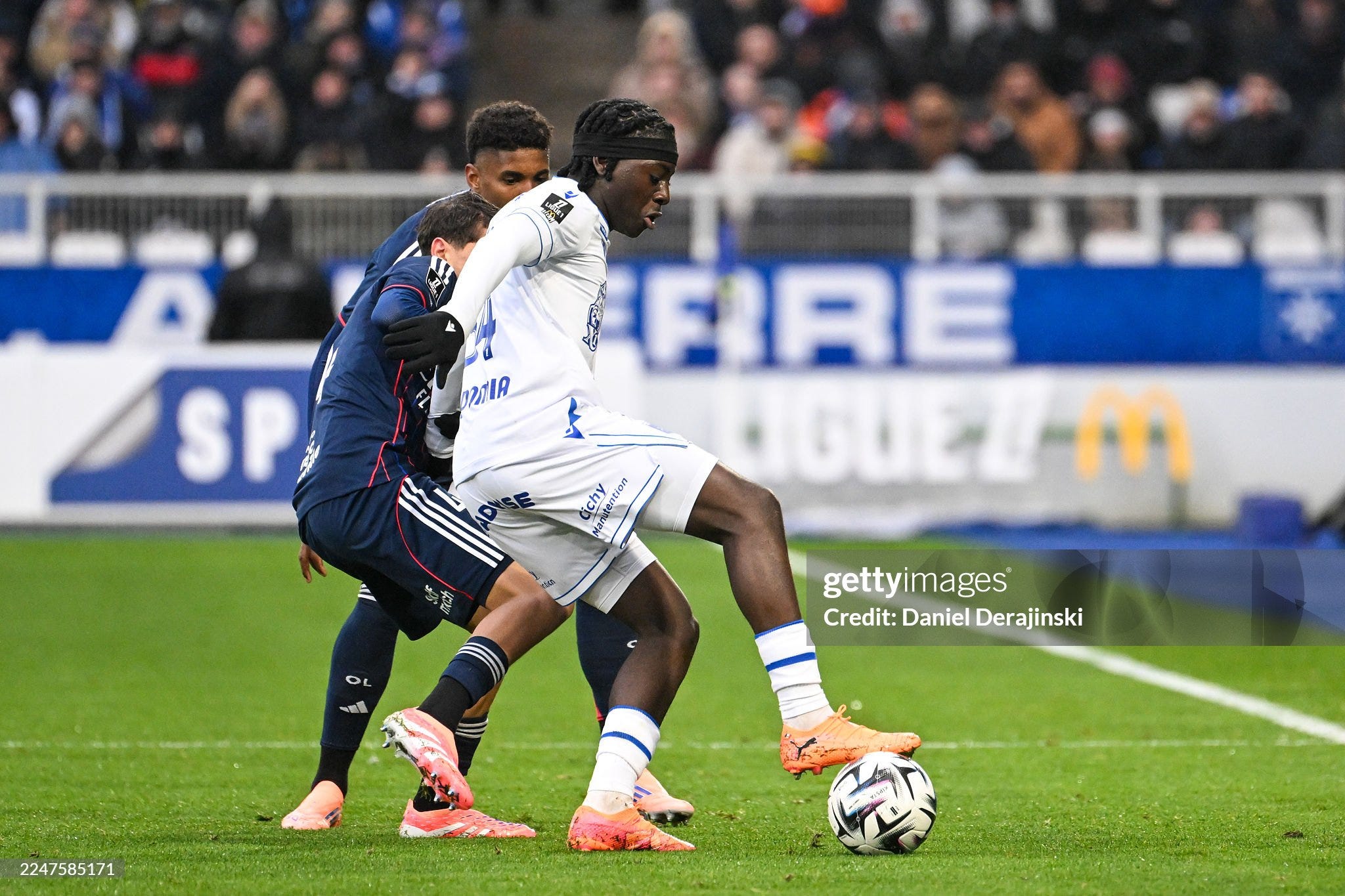
It was a thousand to one and a million to two
The general theme of my newsletter is to put into words my relentless exploration of the negative space within every opinion or piece of advice I’m given.


“He can’t play there” lemme play him there and make it work, so you can own it. More often than the mere coincidence I found great success doing the exact opposite of the stupidest opinion in the room.


One of the mantra I live by : “remember that when you want to do something, there’ll be people who want to do the opposite, people who want to do nothing at all, and people who want to do the same but are too afraid to commit to it”
Throwing a wild guess of who stands more or less where helps to get an idea of the negativity
Because realistically, wisdom is about commenting and acting on things you can control. Give it a go, and if it fails because the purpose of a system is what it does, well you ought to know it from the start. Good decisions stem from good observation. There’s no blind luck, just putting together what’s relevant : AI will never replace million years of evolution with whatever connection the brain will process.
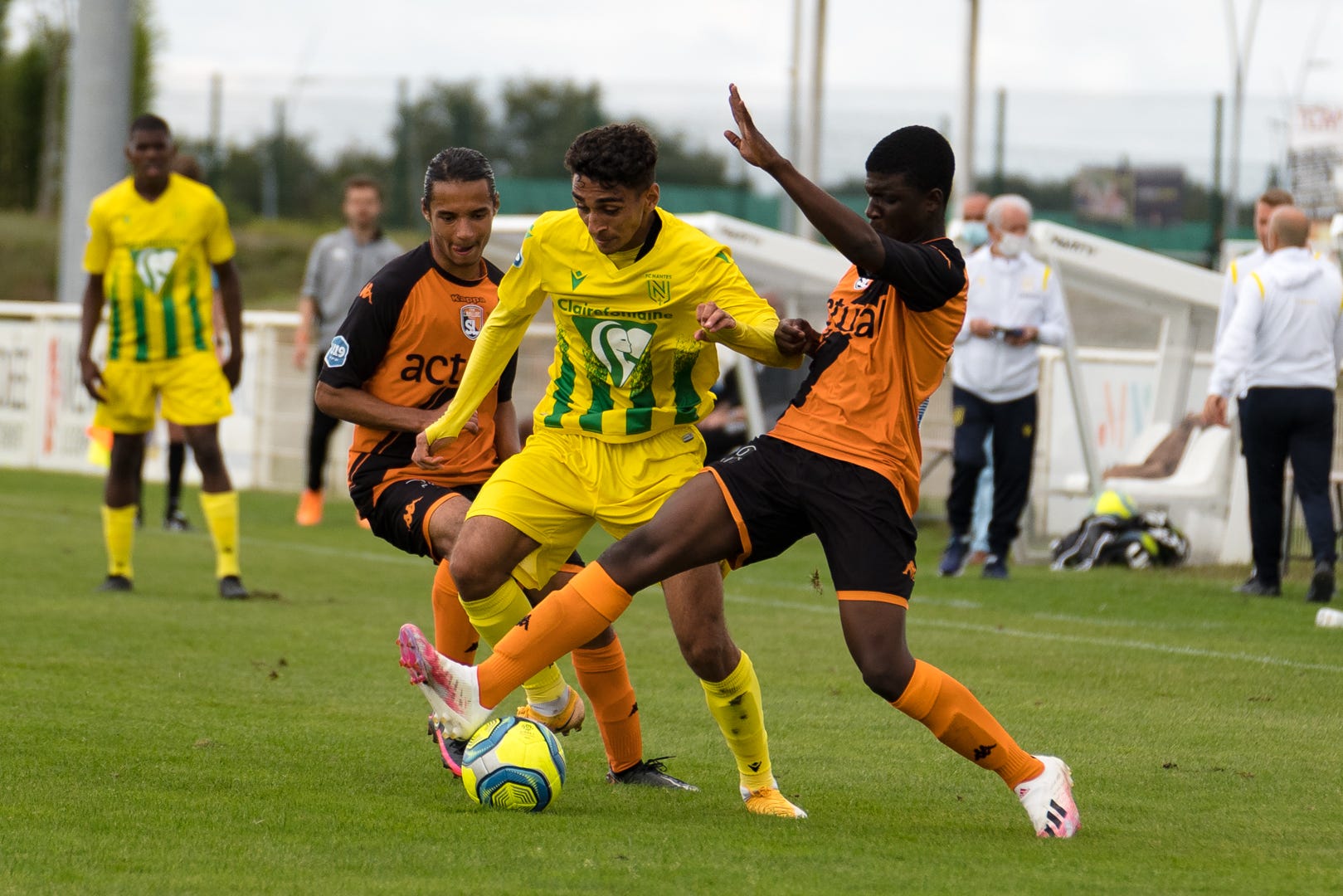
In my coaching journey, I made sure to get valuable experience in “talent hotbeds” where I’d be guaranteed to find maverick talent, players that only exist through what they do, and not reflecting a conveyor belt of players that merely do what’s written on the tin.

Because I want things to happen, and don’t stifle creativity ; at all or out wide, I would often entertain the idea of a midfield three (to have one player screening the defence - to keep two layers at all time behind the ball), but in particular featuring wingers in midfield.
A dribbler in midfield can go both ways, and some of them can pass / shoot.
For sure, the realisation that you’re where you are at in the food chain more or less compels you to keep pace outlets out wide.
It’s only when you start to -not coach- but realise that your okay technical players won’t always retain the ball safely around the box to create patient chances, press relentlessly and get end product all at the same time (usually you get 2 our of the 3) ; and that you’re better off playing forward thinking football instead, get crosses in and play over the backline.
But since we’re talking about top level footballers, they’re all quick, more than you believe. There’s a solid rationale to appreciate why 2 or 3 players from the same 16+2 (16 outfielders + 2 GKs) age bracket players turn professionals.


Don’t have time, space or room for theory players because the game will teach you your level.
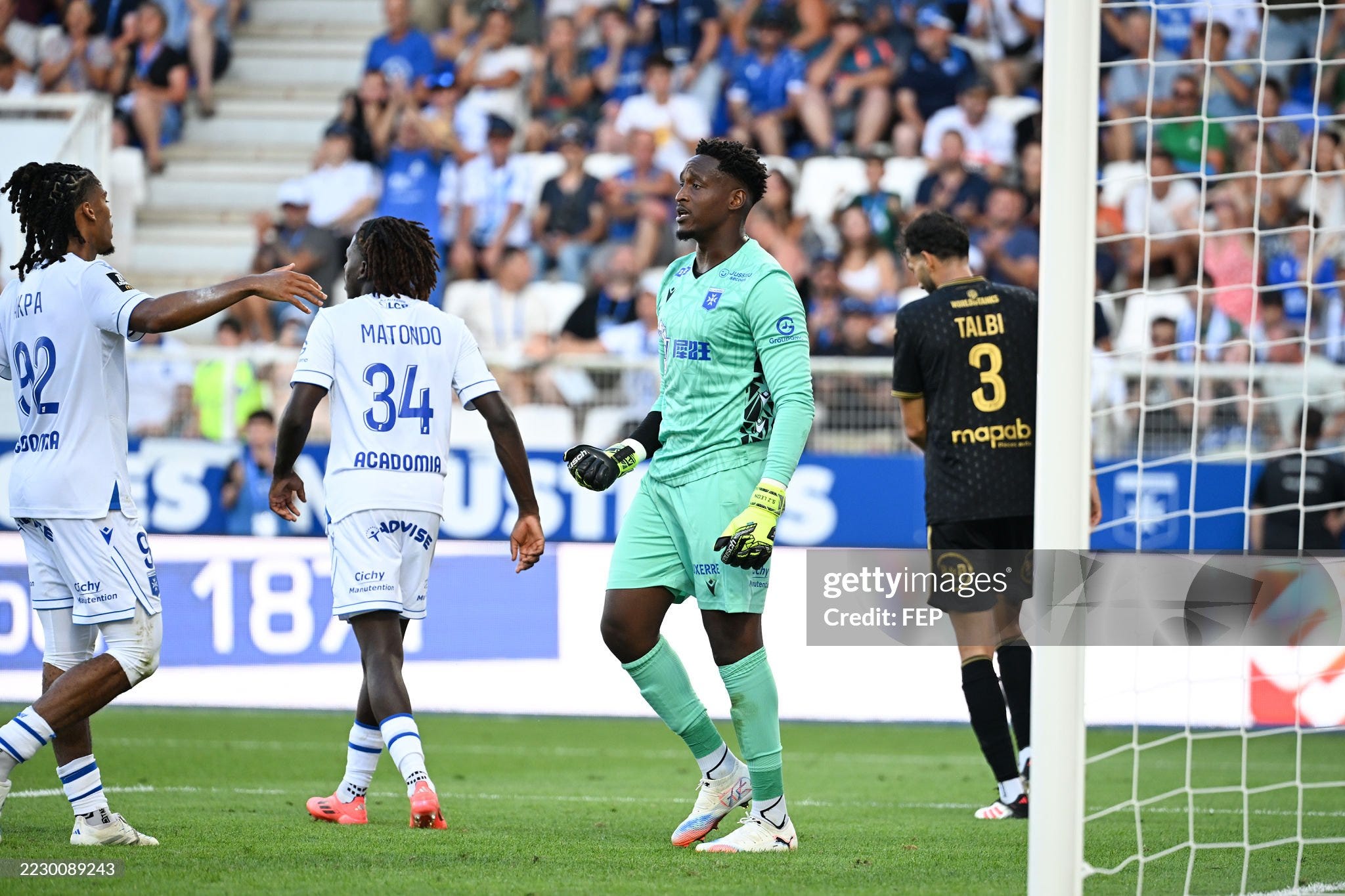
For sure, there’s an element of fast-tracking to get investment back,
Since Ligue 1 and Ligue 2 clubs sign players in their U16 season, 80% from Paris area and that their pro contract is capped at three years.
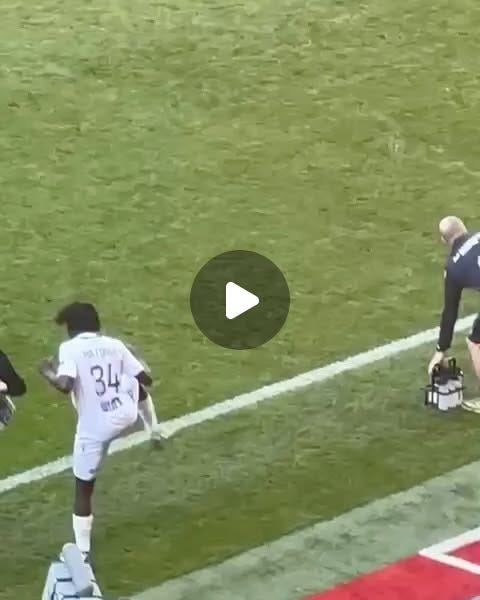
Matondo joined AJ Auxerre from US Grigny at the end of his U15 season in 2023 - the 50km radius cap is lifted when players enter their U16 season, and can therefore join a professional club.
Usually offered after a 6-8 month buffer to see what they’re about when making the jump from star of the team training 3 times a week as U15-U16 Grassroots; to another talent in a 60-player batch in an Academy (U17-U19-B team).


As a result, the dealine of the contract expiry closes in thick and fast; say you sign professional at 16 and a half, you’re out of contract at 19 and a half like Matondo (March 2008, turning professional in June 2025)
You want players to explore U17s and U19s for the first season, start the second season training with the first team, playing for the B team and getting a fast track First team debut before January ; so that clubs keep a one year and a half window to
Platform the player expertly to drum interest
Make sure they keep on top of the power play to guarantee they don’t give 30 starts to a player who then leaves as a free agent
resonate with 1. ; information is a pre-requisite to trade, except in football where you can very much wire money to an influencer even if industry insiders know the player is a lemon or a nutcase - because there’s a few of them in the French Academy system.
2023-24 : U17 one year up as U16
Matondo played with the U17s in his first season at the club, as U16 ; scoring on the second day of the season vs FC Annecy’s U17s

And from kick off consecutive to a goal conceded

Auxerre missed out on the playoffs in 2023-24 (first + best seconds qualify).
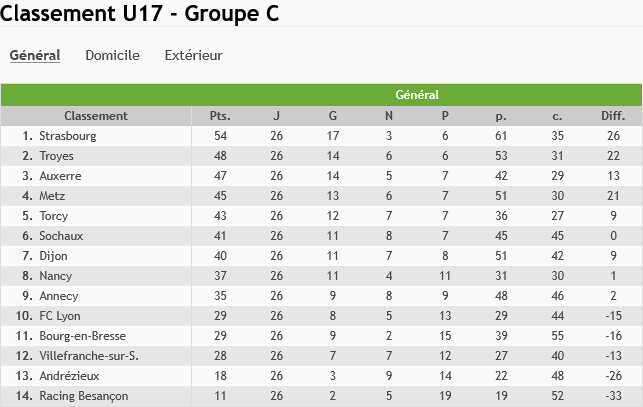
This is what U17 National League looks like (and probably why BlueCo would rather scrounge at a table with the meal served, than cook themselves).
Troyes, Auxerre, Sochaux are the proverbial Ligue 2 clubs where Parisian players join knowing they can get a fast tracked debut. Strasbourg consistently have a good academy, with numbers, competence and results stemming from investing on it.
Torcy is a Parisian club (where Pogba, amongst others came from) and professional clubs’s scouting process usually relies on the extensive and thorough process to name pick who ragdolled them for 90’ there.
Bottom 5 clubs are federal clubs - no Academy therefore train in the evening, no school / football curriculum and no contractual protection.
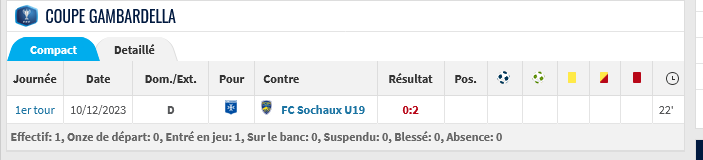
Also, as it’s common practice ; the best prospects get a run out in the U18 Coupe Gambardella where scouts are in attendance.
Matondo as U16, got 20 minutes at the end of the game as AJ Auxerre crashed out in the first round, since these are regionalised seeds. You get grassroots clubs (who qualified 4 or 5 rounds) playing each other, or a massive pro club straight away. Or a Nantes-Angers, or Sochaux-Auxerre straight away.
Not everything is the excesses I mentioned in other newspapers : manufacturing hype through a pathway where Ajax are both in charge of the promotion and the sale of the player. Everyone kinda does it, it’s good practice. Meaning scouts need to look at who’s actually good.

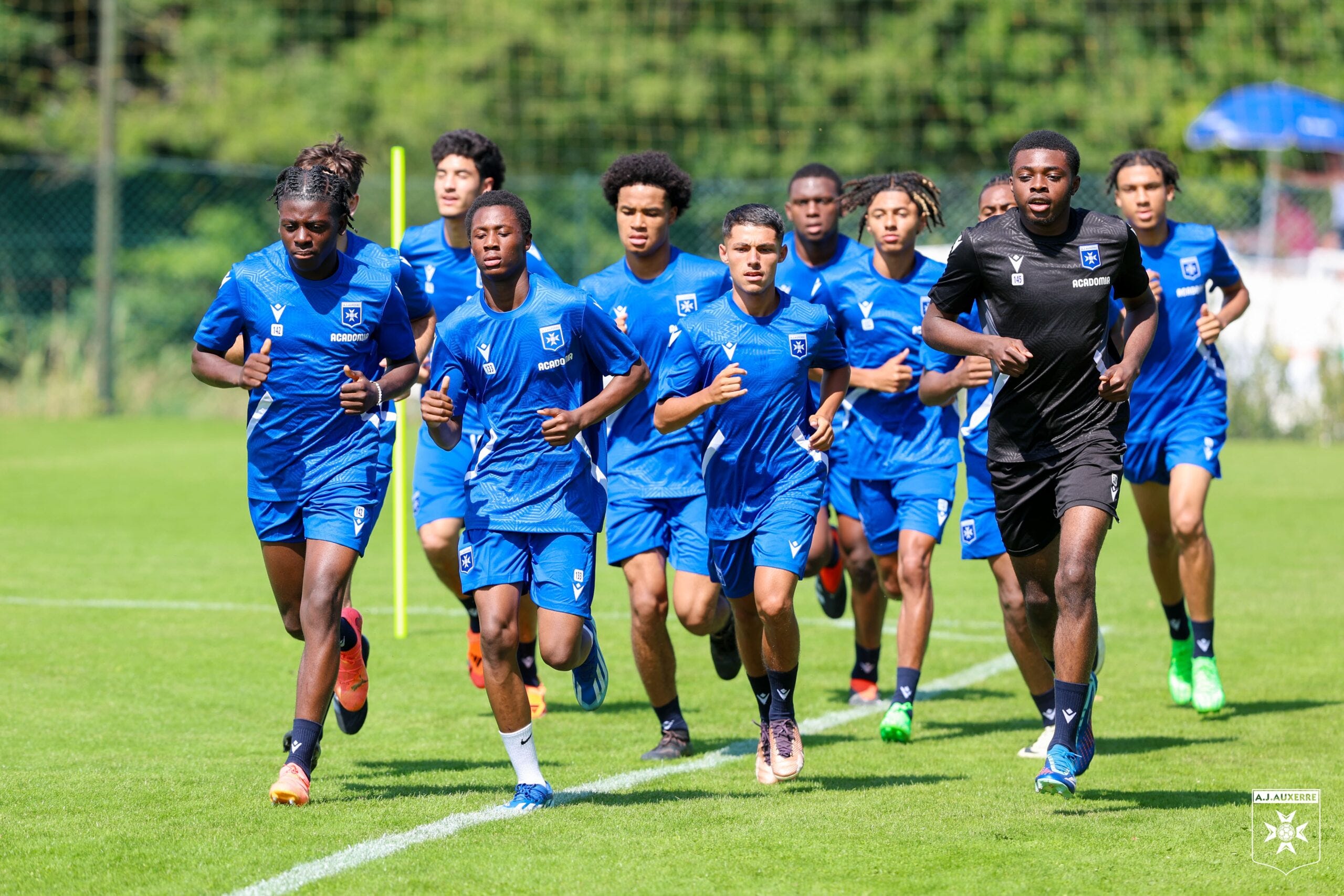
2024-25 : U19 two years up as U17
This is the regular “elite” pathway.
U16s play National U17s the first season
Then the best U17s play U19 League (that’s why it’s more interesting to coach in)
Whilst respecting the first U17 season ; sometimes pro clubs think playing everyone up is useful, until they’re bottom 6 in their U17 league which is unserious.
Matondo started 2024-25 with the U19s
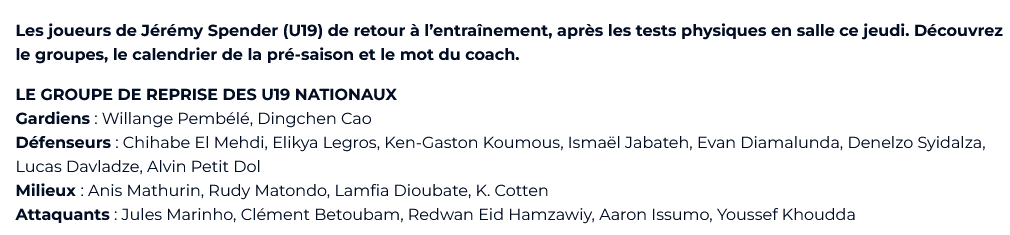
Playing in the eastern seed. The one I coached in (as the youngest coach at the level in 2019), was the C / Western one.
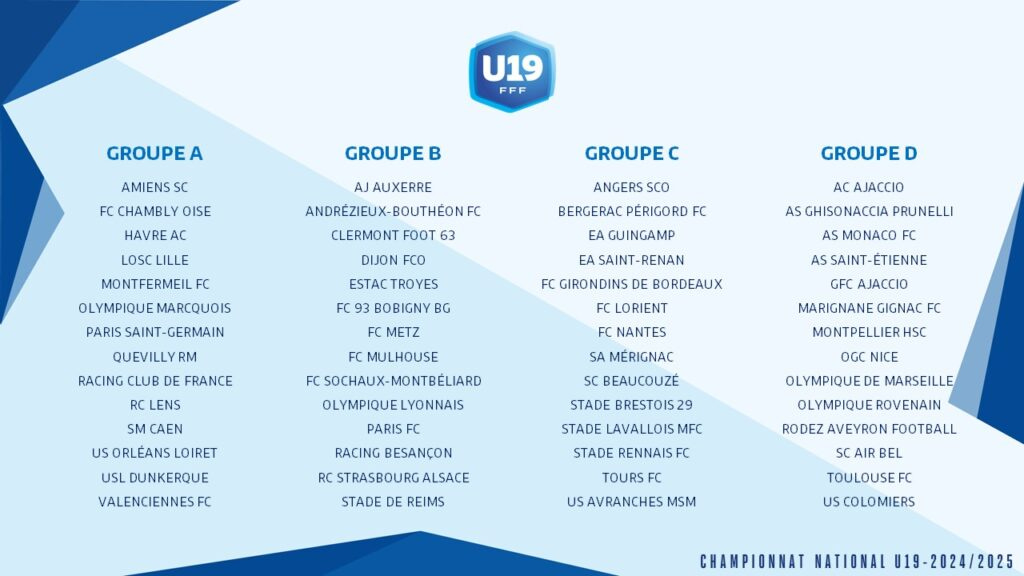
September 2024 ; U17 Matondo scoring and winning games at U19 level.

then reached at least the Round of 8 of the French Youth Cup (Gambardella) popping up with another late goal.

The exercice of digging up match reports on websites is comparable to doing so with Non League in the NL Paper or FL Paper ; there’s only so much that’s dedicated to a single game. Goalscorers and occasionally an outfielder (or goalkeeper) playing out of their skin. Noise, per definition, is audible.
I’m posting the entire timeline because that’s a textbook example of how French talent get a first team pathway :
2023-24 : U16s with the U17s
2024-25
Start the season with the U19s
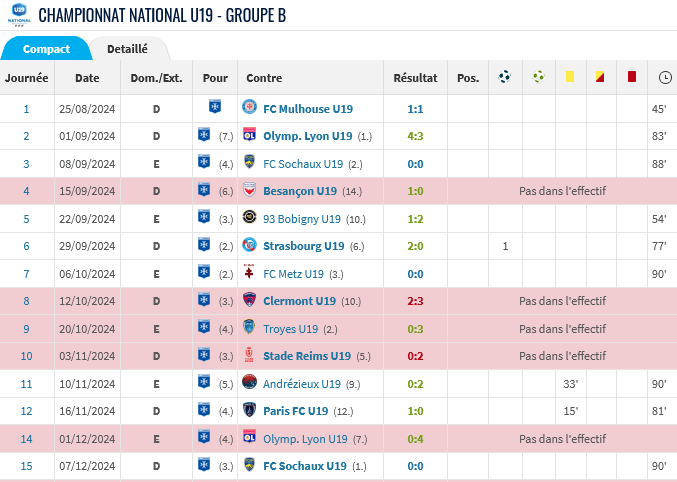
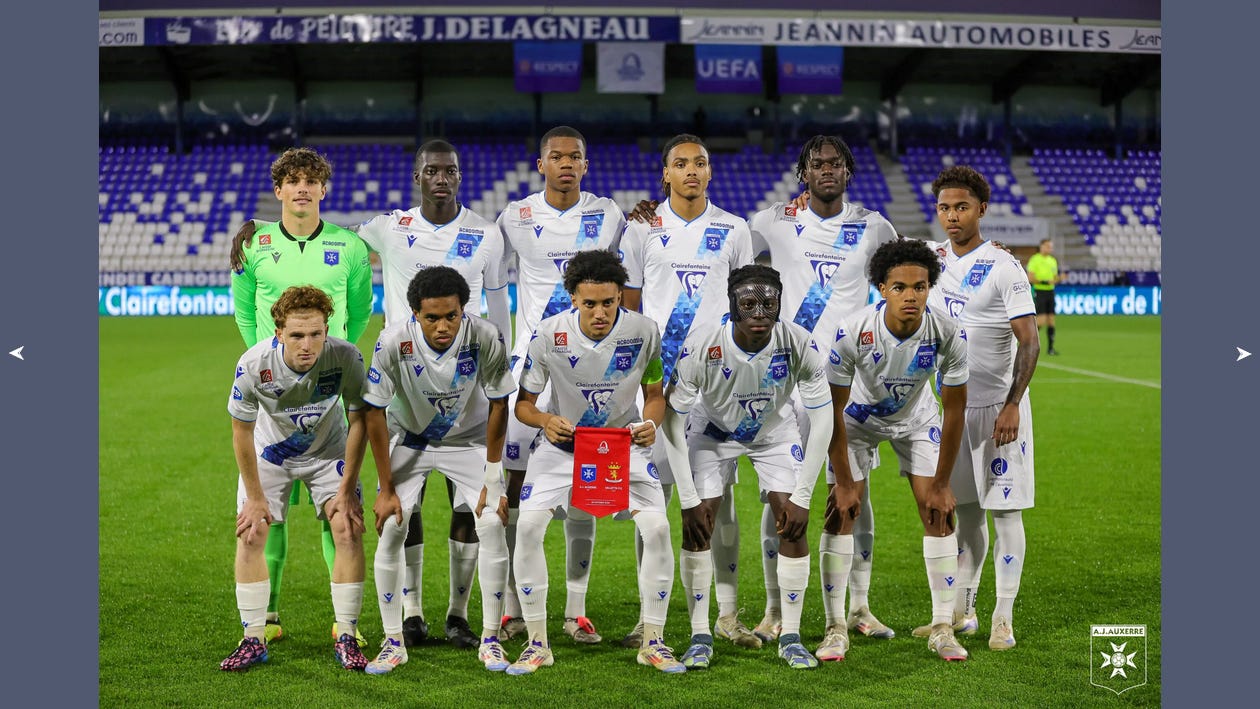
As a result from AJ Auxerre winning the U19 National League the season before,
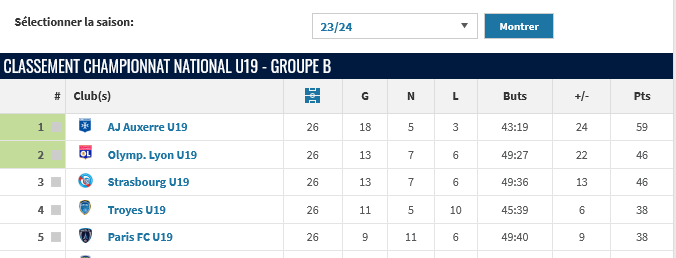
they had the Domestic Route in the UEFA Youth League.
Worth bearing in mind my U19 side slapped the Domestic Route Champion U19s Angers in 2020 ; who were playing Red Star Belgrade a few weeks later. Someone (in french) begged me on the phone for the footage of the 4-0 win, unsuccessfully.
Rudy Masktondo, amarite
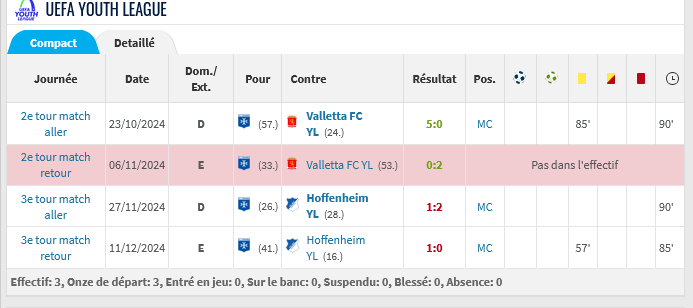
Matondo played both rounds against Hoffenheim after AJA beat Malta’s Valetta FC


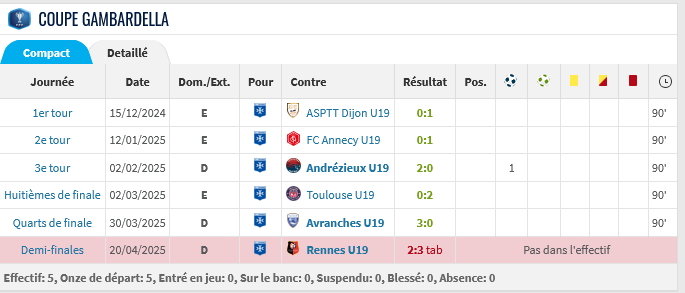
Matondo got minutes for the U18s and the Coupe Gambardella between December and January
Then started featuring for the B team in National 3 (5th division)
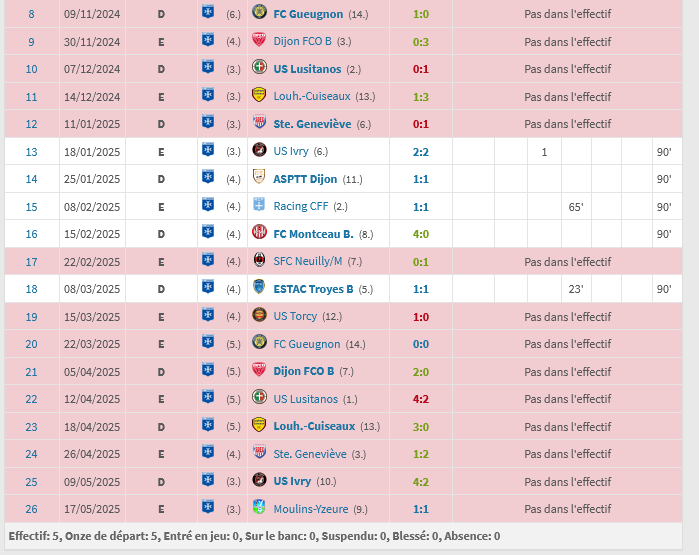
Around match, he’d start training then featuring for the Ligue 1 team.
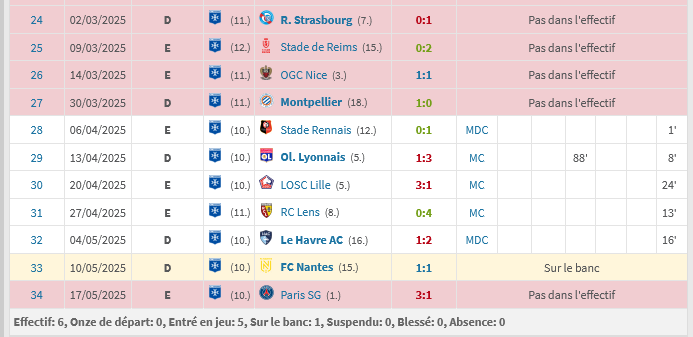
Second season; start with the U19s, help out the U18s in the Cup, feature for the B team and get a first team debut in Ligue 1
Coupe Gambardella 2025
AJ Auxerre is the most decorated French club in the Competition history
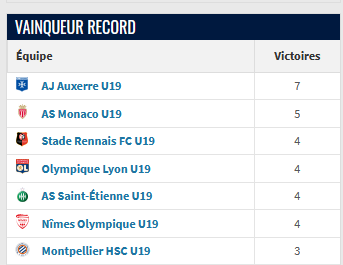
Winning it 7 times, including 3 in 4 years in the 80s
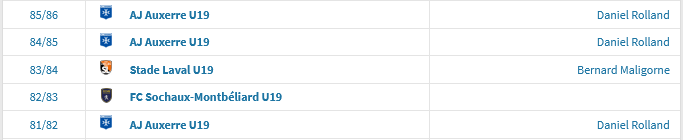
Three including back to back in the 1990s when Guy Roux’ Auxerre was a powerhouse at every level.



Chelsea won it 7 times in a decade, with 5 in a row ; platforming the core of the team that won the Champions League.
Players know what they’re walking into. Sporting instututions, or infested with anything but sporting merit and desire to get better.
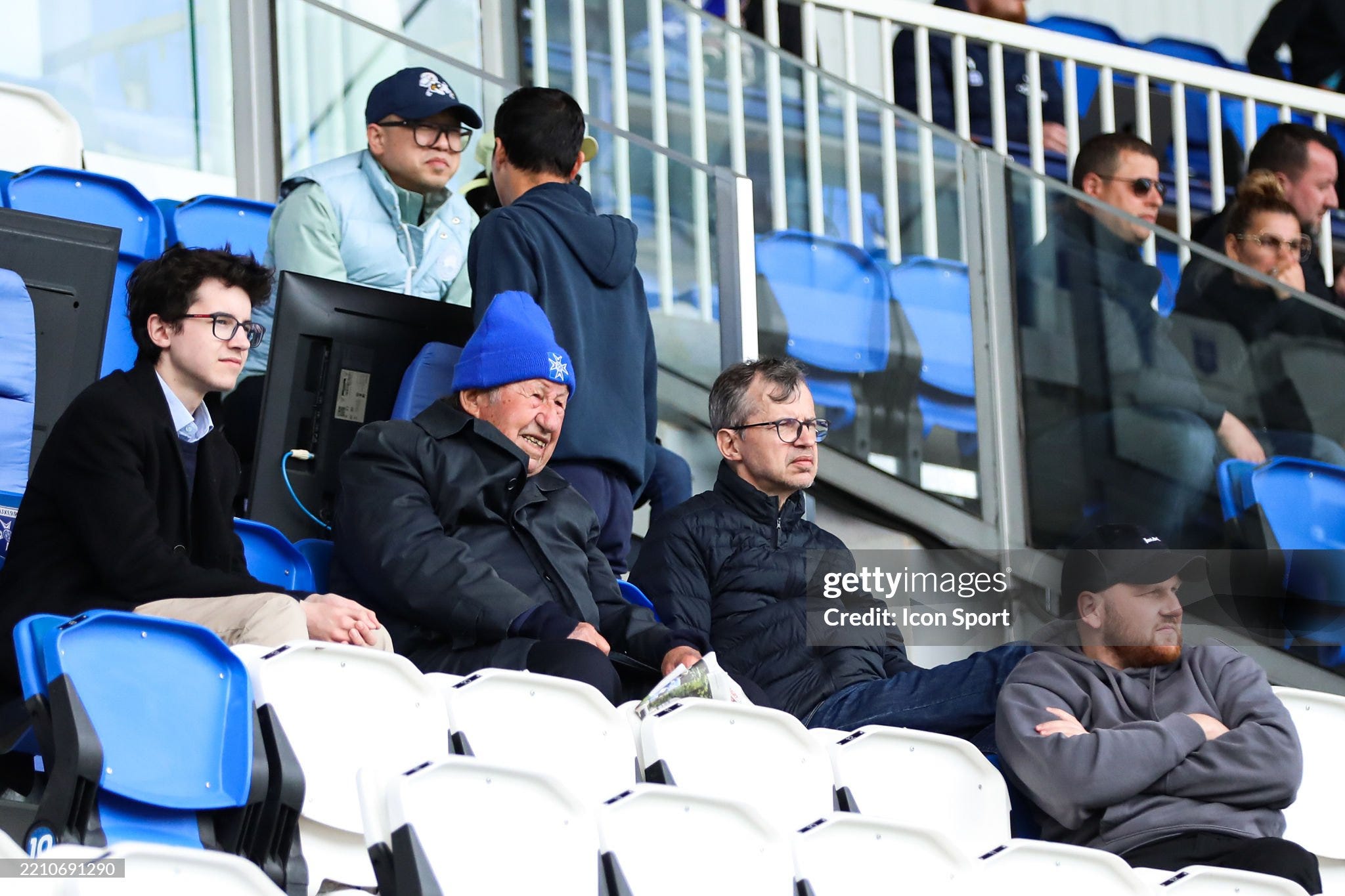
Matondo reached the semi final of the French U18 Gambardella Cup in 2024-25, and exited the tournament without conceding a single goal - but didn’t play the semi-final.
crashing out on penalties to eventual winners Stade Rennais, spearheaded by Kader Meïté.

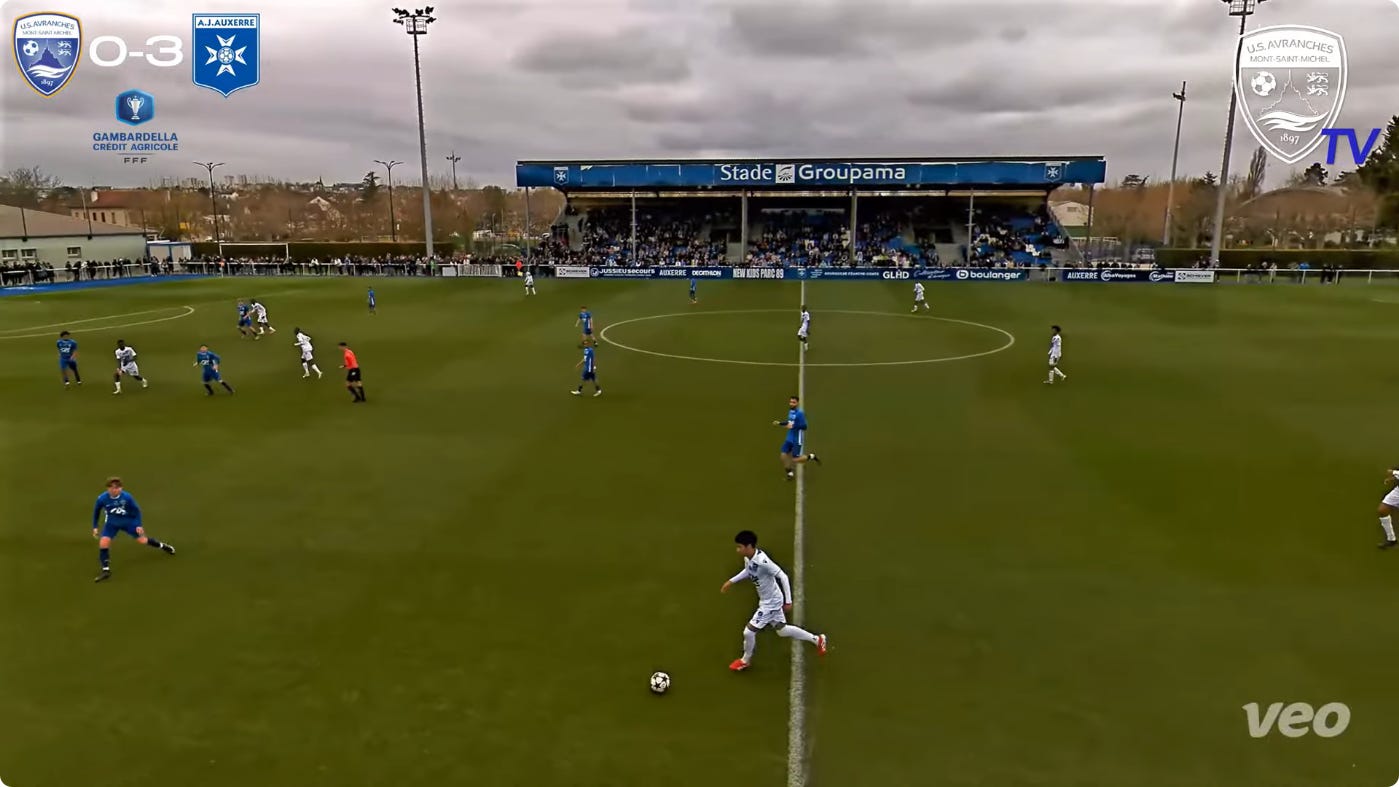
Auxerre breezed past US Avranches in the Quarter Finals
Stay in position! As he’s picking up a second ball on the right
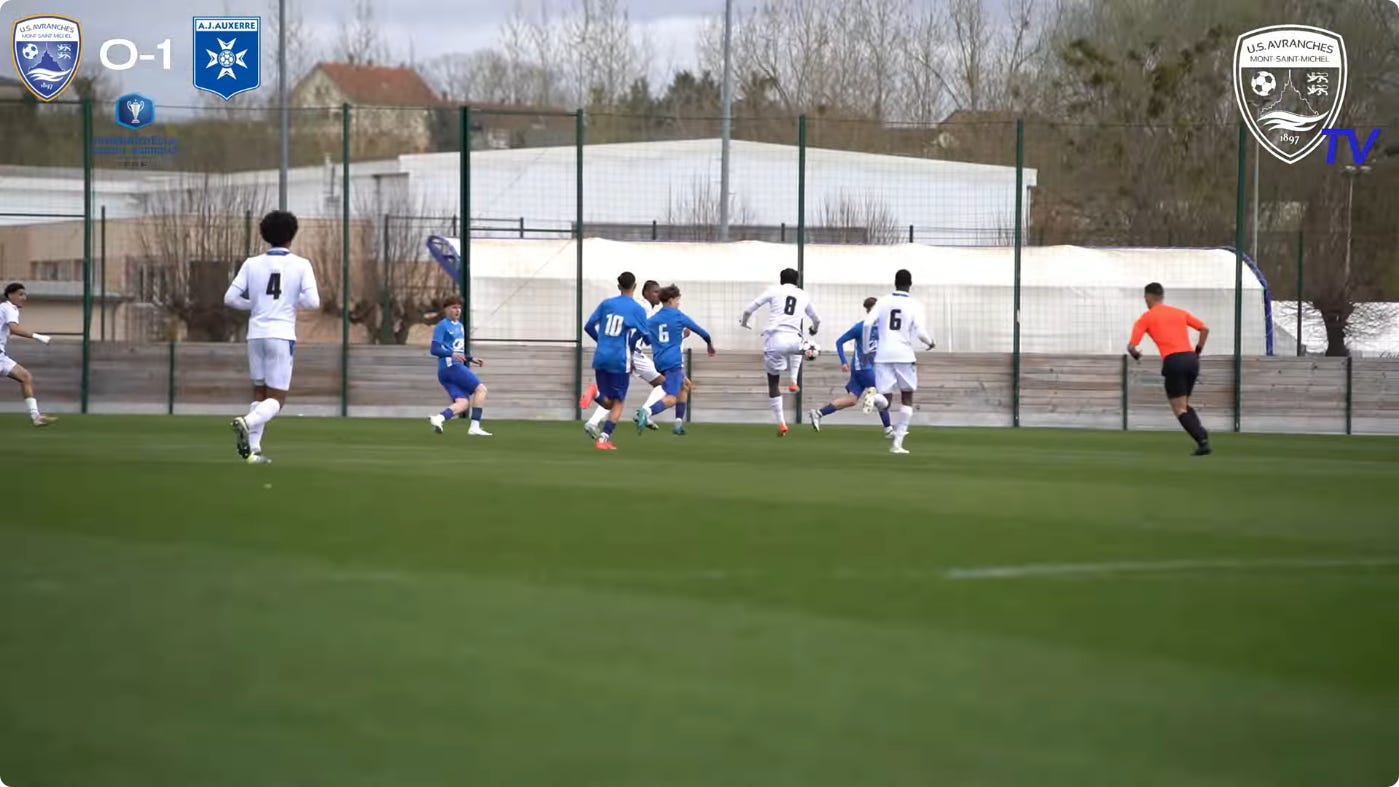
Then travelling across to the left half for a trivela pass with his weak foot.
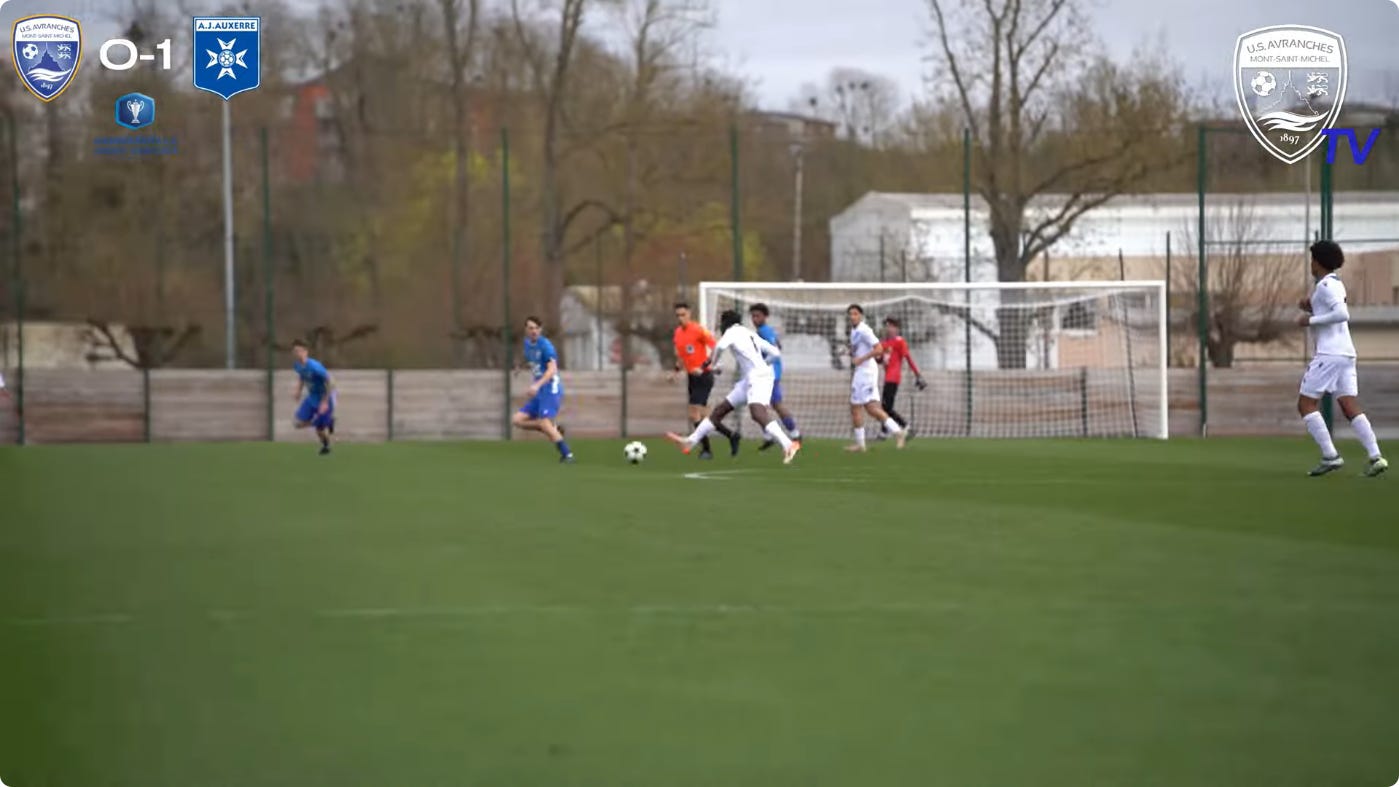
Nice storytelling and all dat, good to see clubs all eventually moving on from the stubborn commercial intern who does the socials on their phone and doesn’t want to lose their inflated sense of self importance ; with clubs investing to produce quality content instead. A good idea of the level :
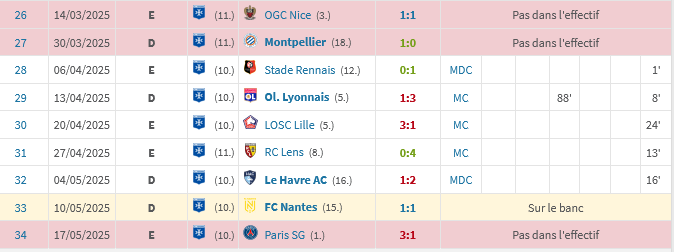
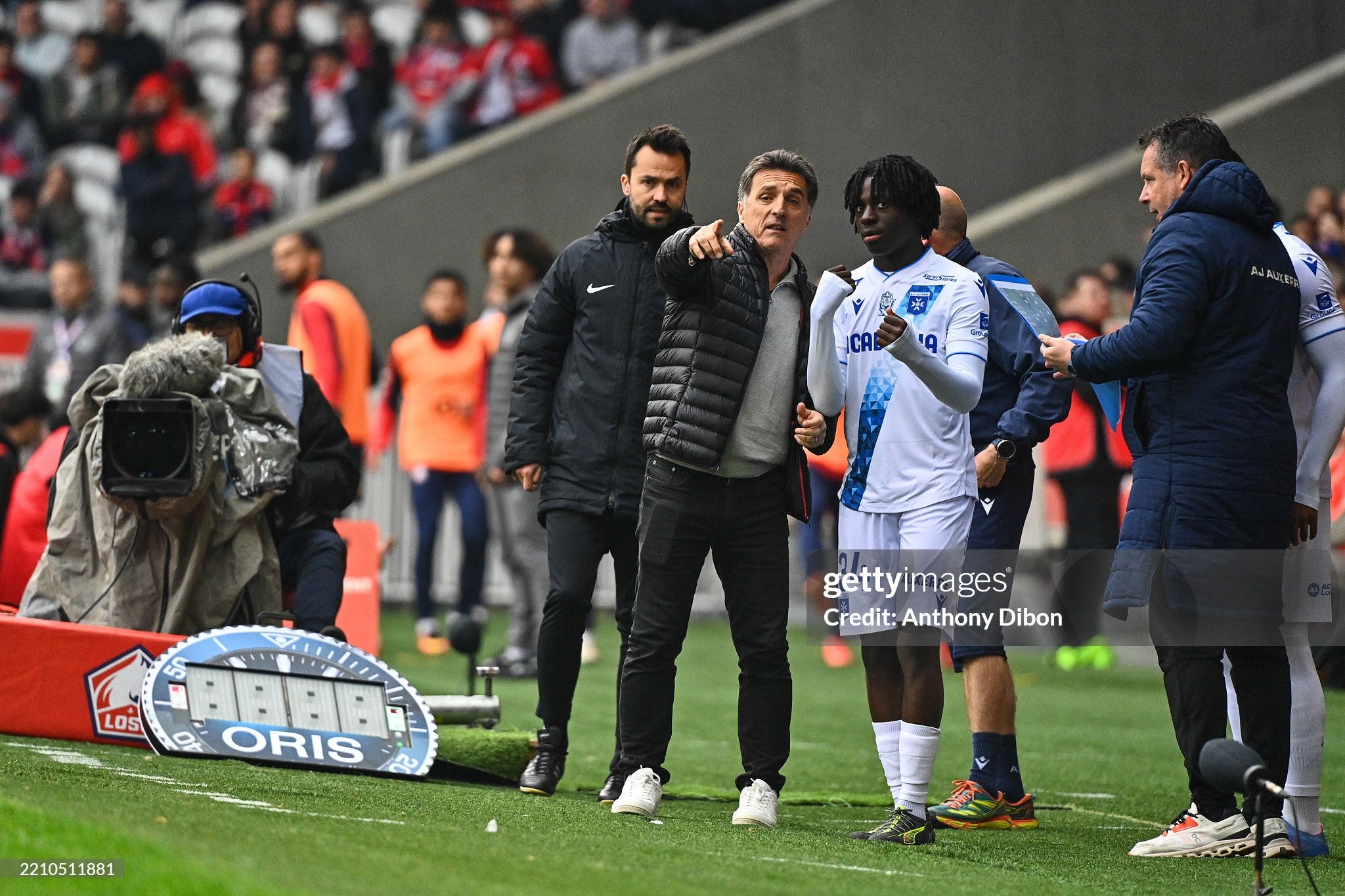
For Matondo, April 2025 was also the moment he started making his Ligue 1 debut.
Getting microwave minutes isn’t the main thing about the first appearances, is how players absorb and handle what’s thrown at them in terms of exposure and whether that changes their preparation.
National Team
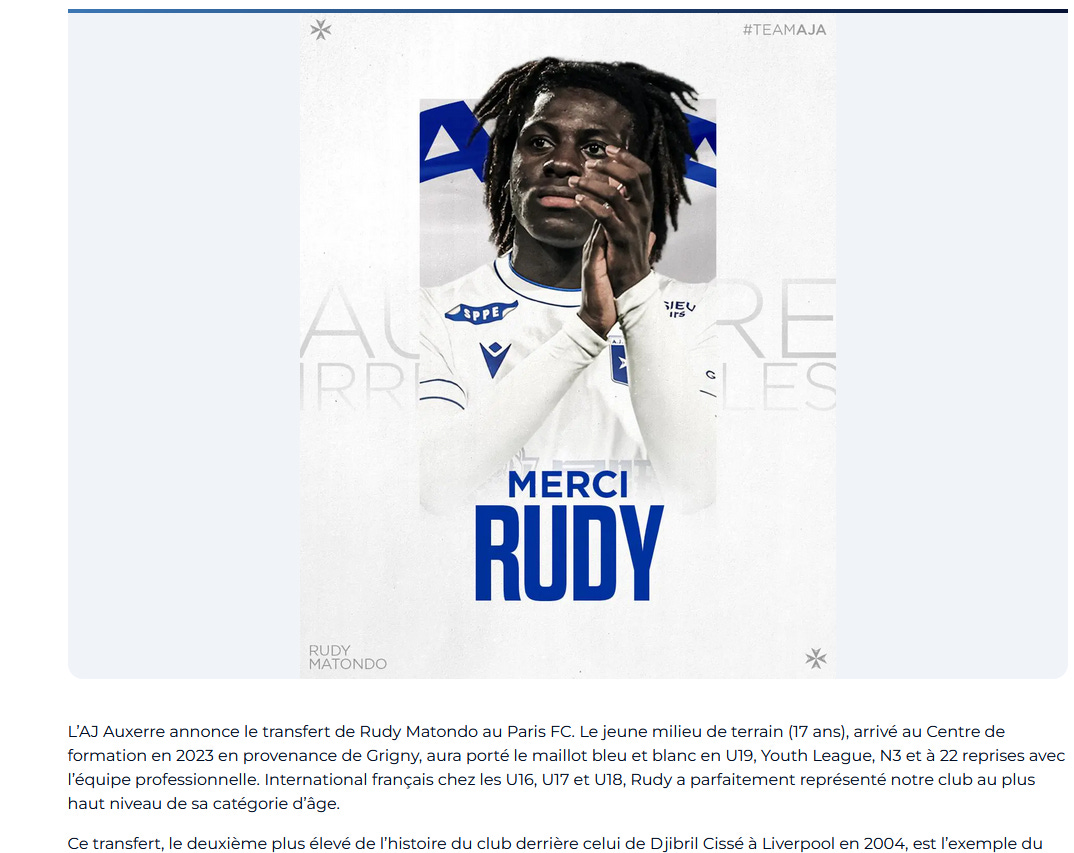
As far as where Matondo stands, he represented Matondo represented France U16, U17s and U18s
He reached the U17 Euros finals with France


France in youth competitions don’t always pull their weight, the quality within the talent pool doesn’t always reflect the results in tournaments. System breakers, coached by FFF’s apparatus of coaches : PE teachers, County / League employees with internal promotion pathways and occasionally former players such as Bernard Diomède.
I wouldn’t say “trend” because the sun doesn’t shine on my doorstep, but there’s certainly a lot more teenagers starting in Ligue 1 this season than maybe in recent seasons.
My semi educated guess is that clubs have ran out of the Monopoly money stemming from : COVID state bonds, Mediapro state bonds, spending the money that didn’t land based on the various TV contracts (sure, if 6 million suckers pay 25€ a month for a streaming service for Ligue 1 ; the stadiums will be full and you’ll get your money).
These are a succession of schemes that can be described with a word, said word carrying legal consequences. What’s the word for : lots of people are supposed to give money at the start, and we’ll redistribute the wealth we gathered for the first clubs who ask for it.
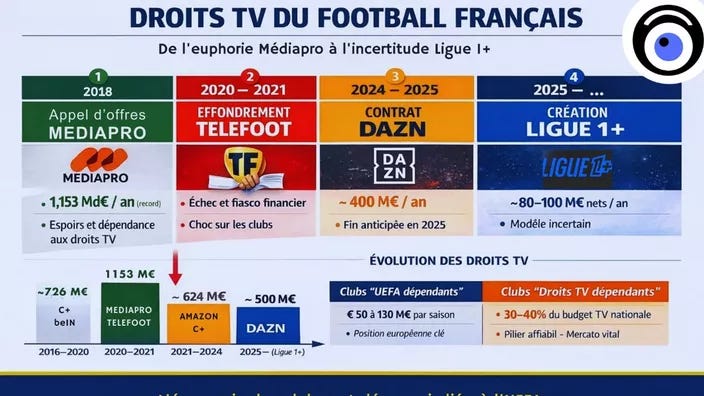
But yeah, the money isn’t coming and the contracts are all being cancelled because “see in small prints, we’d say we’d have the right to snake out of it after half a season”
The latest miserable attempt at at creating a League channel has nice logos and all, but still no business model. Which is disgraceful considering how cheap producing football is (compared to 30 million an episode on Netflix) and how French football is a conveyor belt of good talent. Only thing they need is to hire disinterested, yet qualified and possibly english speaking people to package the “Ligue des Talents” abroad as a premium product.
So now for club it’s very much about trying to survive, by platforming and selling players no matter how well they play.
Can you imagine a time when the truth ran free?
You’re always someone else’s idea of an idiot.
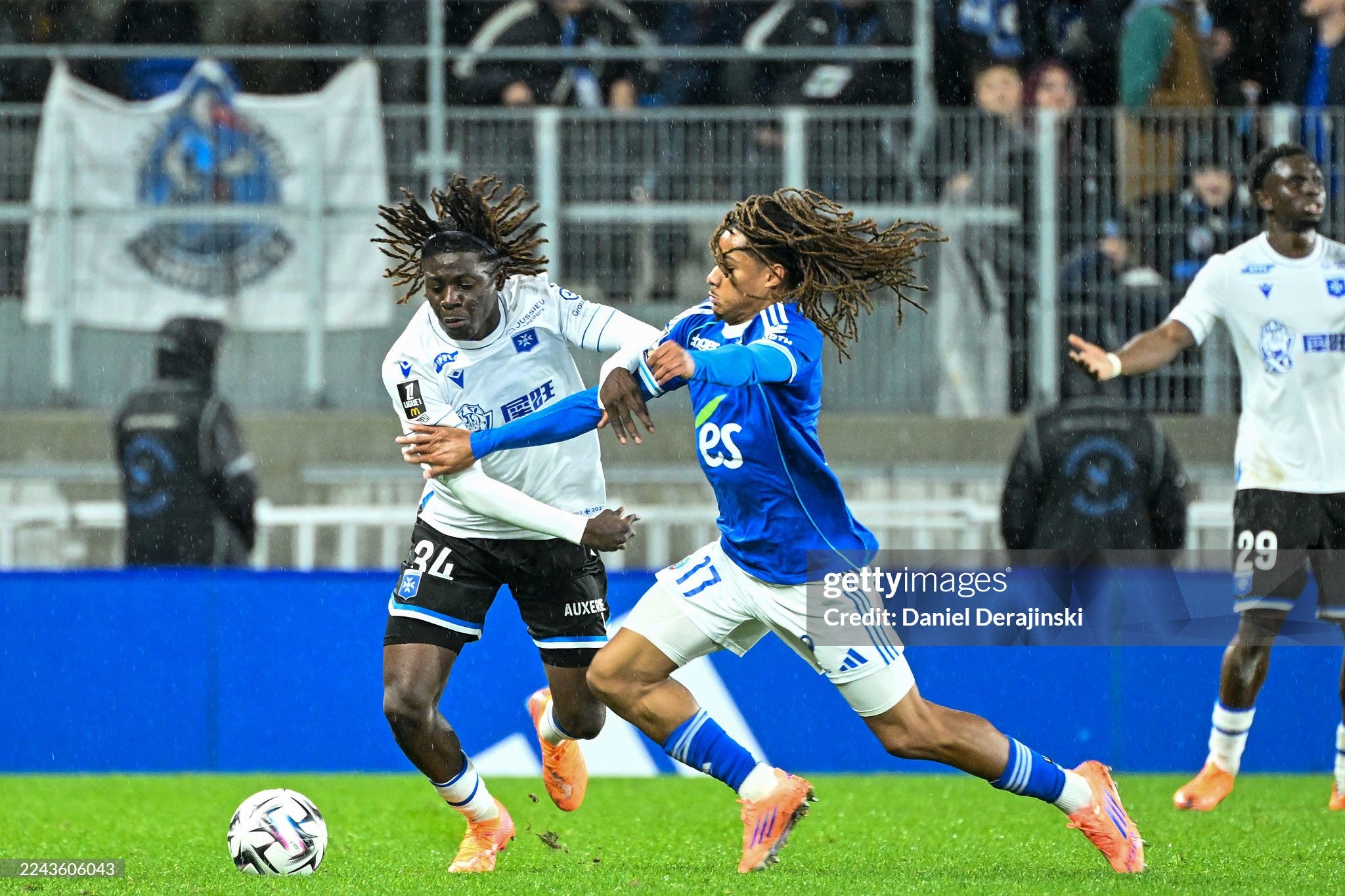
BlueCo signed Mathis Amougou for 15 million after losing 11/15 games with ASSE, who was so bad that he had to be sold to Strasbourg for 15 million where he still can’t get a game in mid table.
I liked what I saw from Matondo, quick-ish, dribbling CM / winger.
That’s probably my favourite cluster of players anyway, after the wistful, idiosyncratic left footed right wingers.
There’s two sides to a coin, and one of them is how capable the player proves to be on the other side of the ball.
If playing a dribbly top Academy graduate in midfield to muck about is nothing to write think pieces about, French players are system breakers and that’s how they play at Grassroots (and therefore Academies) as well.
From the little I’ve seen from Matondo, we get the brazenness carefree tricks, flicks and screwed long passes regardless of momentum ; the polar opposite to the English counterpart taught to “look after the ball” who might run out of solutions in small spaces.
Reiss Russell-Denny is the closest we get to a creative CM within the cluster of Steady Eddies (that’s why I wrote about him last year) ; Matondo is the closest to a “midfielder” from the “dribbly tekkers” wide players.
Ultimately, and that’s the point : position on the pitch doesn’t matter since what matters is what they do with the ball. Put them on the pitch to oil the mechanics and make the team better - Je Ne Sais Quoi, but I know the team looks better with them running about. See also :
And that’s also the point, they act like they’ve been here before defensively, which is the primary reason why they’re making the starting XI
Boeuf Bourguignon
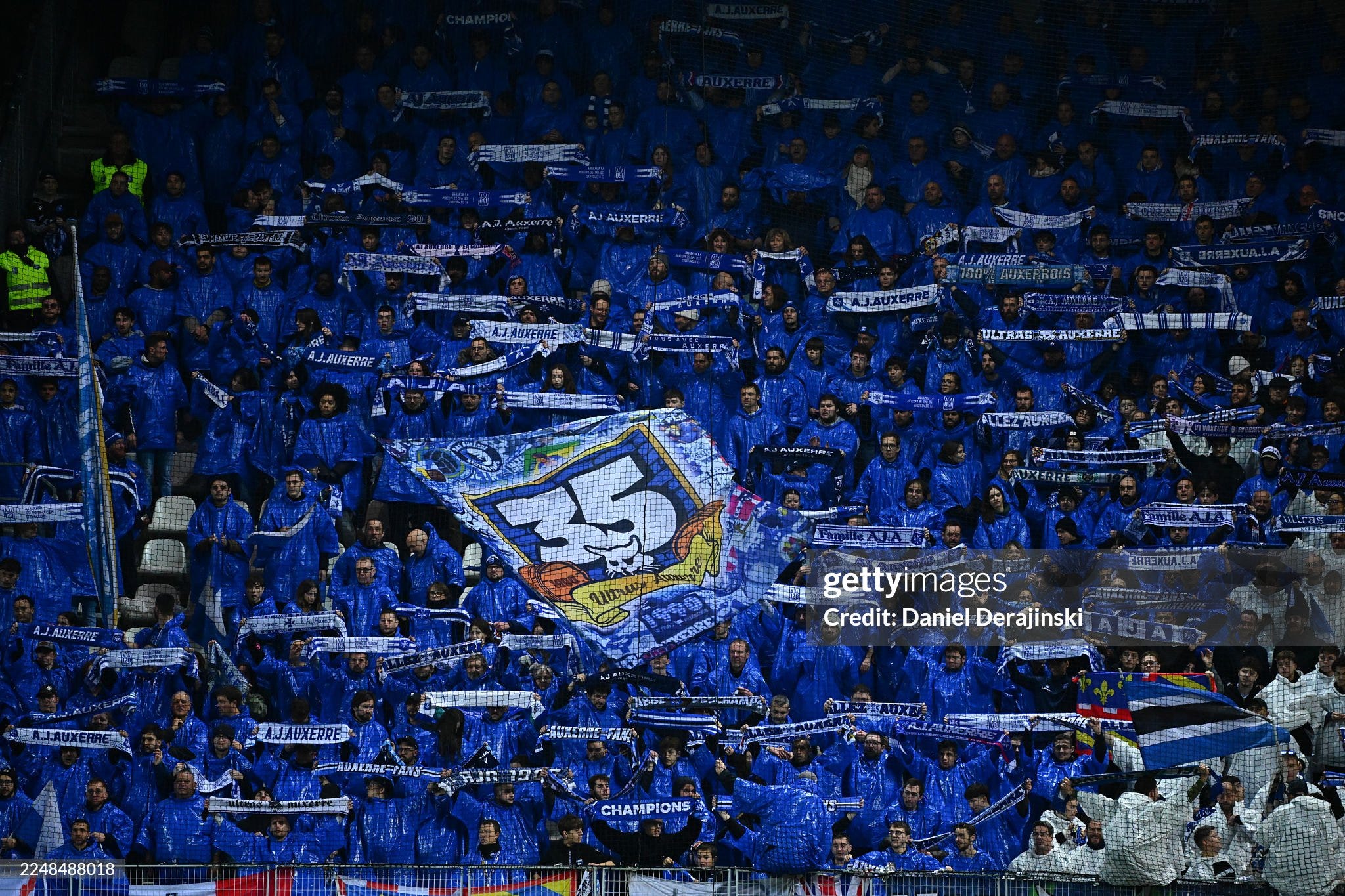
AJ Auxerre brough half of Burgundy (Valois Burgundy peaked between 1300 and 1400, like Enzo Maresca’s build up play) to support AJ Auxerre at Paris FC in November for a draw in that cartoonish Paris vs Tiers-Etat re-enaction

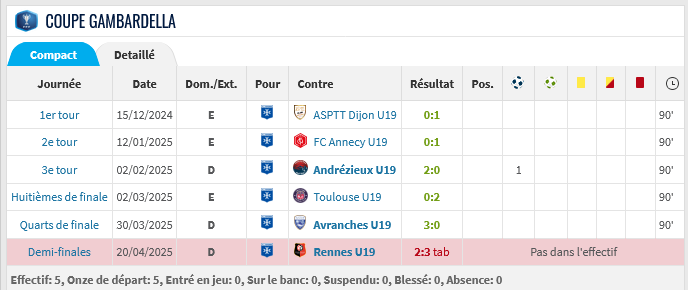
Auxerre is a village ; hosting the club Guy Roux platformed from lower league when he took over in 1961, to winning Ligue 1 in 1996 and playing against Arsenal in the Champions League at the turn of the millenium.
Guy Roux is one of the most iconic figures in Ligue 1 history, not only because his tenure as a head coach lasted from 1961 to 2005, but because his legacy is immense. He was driving every department of his club, saving costs where he could, fetching lost footballs, begging the federations for a fresh set of Cup jerseys to re-use for the youth teams. They were the proverbial “top Academy prospects will get first team debuts”.
I genuinely miss watching football and waiting to see who Pochettino, Wenger or Ferugson (or Klopp in fairness) would give a debut next, knowing there wouldn’t be any sell out influencer nor agent shenanigans behind it.
As for first team business, Guy Roux’s 433 became iconic with the three quickest players on top and a defensive line “the lowest in the division, so that’s more space for Djibril Cissé when we win it back” when CANAL+ started publishing embryonic football stats on TV in the early 2000s and obviously asked the man with the beany hat about it.
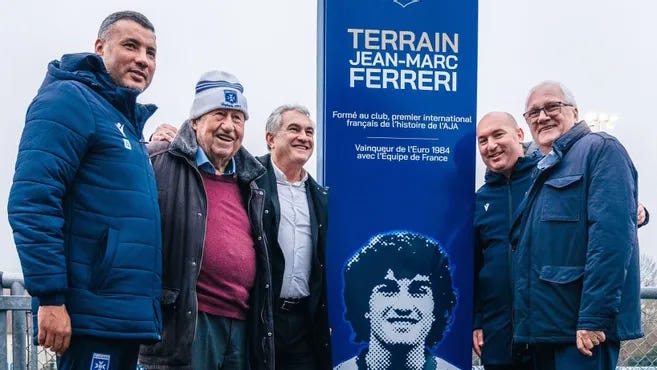
Laurent Blanc, Eric Cantona and Djibril Cissé starred under Guy Roux, but also several hundred of football professionals from players to coaches :
JM Ferreri and Basile Boli in the 1970s, Patrice Garande in the 1980s, Laurent Blanc, Sabri Lamouchi, Corintin Martins, Taribo West in the 90s. Djibril Cissé, Jean-Alain Boumsong and Teemu Tainio in the early 2000s. The last batch was Abou Diaby, Younès Kaboul and Bacary Sagna who then joined Arsenal.
When it came to Academy endeavours, Guy Roux was also involved to cherrypick players and he’d be known to visit families to pitch the project, that was seen as the ultimate approval in French football. The best youth players in the country would play for AJ Auxerre for over 4 decades.
Knew everything about everyone, watched every Academy game.
I got coaching badges with people who went through Auxerre Academy.
Guy Roux, sitting on a plastic chair one yard behind the opposite touchline to the dugout - with his resonant voice across pitches “hey, you, track back!”
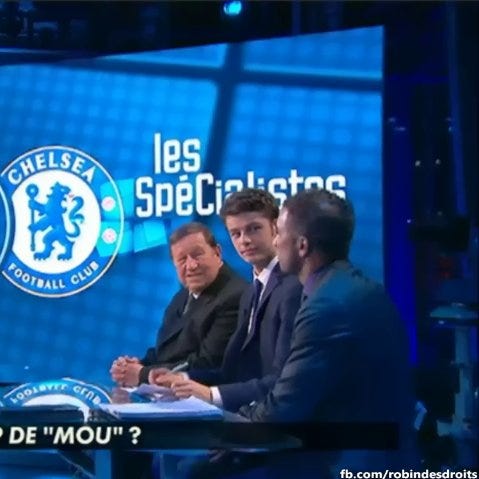
I was privileged to spend a few evenings that felt out of time, sitting alongside Guy Roux on national television to cover Champions League games.
I’m serious without taking myself seriously, but I’ve been where no one else has been from a digital content creation then coaching and media presence.
Some of the stories were extraordinary, some of them were public, some less and there was always a huge amount of folklore the great Guy Roux (who will turn 88 in October next year) was keen to entertain.
He started as a school janitor between Poitiers and Auxerre, then made ends meets by being a ghost writer for the local newspaper ; meaning he was the one writing elegiac prose about the promising young up and coming AJ Auxerre head coach - none other than himself.
He had intelligence and spies everywhere, and could know his players’ whereabouts. No Stasi stuff, but giving out free tickets to toll booth collectors on the highway, or nightclub staff.
Auxerre is 2h from Paris, (170km, 100 miles) - and around the area, players went with their bribing scheme as well, so that DJs had a special playlist with a particular song that means “duck for cover, Guy Roux is in the place”
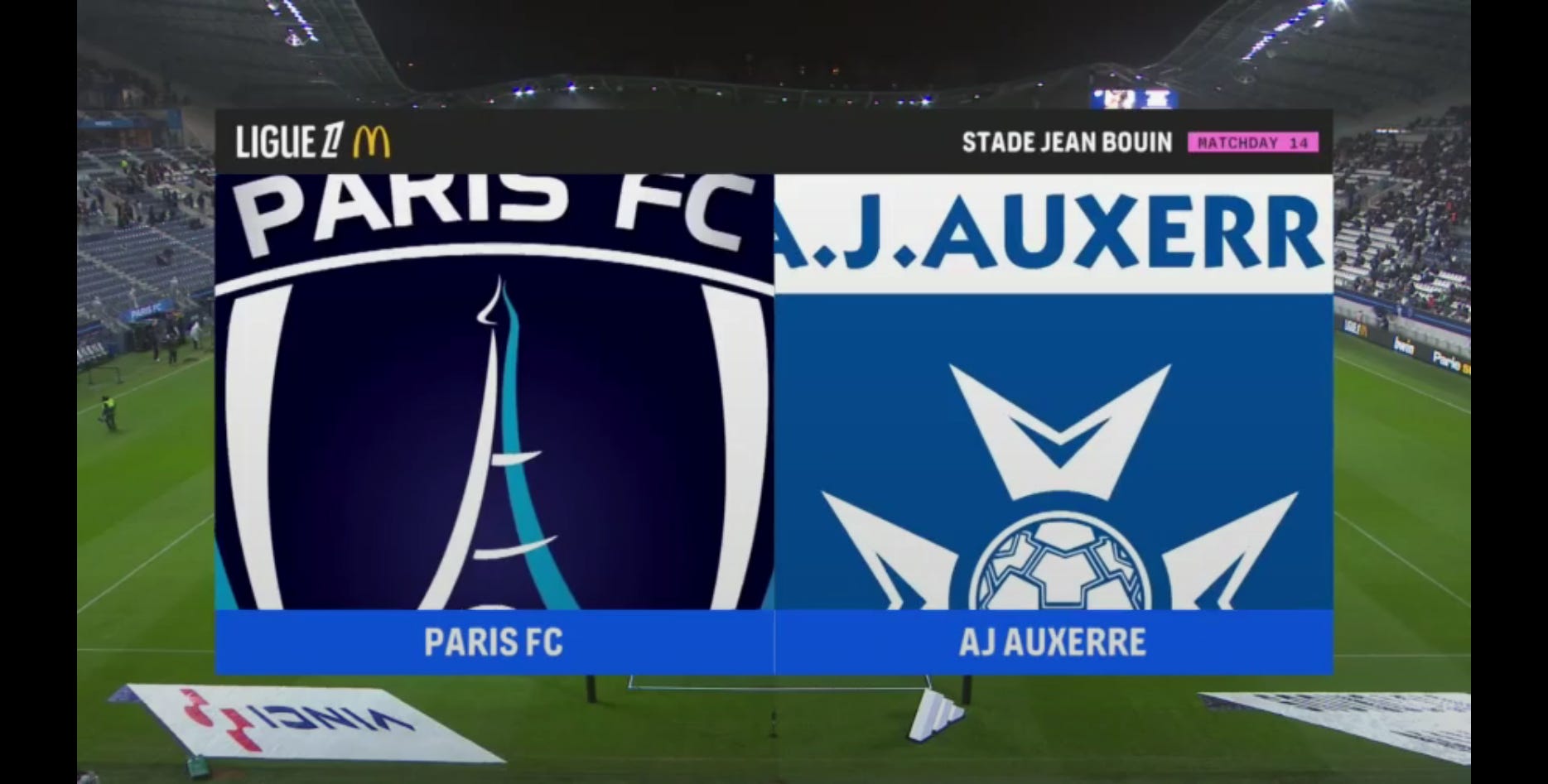
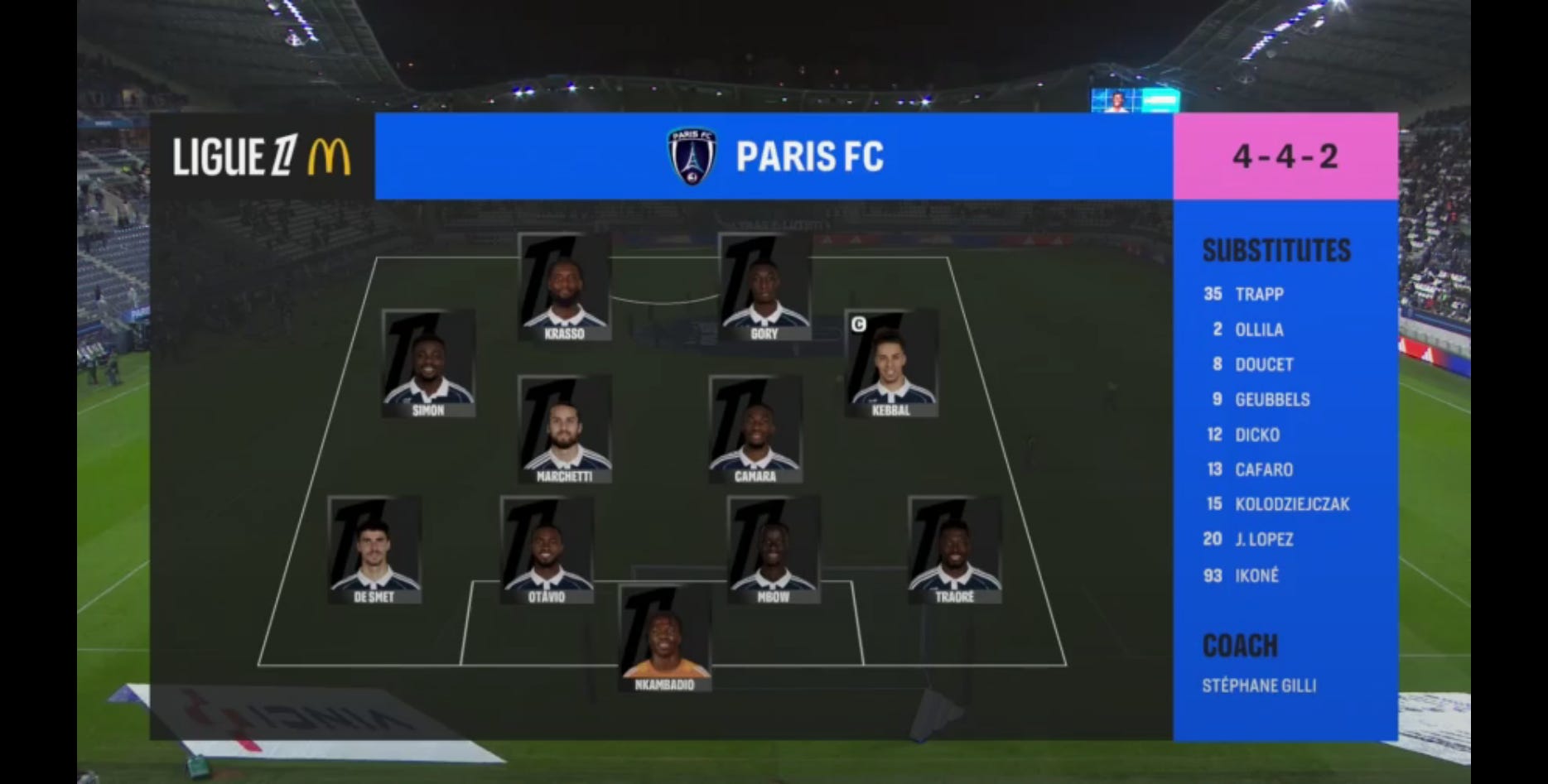
Paris FC, finally promoted in Ligue 1 and somewhat backed by LVMH / Arnault Family, and Red Bull ; who you’d expect to have some form of taste and methodology before spending nine digits on transfer fees but here are their team anyway. What in the Ligue 1 McDonalds am I looking at
Like, if you sign seasoned Ligue 1 players to fit the bill, fair enough but you’ll have to pay the bills to be one place ahead of the relegation ones ; with players who obviously hardly moved the needle. Now what, Antoine Kombouaré. I don’t dislike it, but yeah. But he’s a good coach and will get the job done.
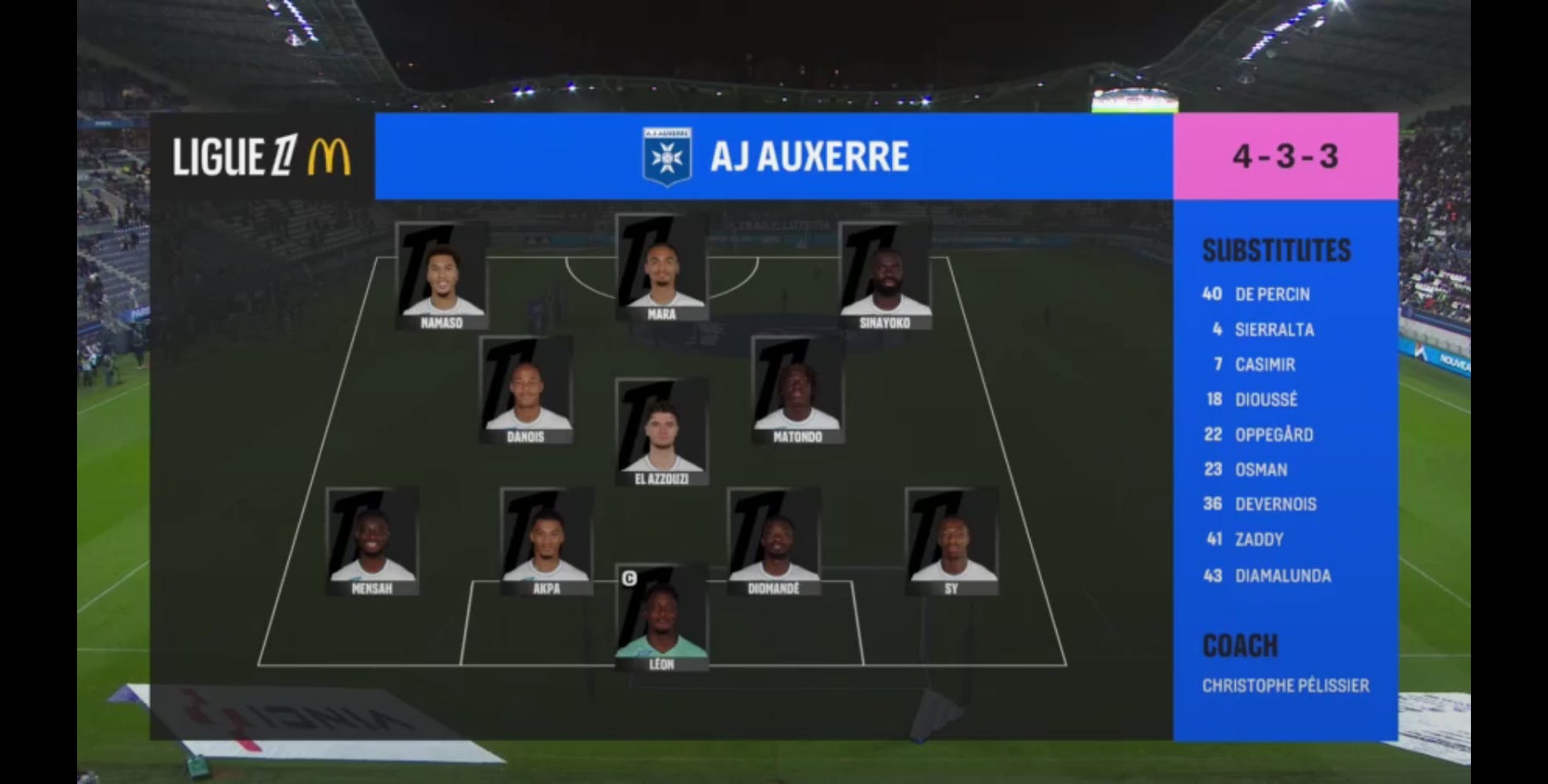
AJ Auxerre have some good dynamic attackers in their historical 433, Guy Roux’s shadow is still extraordinarly influential in AJA’s universe.
Rudy Matondo started as part of a midfield three, paired with Kevin Danois.
behind Danny Namaso (Michael Olise’s team mate with Reading U21s), Southampton and RC Strasbourg flop Sekou Mara, and Lassine Sinayoko.
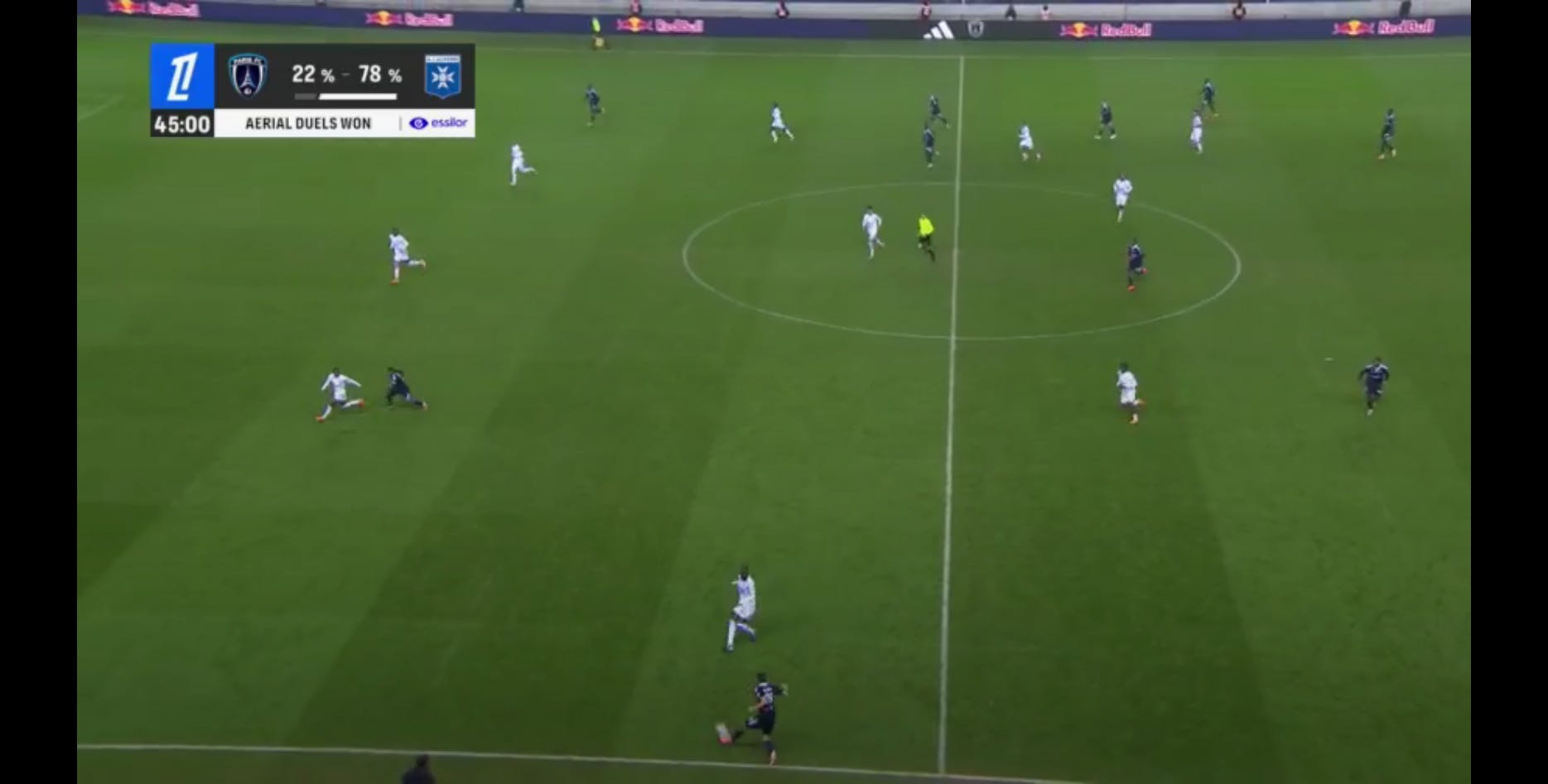
The game is available on Ligue1+, a link that might be useful for anyone who pretends watching Ligue 1. Here I am, watching Paris FC - Auxerre in TfL on my phone to optimise my commuting time, whilst brainstorming key moments and minutes to document below.
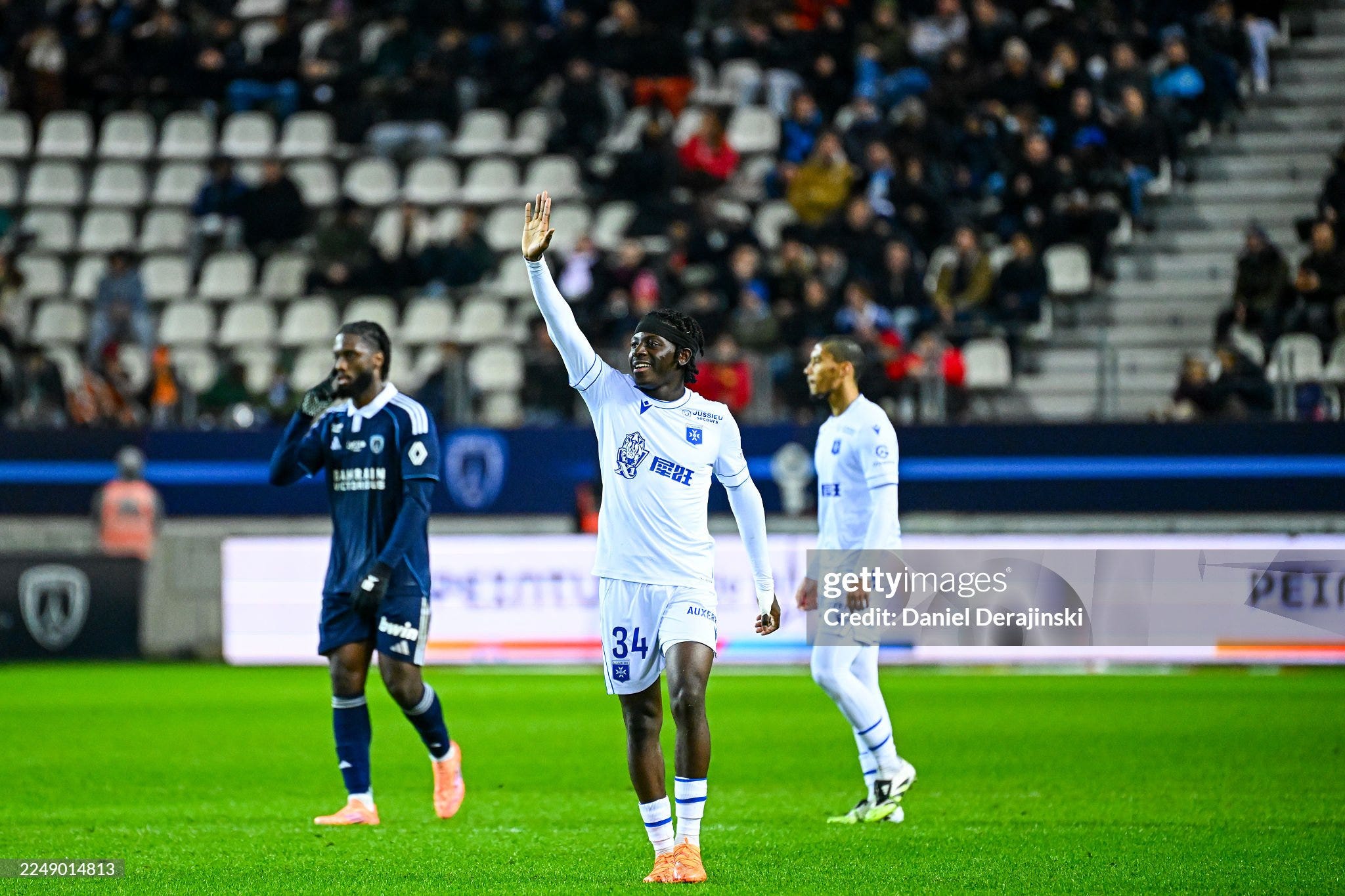
(Not) Lost in our fate
Top level holds together because it is a scene where professional players get involved in synergy in a range of familiar plays that directly contribute to keeping the whole together. In other words, defensive structures don’t fall apart systematically on every play (think, 7 players taken out on a single play), and teams aim at negating individual superiority with double or triple teams :
a fullback and a CM against a dribbling wingers should be in a position to defend both ways.
Winger 1v1 against a fullback will have success more often than not (unless he’s Alejandro Garnacho, winning 40% of those)
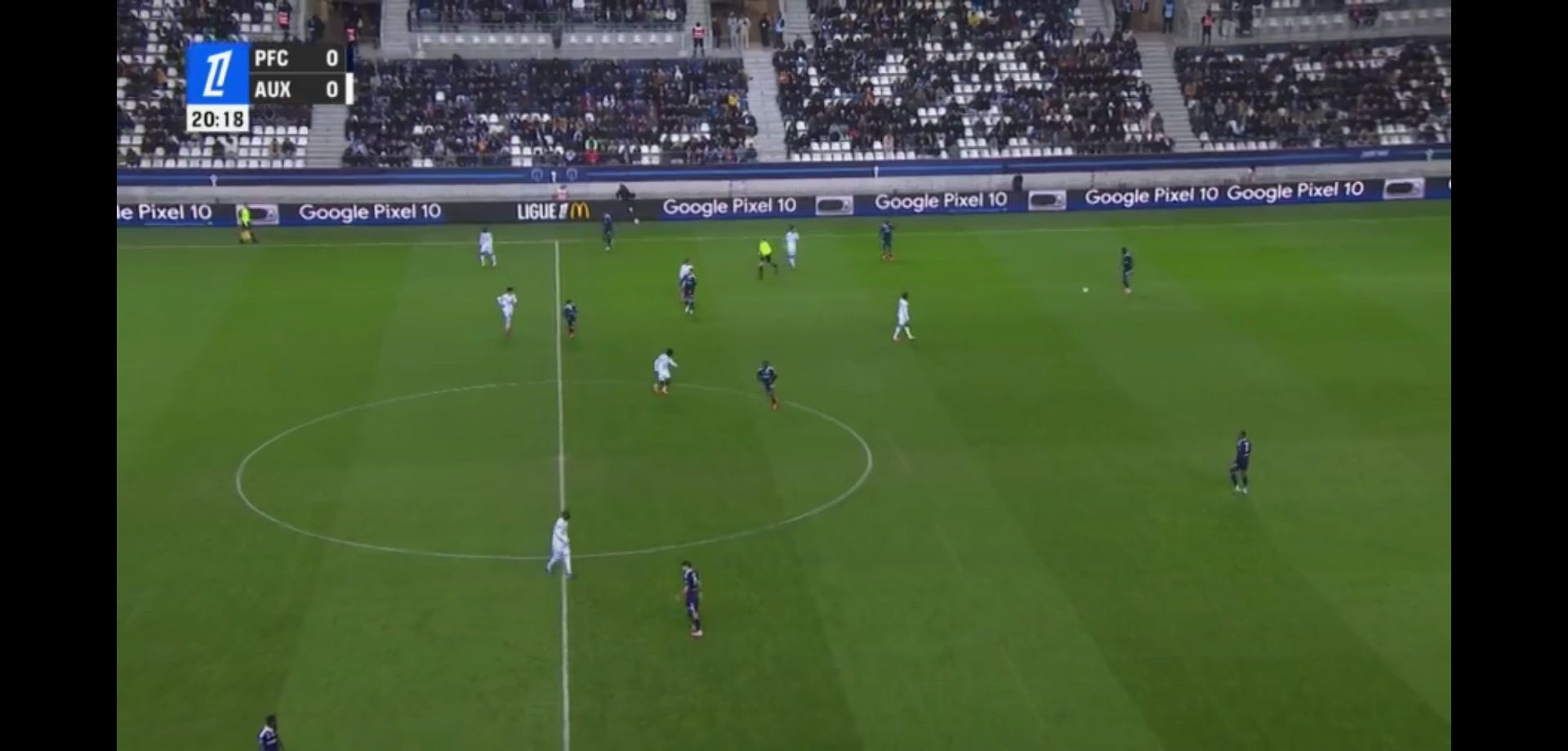
I don’t like my teams conceding from open play, let alone after a well worked goal. One of the things I like to work with is the specific defensive supporting movement from the CM when the ball goes wide.
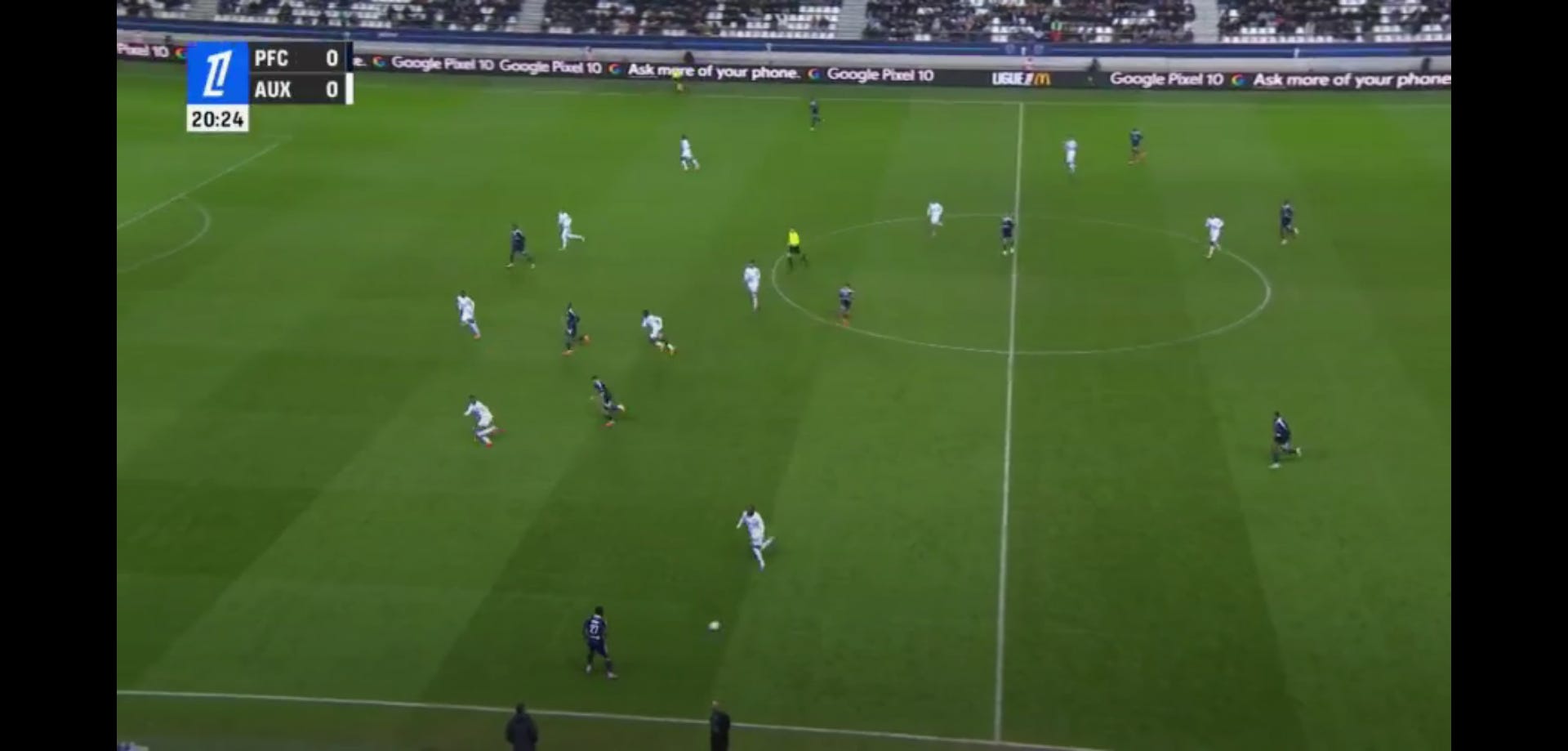
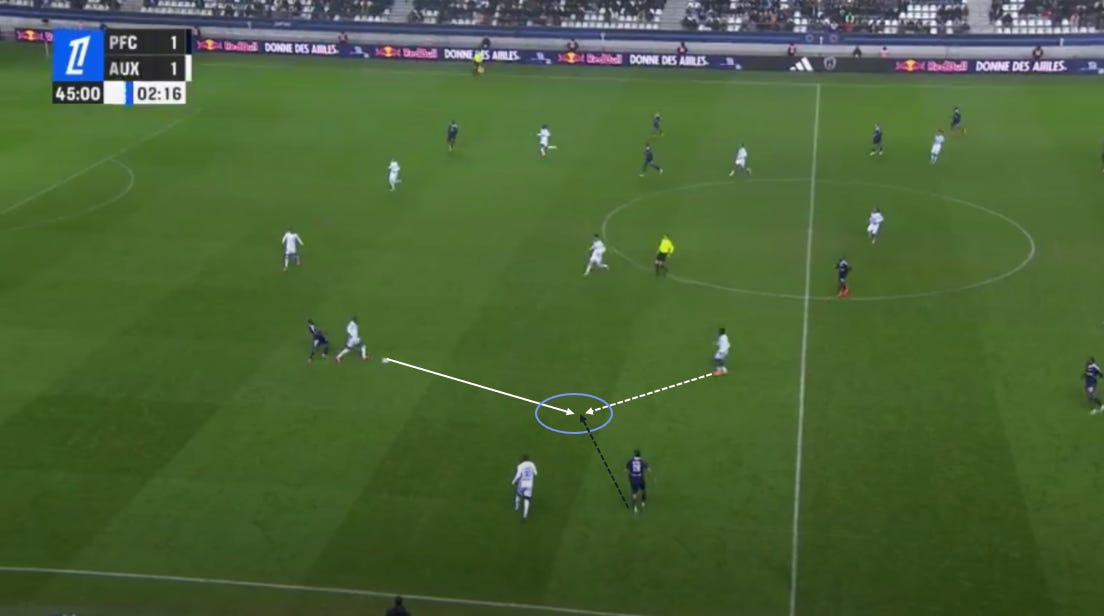
Matondo’s priority is to defend the line between the ball and the goal to support his team mates : right back and winger are staggered diagonally to have time to step on the line.
Matondo’s movement resonates with what’s outlined above : a synergy found in the range of movement that is :
frequent enough that is has to be assumed as a given
easy to fix when it’s not executed properly
Getting under the ball,
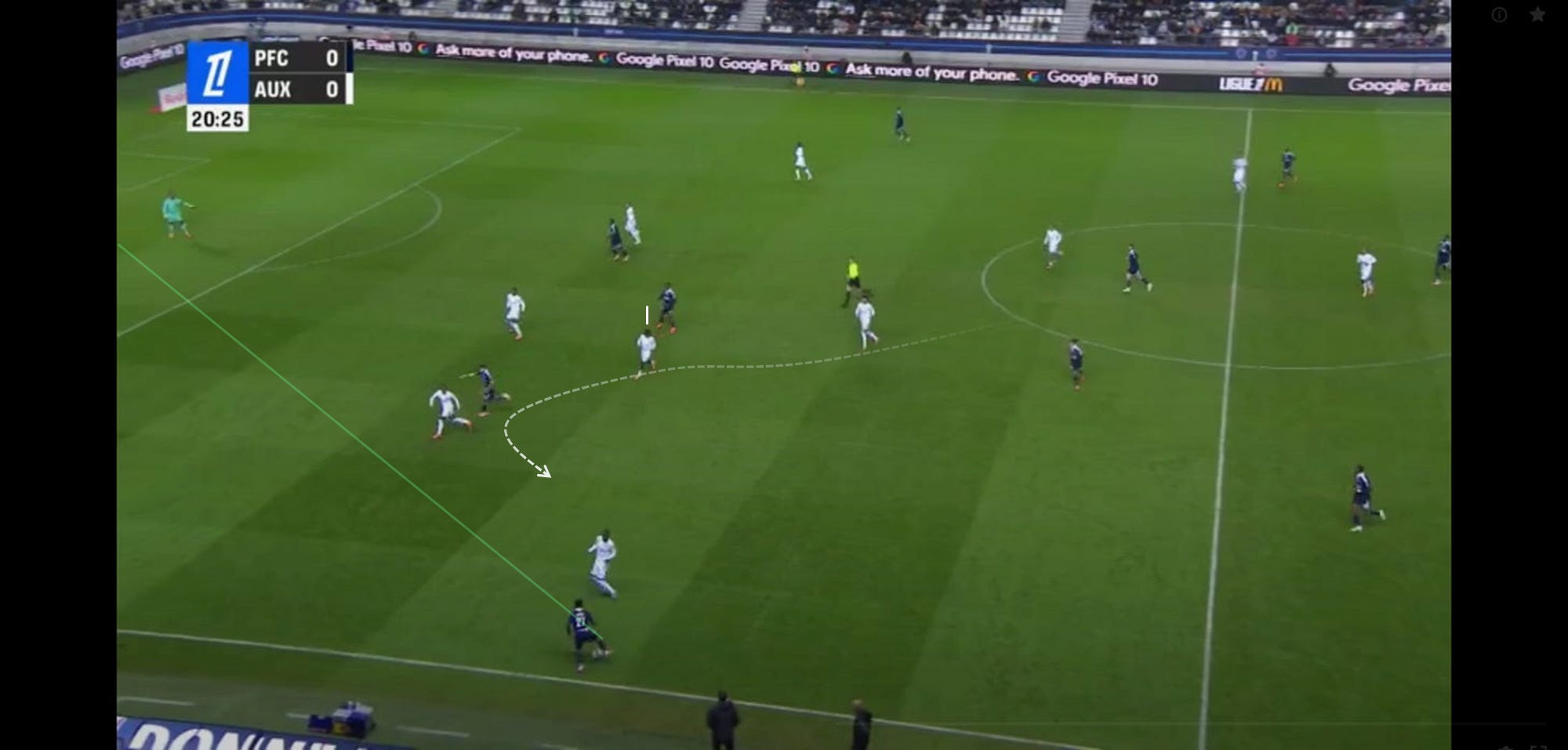
So that he can restrict access to the direct route to goal,
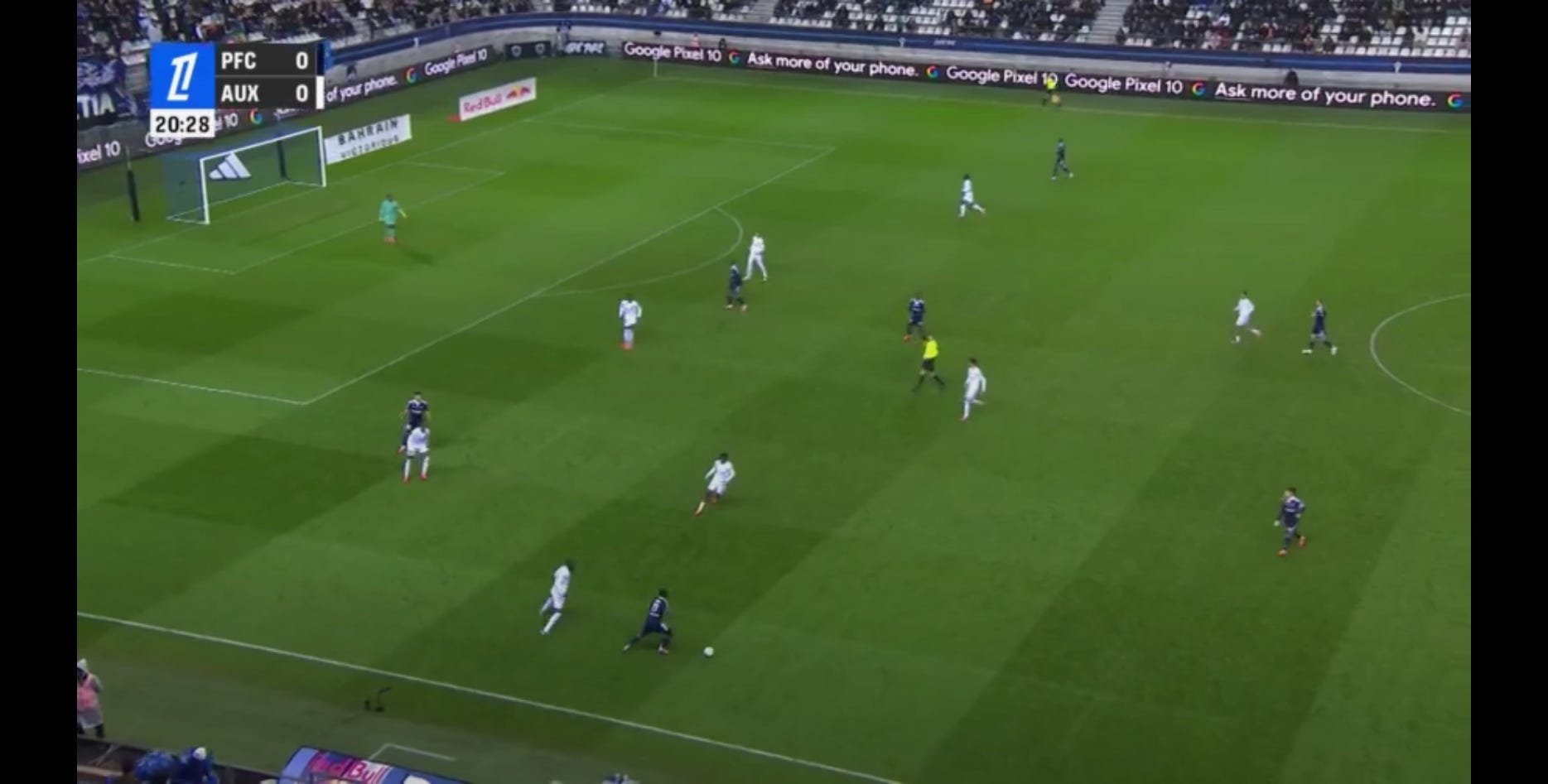
Force the opponent back : you cannot close down forward, if you didn’t manufacture the space to do so.
That’s why a lot of midfielders arrive level with the carrier, and end up wrong side.
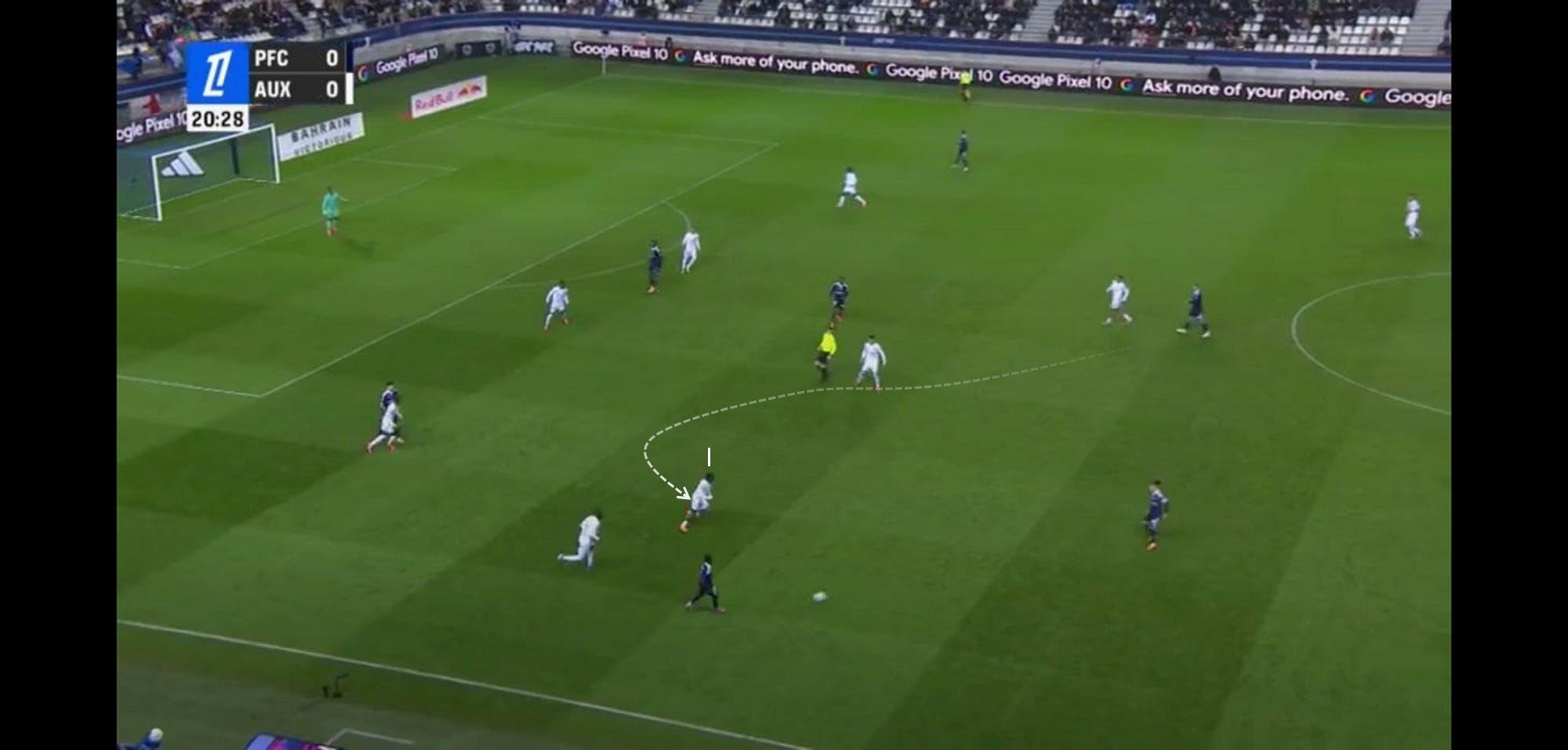
The next step is to press the back pass, therefore sprint
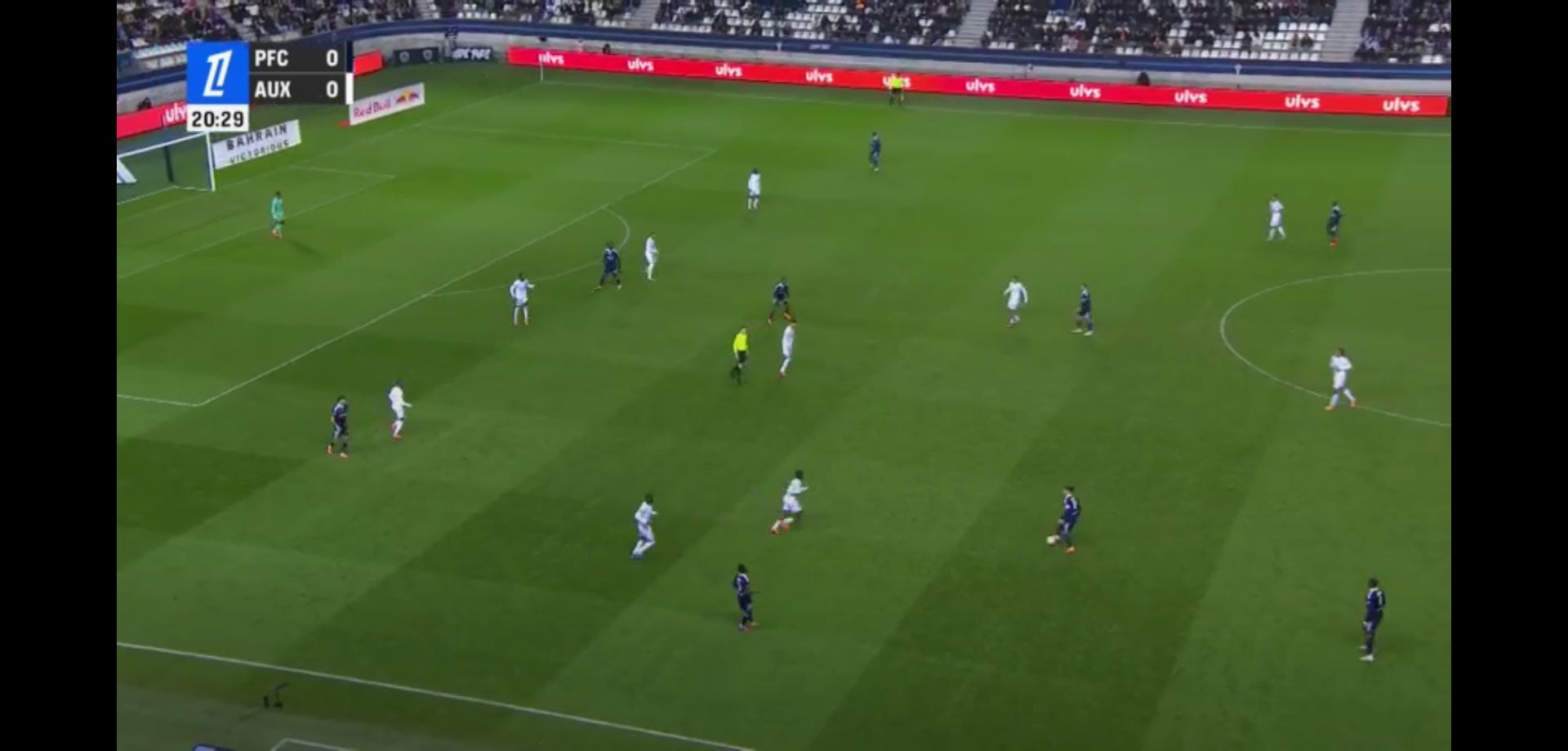
Decelerate
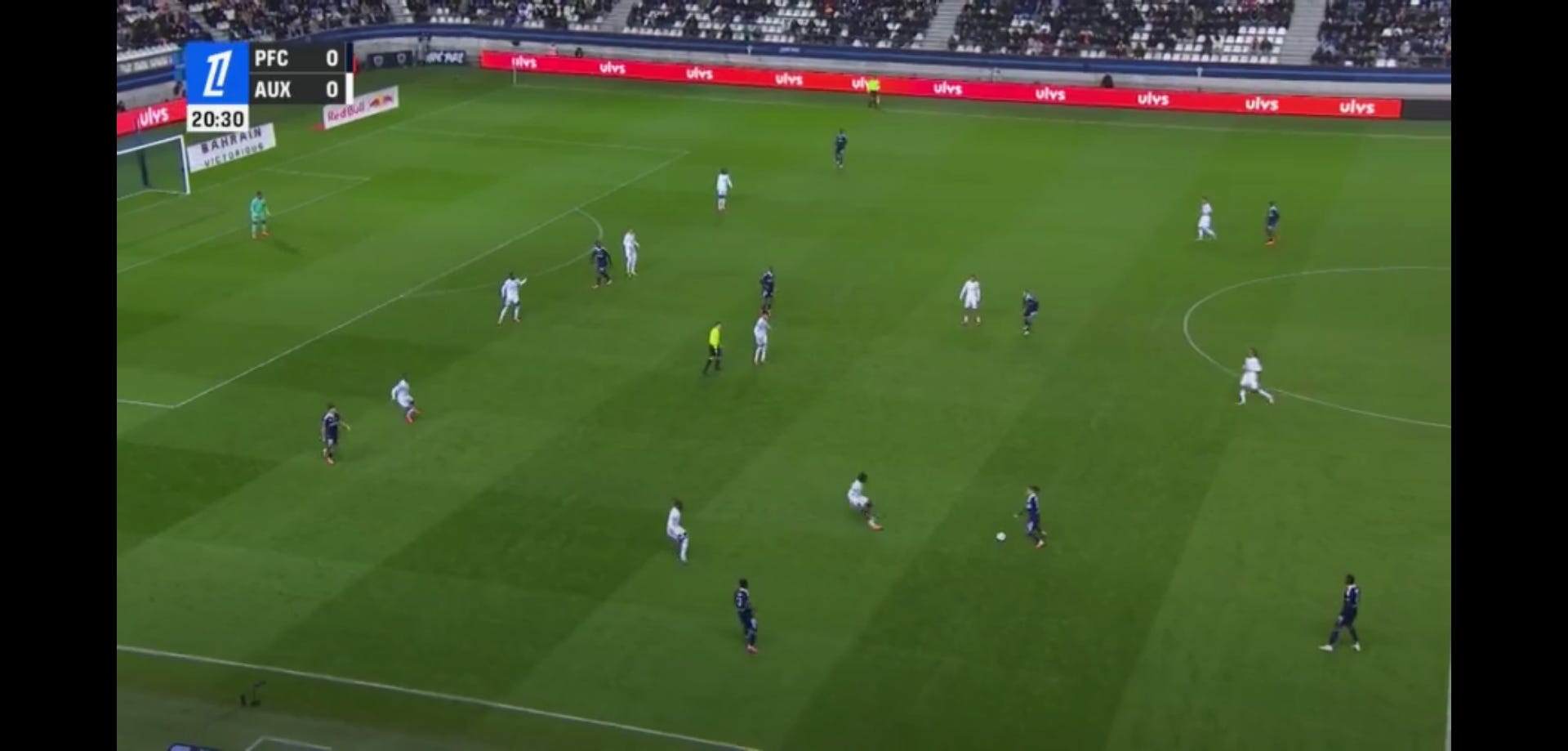
And jump on toes to stay dynamic and funnel the opponent into bodies
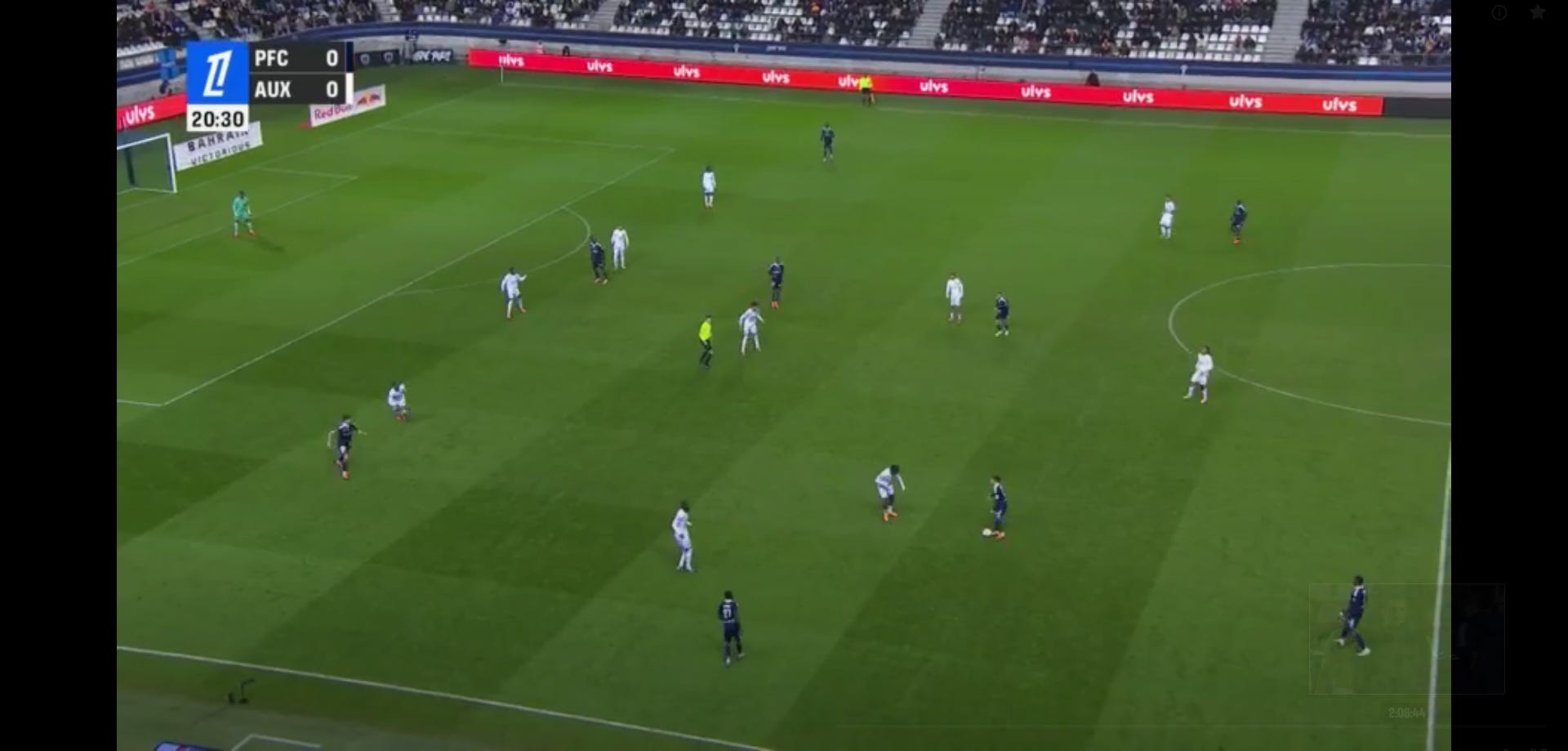
This is what RM does here ; side on, trying to force his opponent to play the ball back where his team mates have locked in on potential receivers
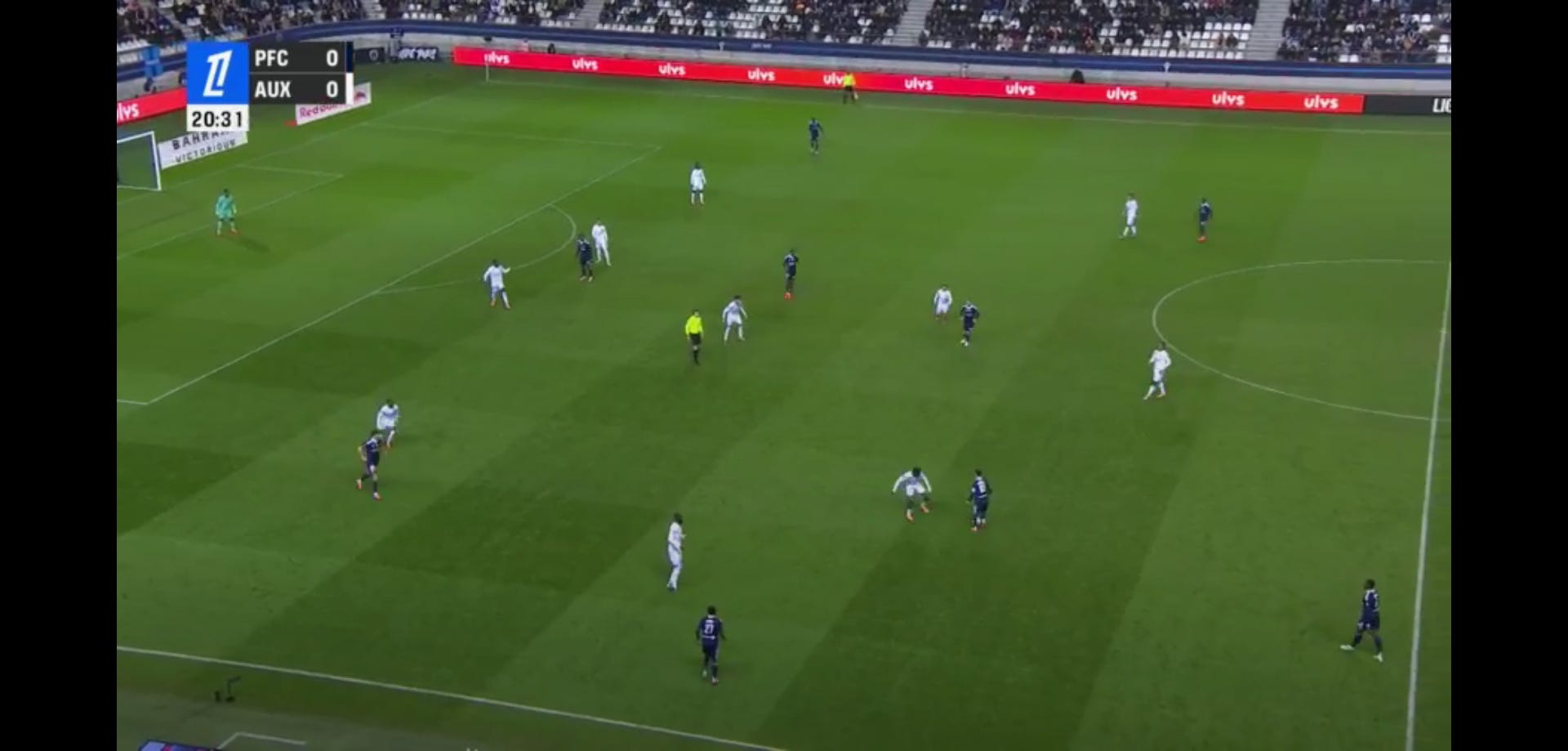
The subsequent challenge is to squeeze up, and eat up ground to stay tight
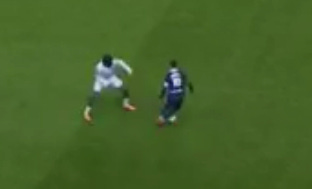
Jumping from his right leg, pushing forward to keep the same stance, just closer.
Using both legs by shifting weight just exposes to the opponent to knock the ball around or between the legs, and crash on the support leg
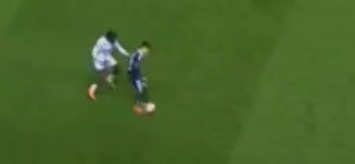
The player is forced back, and Matondo decelerates again to put his hands on the opponent as he’s forcing him back.
Just like you need to maintain core strength like I am, sitting in a deep hotel lounge couch leaning over to reach my laptop ; I just switched to an armchair to rest my back.
It’s annoying for players to have to offer mild but real resistance to being shoved by their direct opponent in these situations, this is how match-ups are build. Don’t need to “leave one” and kick the support leg, but just nudge the opponent as he’s connecting the pass.
Who knows, it might not be caught by the ref, or not judged meeting the threshold for a foul. And the pass might be shanked.
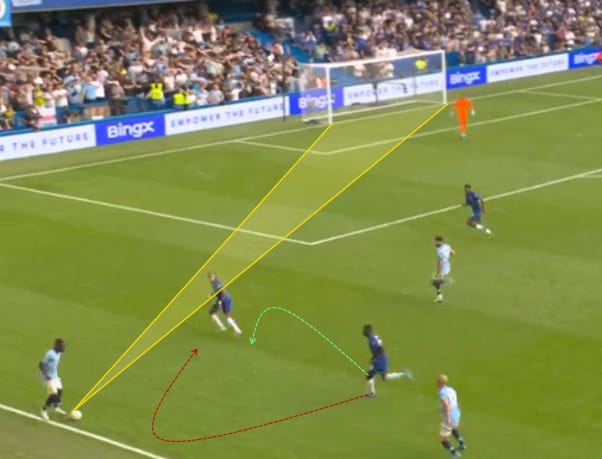
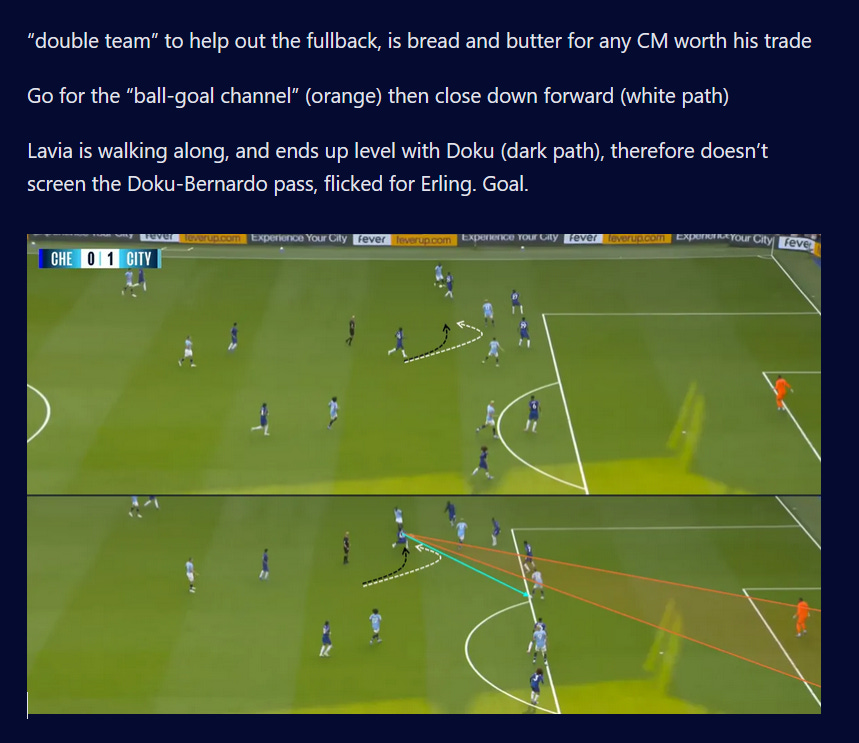
This is an example from the non-Player of the Season Moisés Caicedo, who obviously did the red run as opposed to the green one, in Manchester City’s walkover win at Stamford Bridge ; thus (since Polymarket and Substack partner together for a better future, you wouldn’t have bet on me using “thus”) failing to protect the channel between the ball and the goal (yellow)
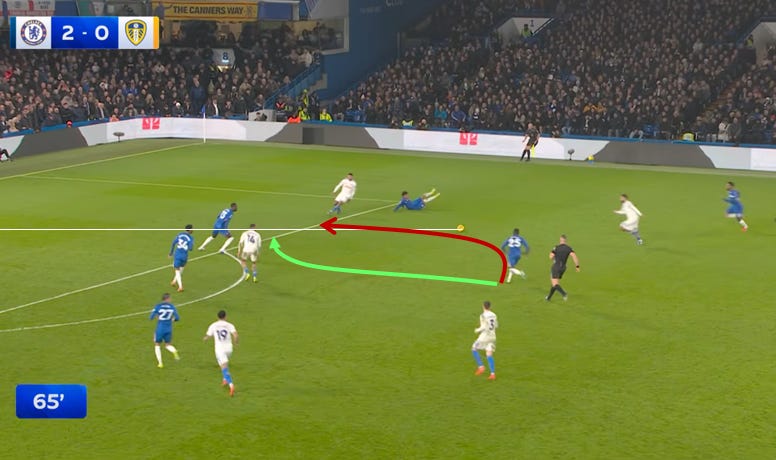
Then again against Leeds, ball watching instead of doubling up with Trevoh Chalobah
What it would give : being ready to force the opponent on the outside of two players working as a pair.
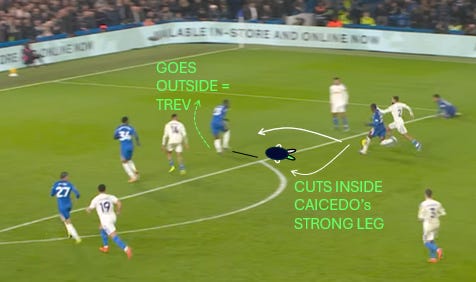
Is this fucking Rocket League?
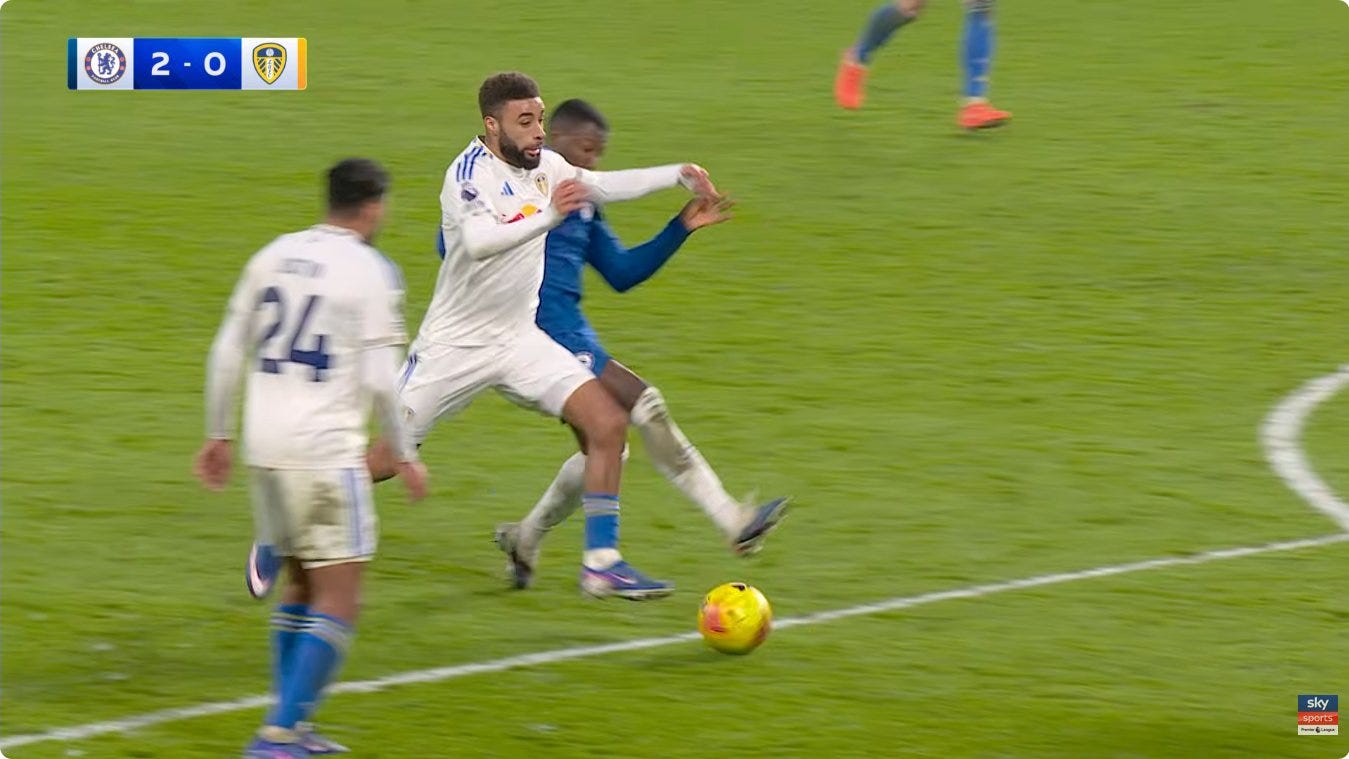
Roméo Lavia, the £62 million theory footballer, not any better.
Another case of a coaching darling player because he dribbles about in Academy football, who can’t scale up to senior football where you actually have to stand somewhere to contribute wining it back.
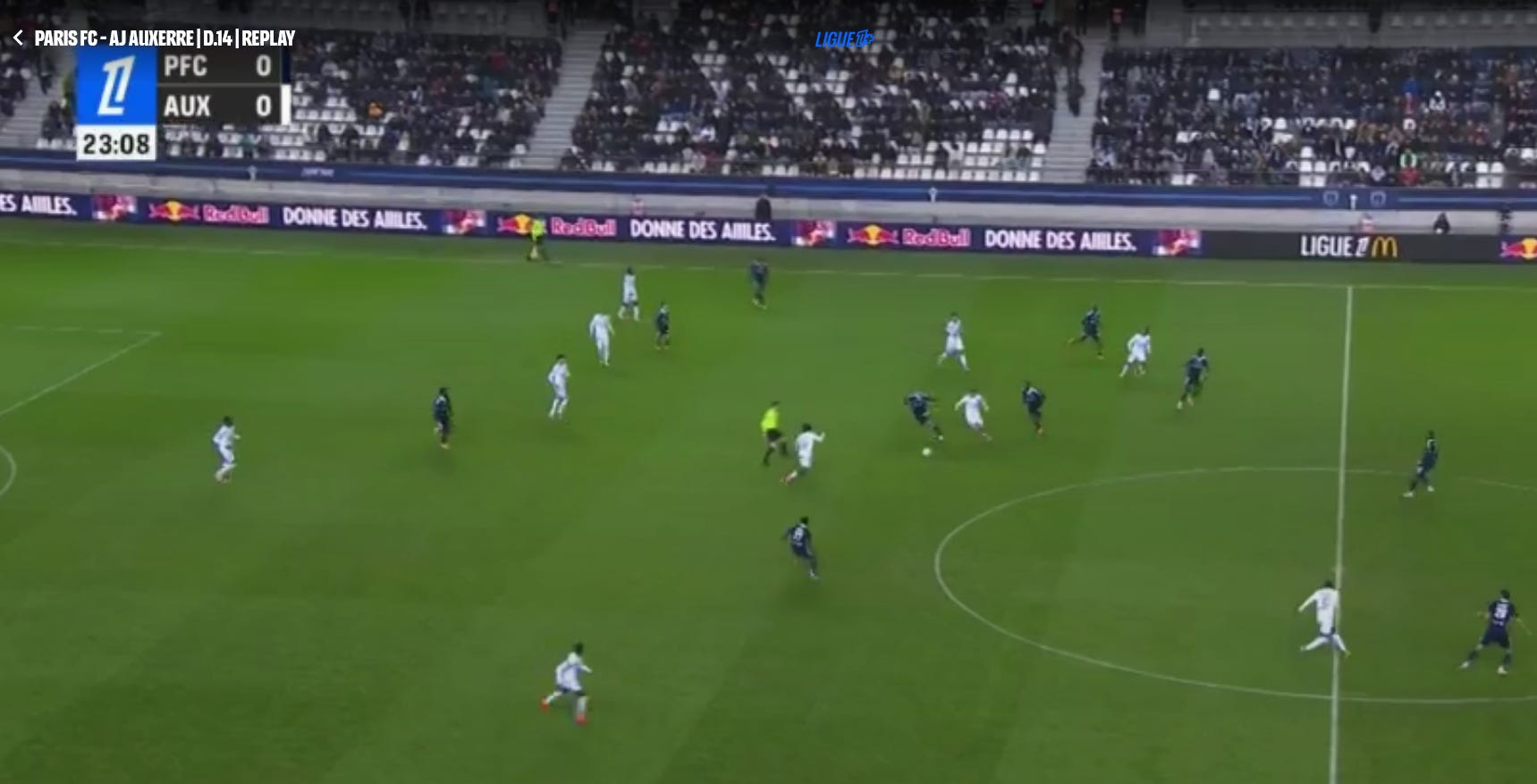
One foot roulette
Creative problem solving in small space : form meets function, improvisation to get on top of a chaotic 50-50 (a backpass missing the intended target)
The drag with the right foot is cool
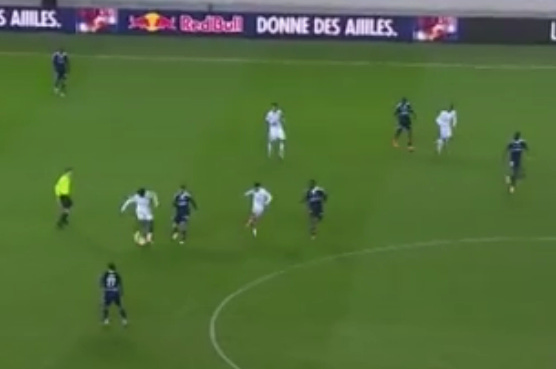
But especially the next two steps Matondo does with his left support leg :
One to land and start spinning
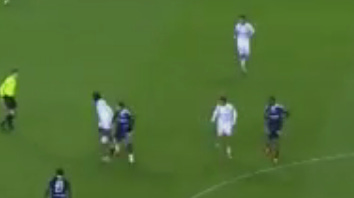
one to finish spinning and push to his right shoulder, keeping shoulders over feet
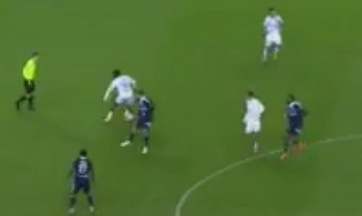
So he can get away in one touch, two support foot steps.
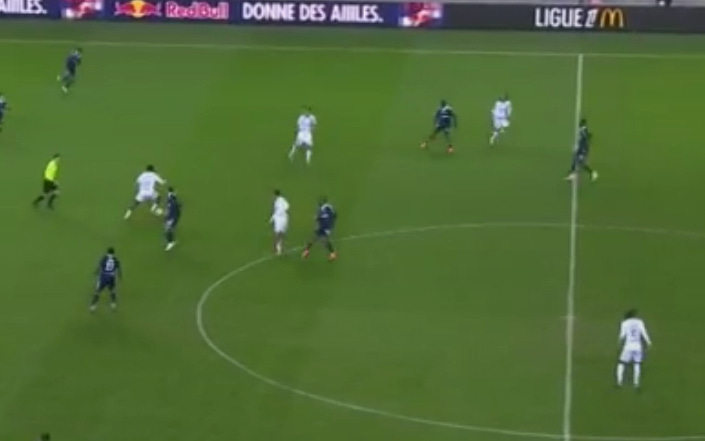
Tracking markers
A second wave from a sustained attack, Paris FC attacked wide, ball went out for a throw-in, Auxerre got back under the ball.
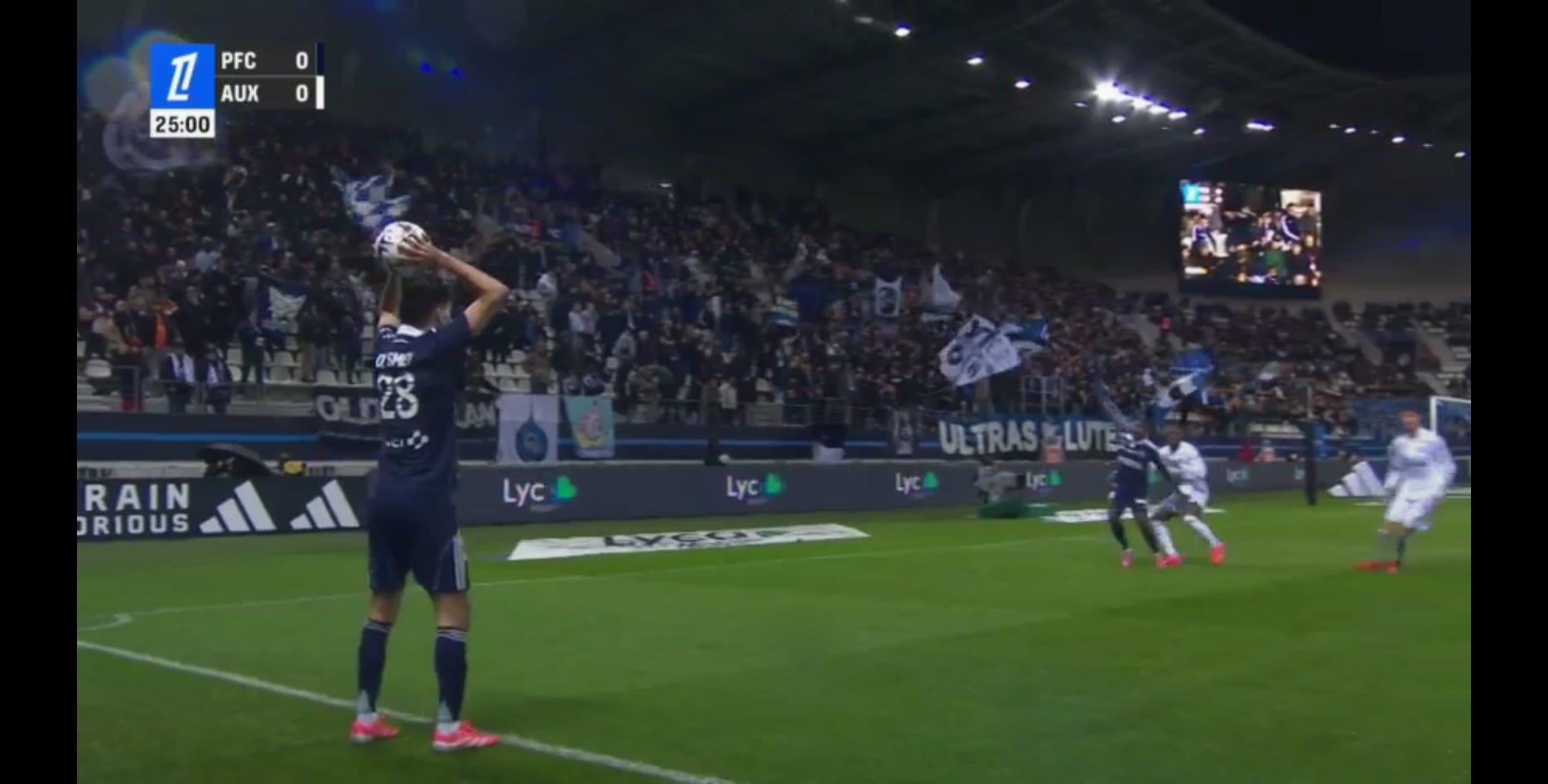
Paris FC go back in the same wing,
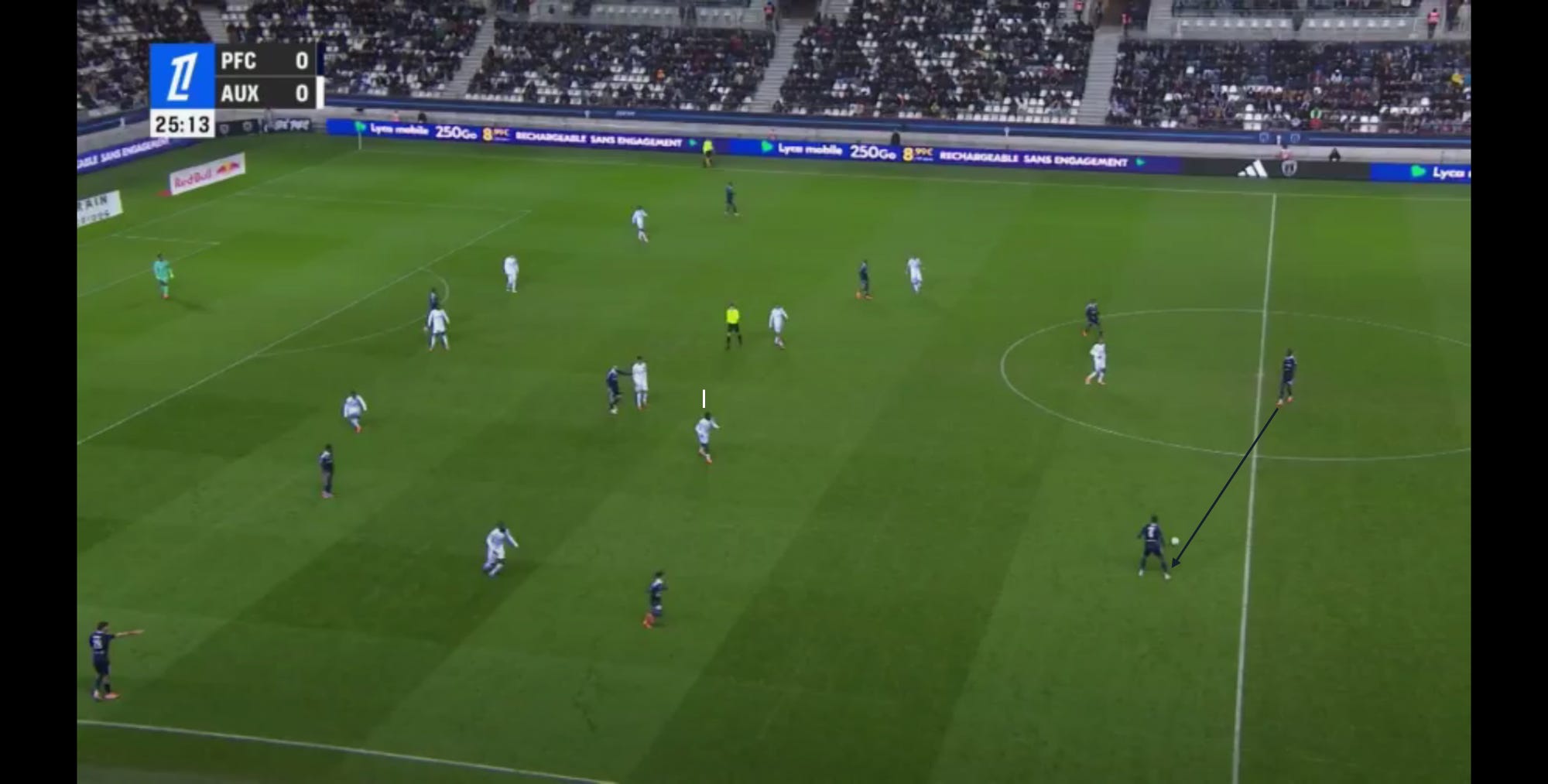
And AJ Auxerre organise accordingly against Paris FC’s rotation :
left back De Smet pushes on (side point, what are these signings? even FM wouldn’t be so lame), Moses Simon cuts inside and Kebbal rolls out from 10.
Matondo sees the 2v1 that will develop wide
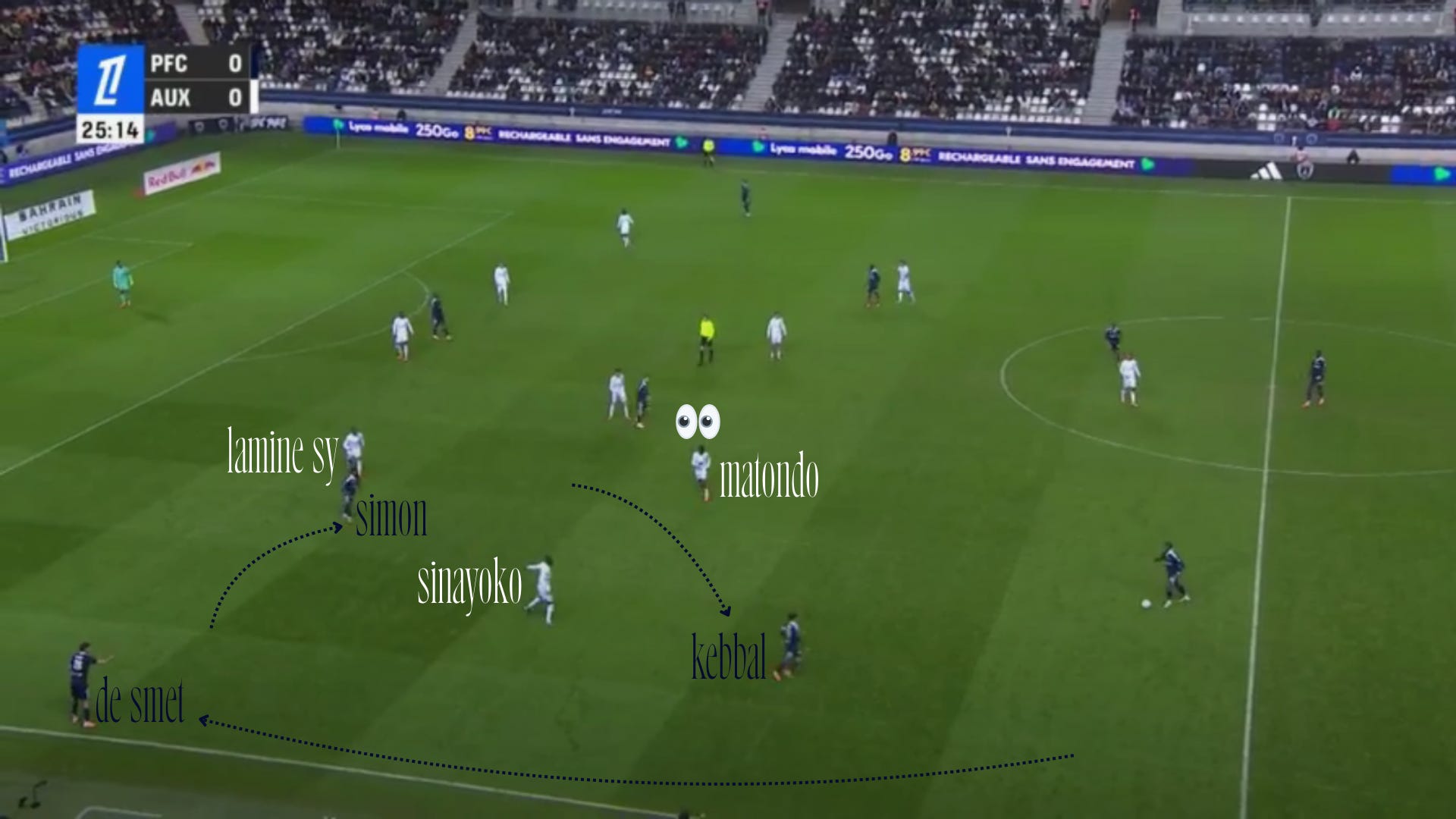
And defends the zone, therefore anyone who enters the channel between the ball and the goal. Don’t need a GPS to be well positioned.
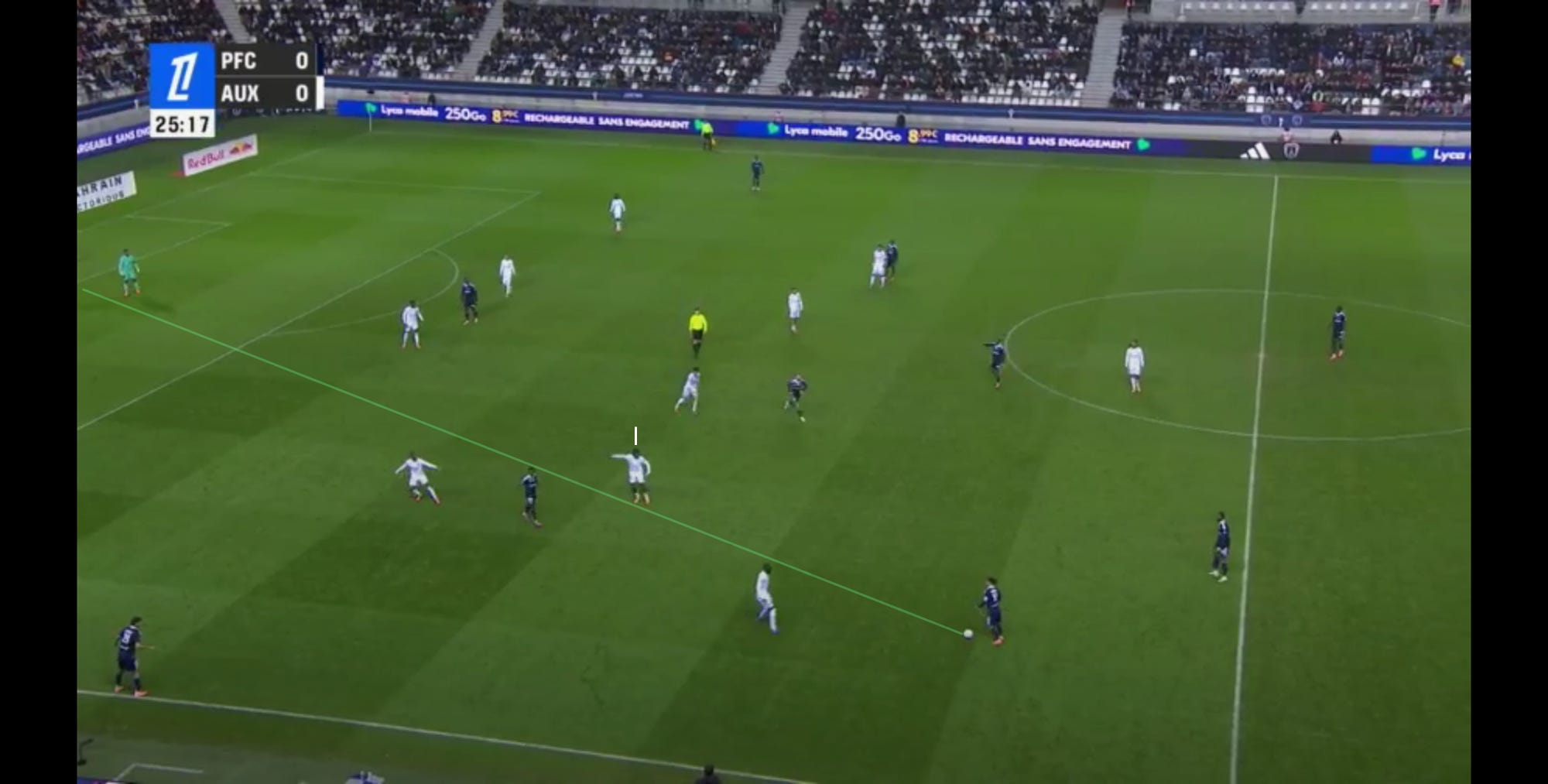
Azzouzi, Matondo’s base midfielder gets done by an interchange and gets split
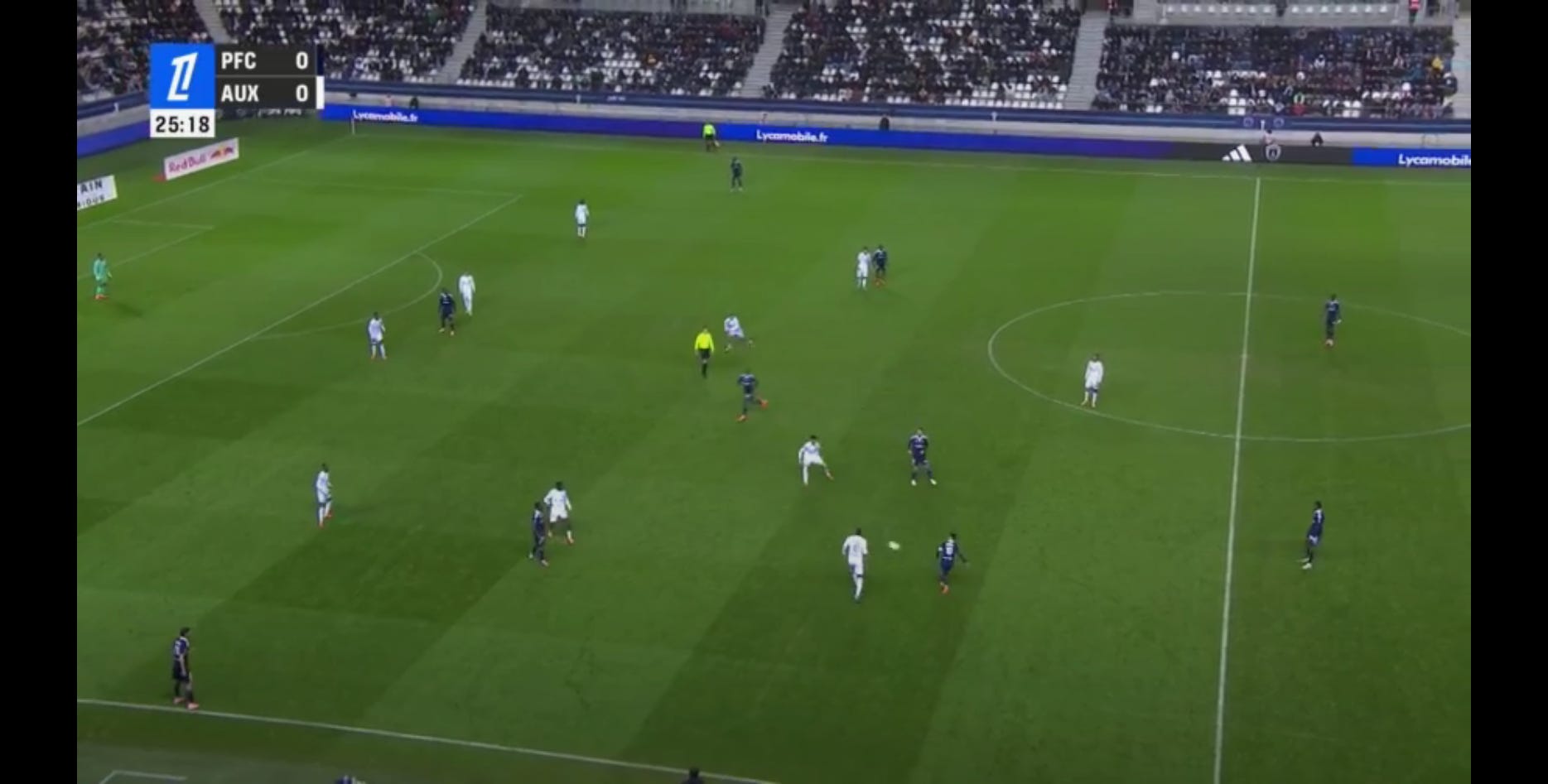
Matondo sets a screen to prevent access, block the pass on the ground with his right leg
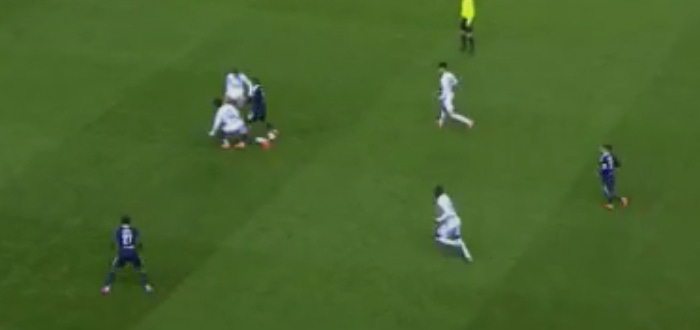
The trigger of the pass back is read a bit late by Matondo who only jumps when Kebbal receives, ideally during the pass.
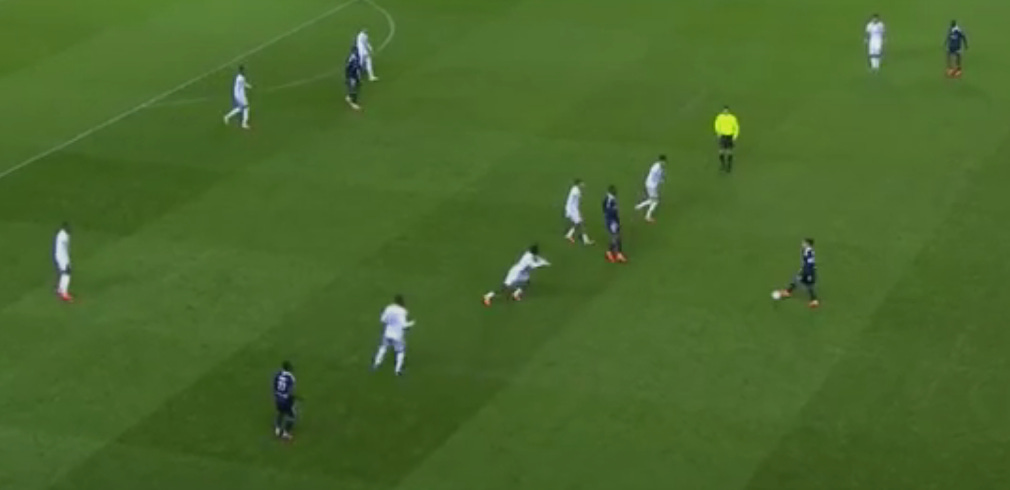
One of the other tricks of the trade is to close down by changing direction every couple of steps, to catch up on what the carrier does, and to force him to make a decision
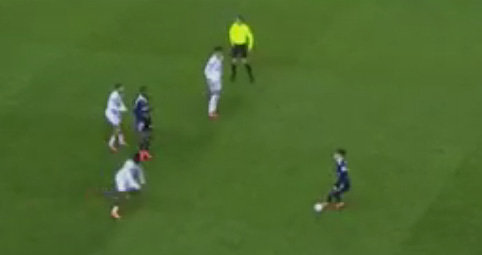
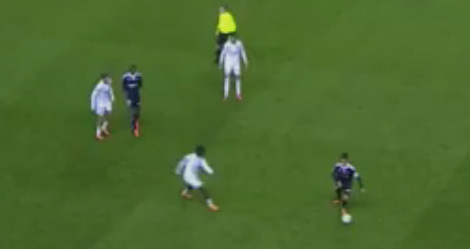
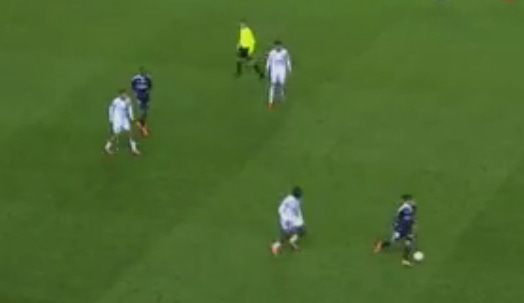
to force another backpass
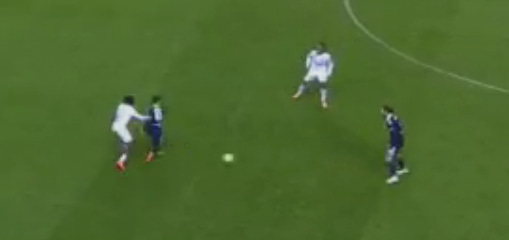
Tangle legs, close but no cigar
Scouting is eminently an experience of what actually happens, not what could’ve or should’ve : the more you watch games, the closer you get to seeing what actually did.
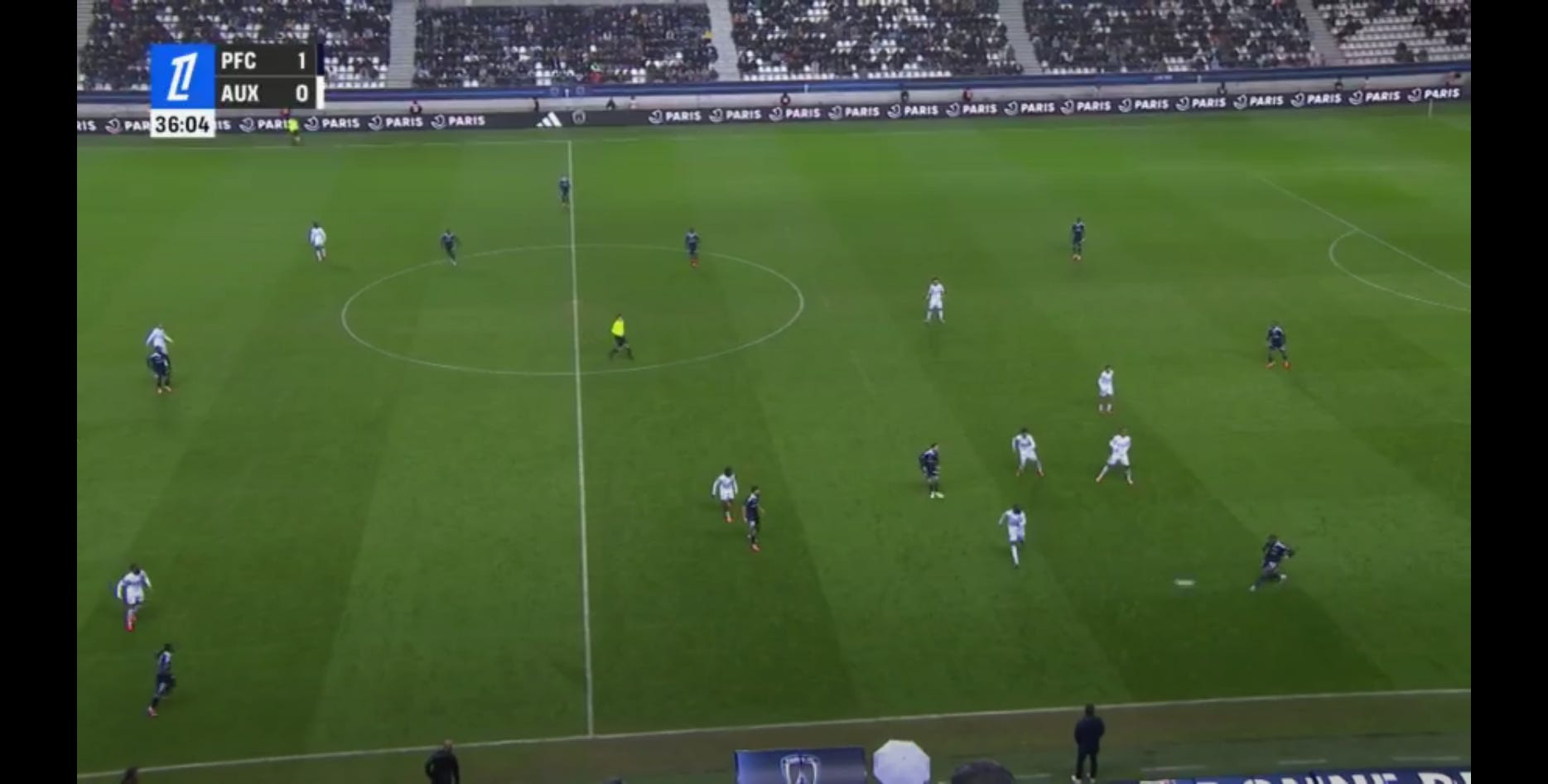
Ball fired towards Moses Simon, Matondo followed up to get under the ball
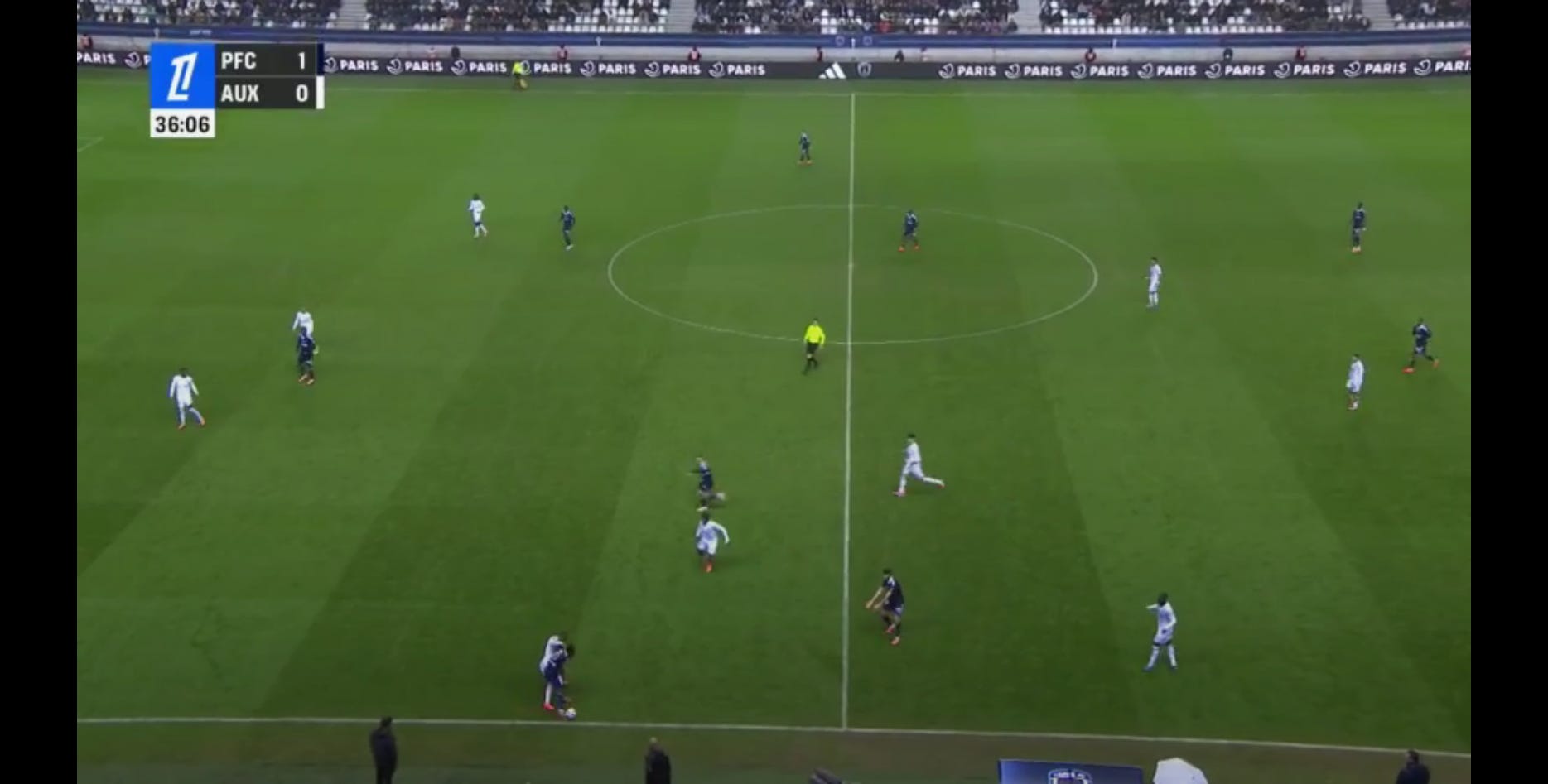
On the change of direction however
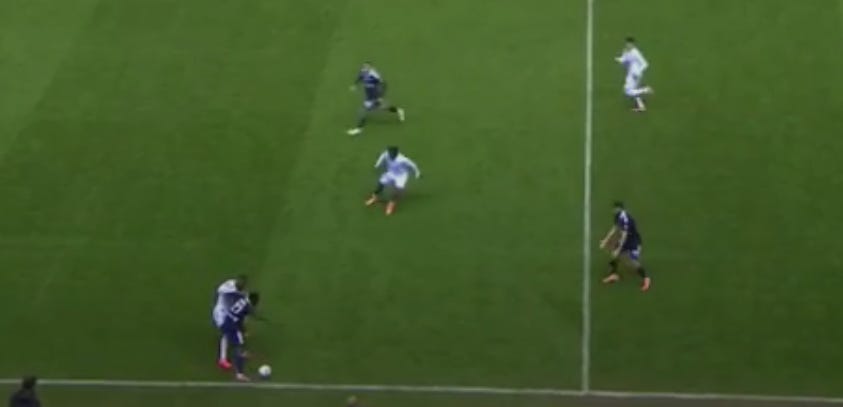
The left leg crosses to land in front
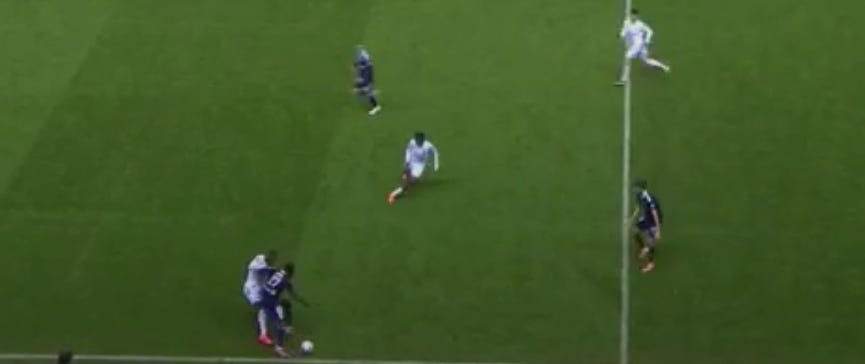
RM has to get his right leg around the left to not tangle his own legs
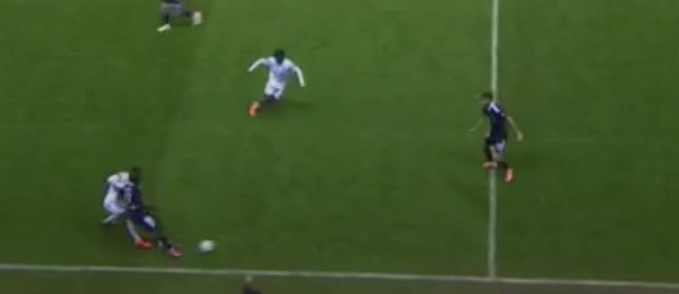
Therefore lands his right a tad too far behind, and can’t generate the sufficient force to push
“bounces” on the ground rather, than pushing the ground with his right to take off
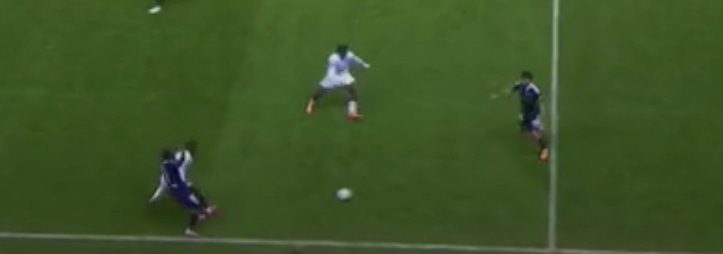
As a result doesn’t move much
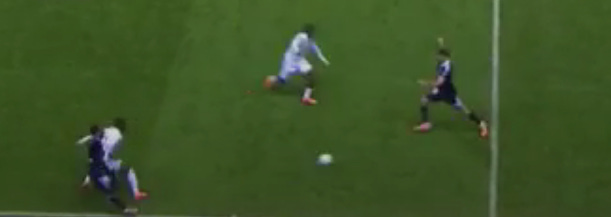
And ends up a tad short to block the pass clipped in the channel.
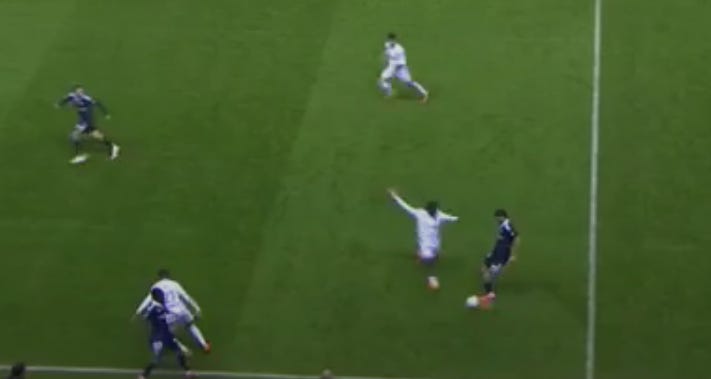
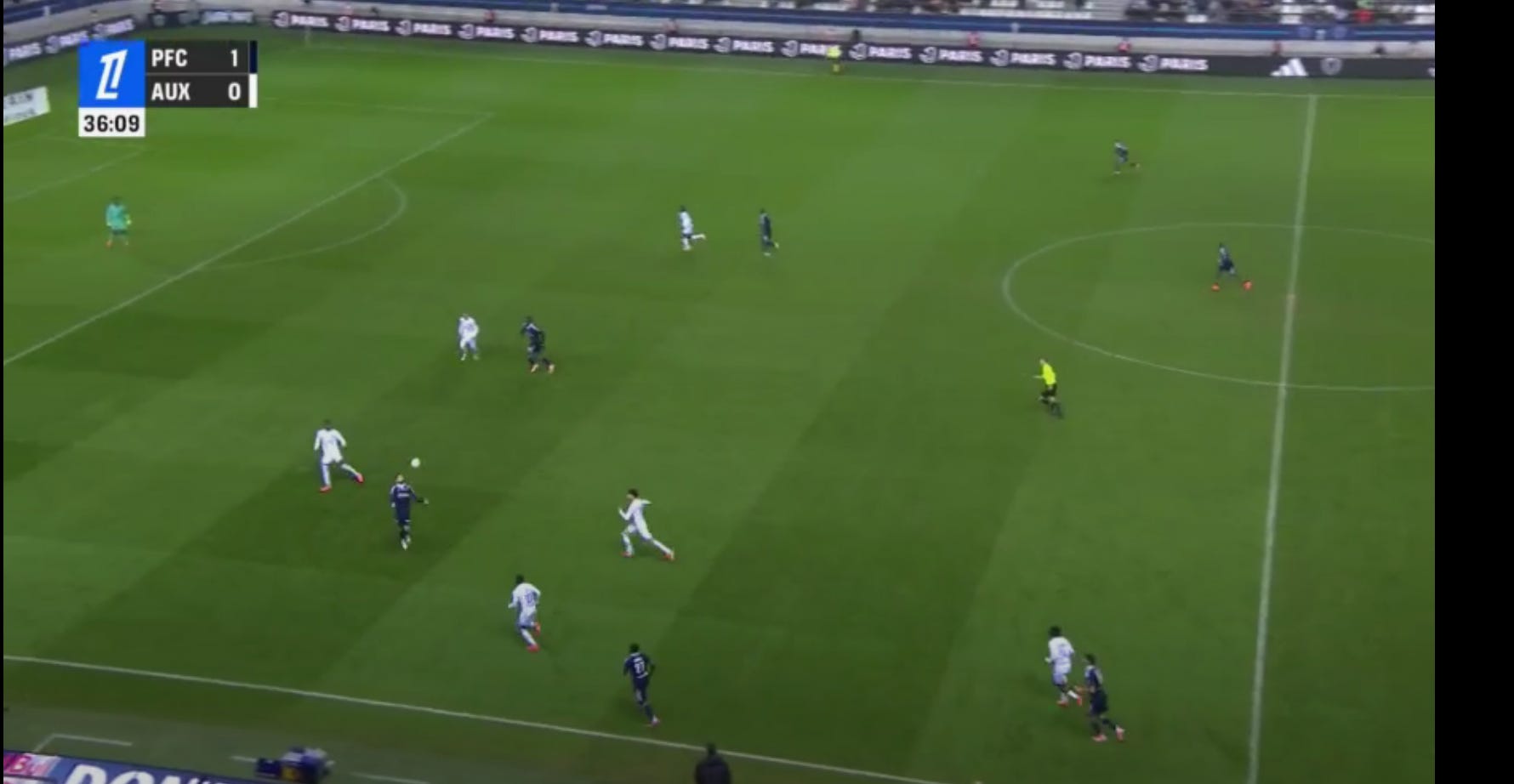
The positive thing is how he got under the ball to close down, lots of CMs let alone in their debut first team season do it
The granular detail of the change of direction lets him down.
it’s not so much a case of “do this do that”, but repeat enough instances of that particular moment to end up doing what works.
The time to readjust between two plays is satisfying, Matondo is already agile enough to flick the ball in the air for a team mate ; doesn’t need 45’’ to recover from the last play, and doesn’t look leggy.
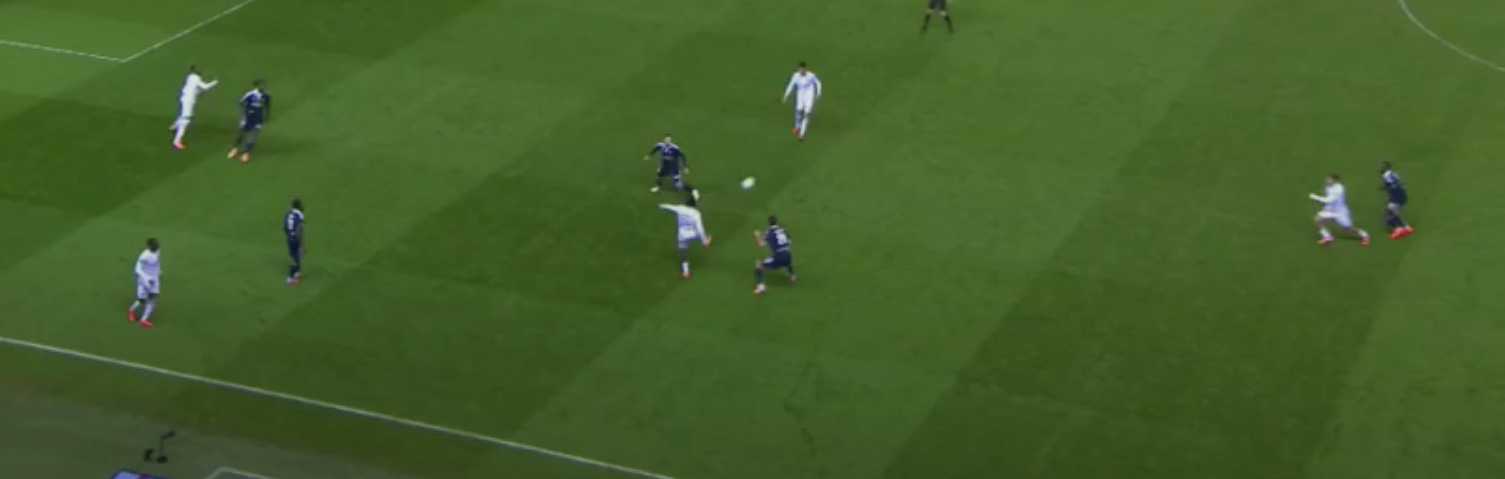
Same when the break lives on with a pass fired to Sinayoko
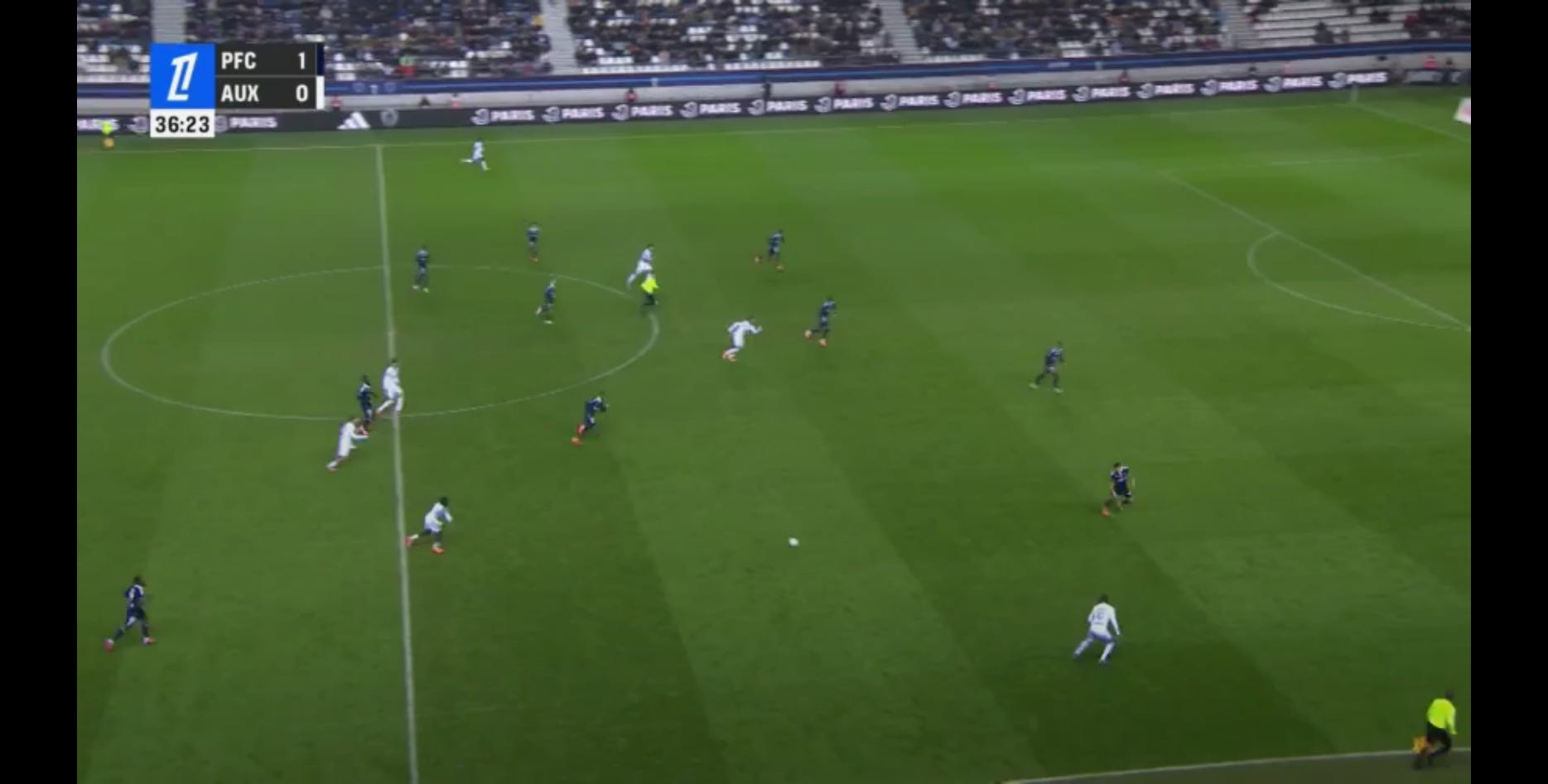
CM overlap in 433 klaxon
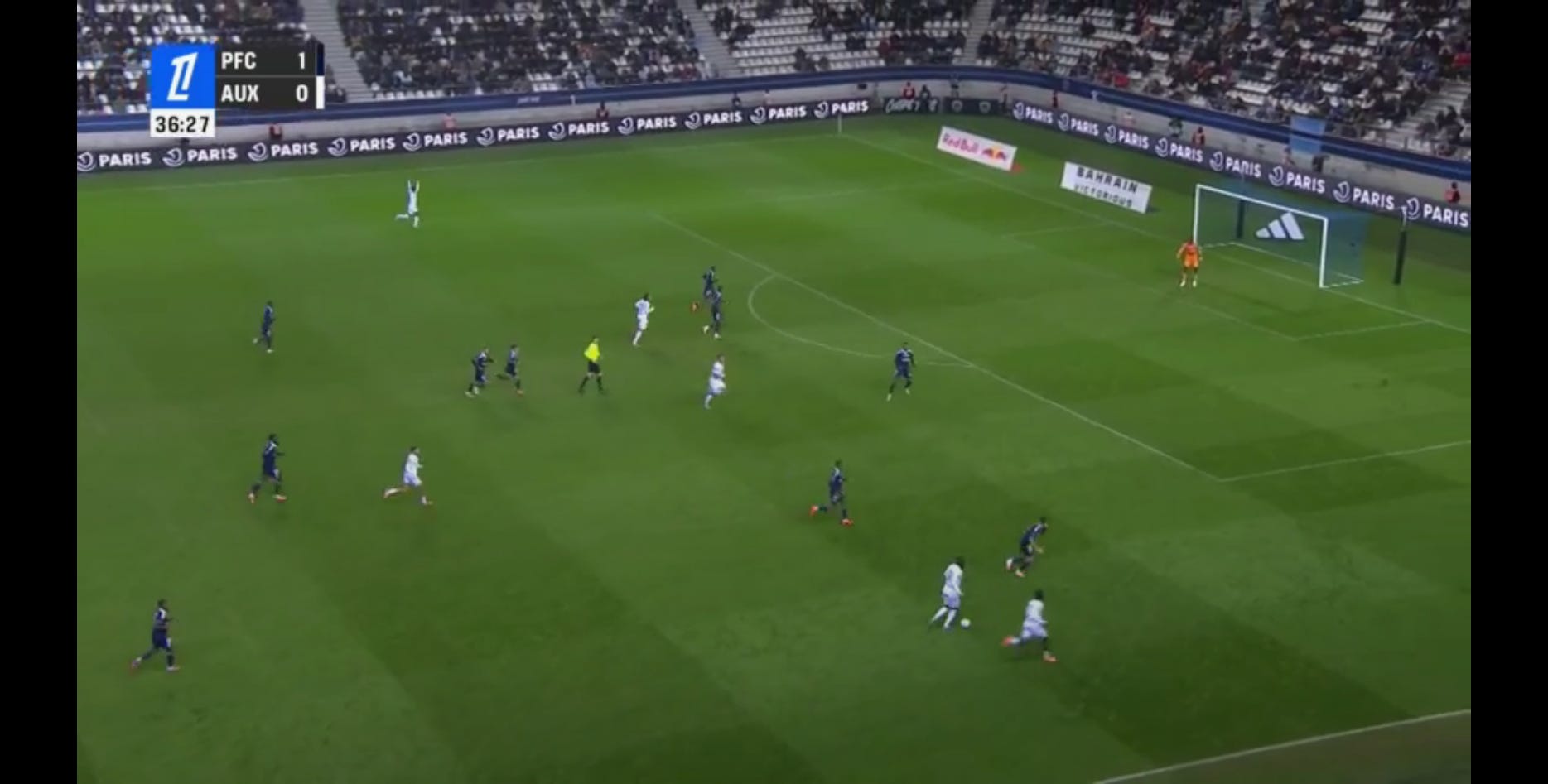
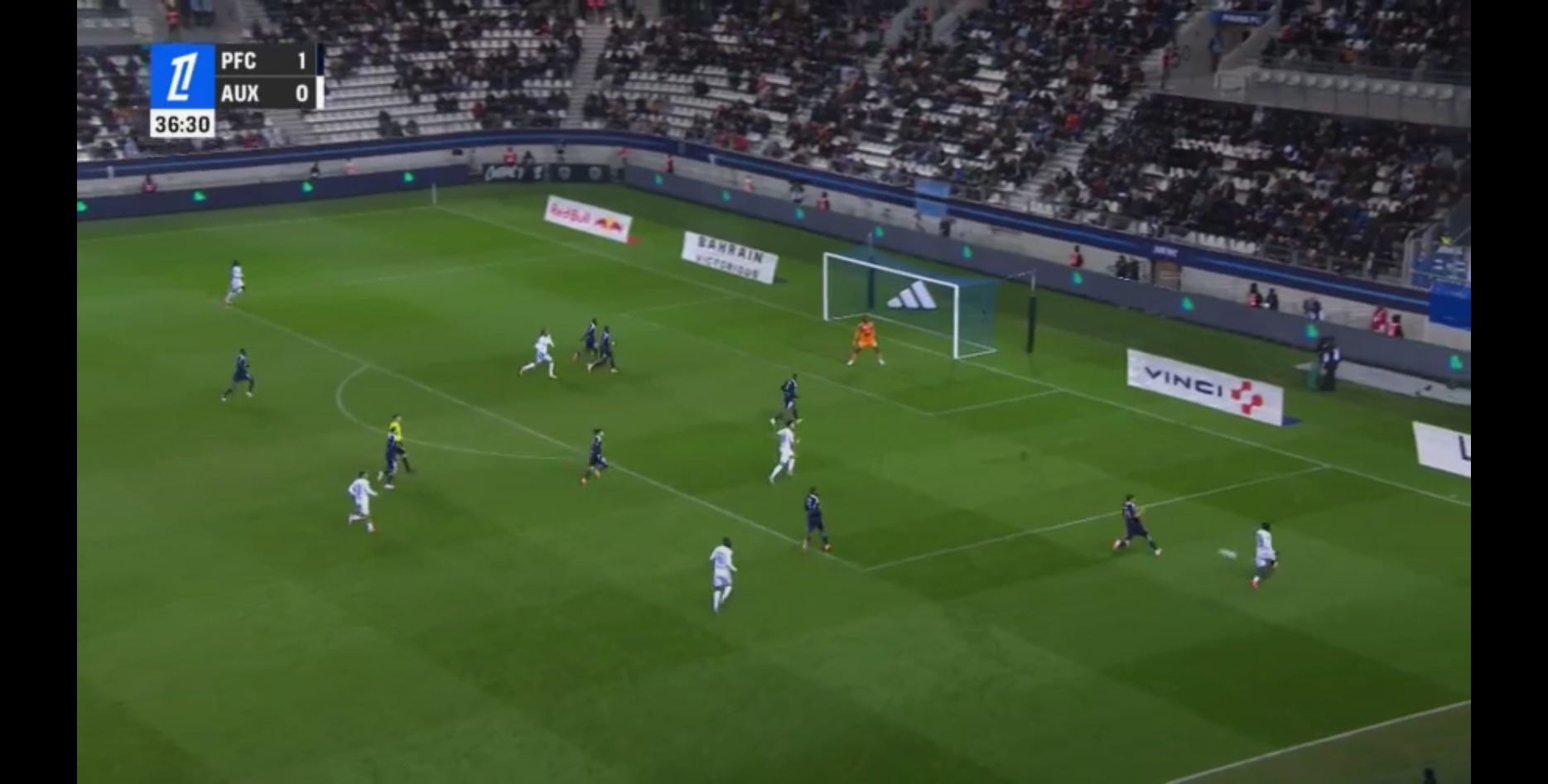
To end up firing a more than good enough cutback cross
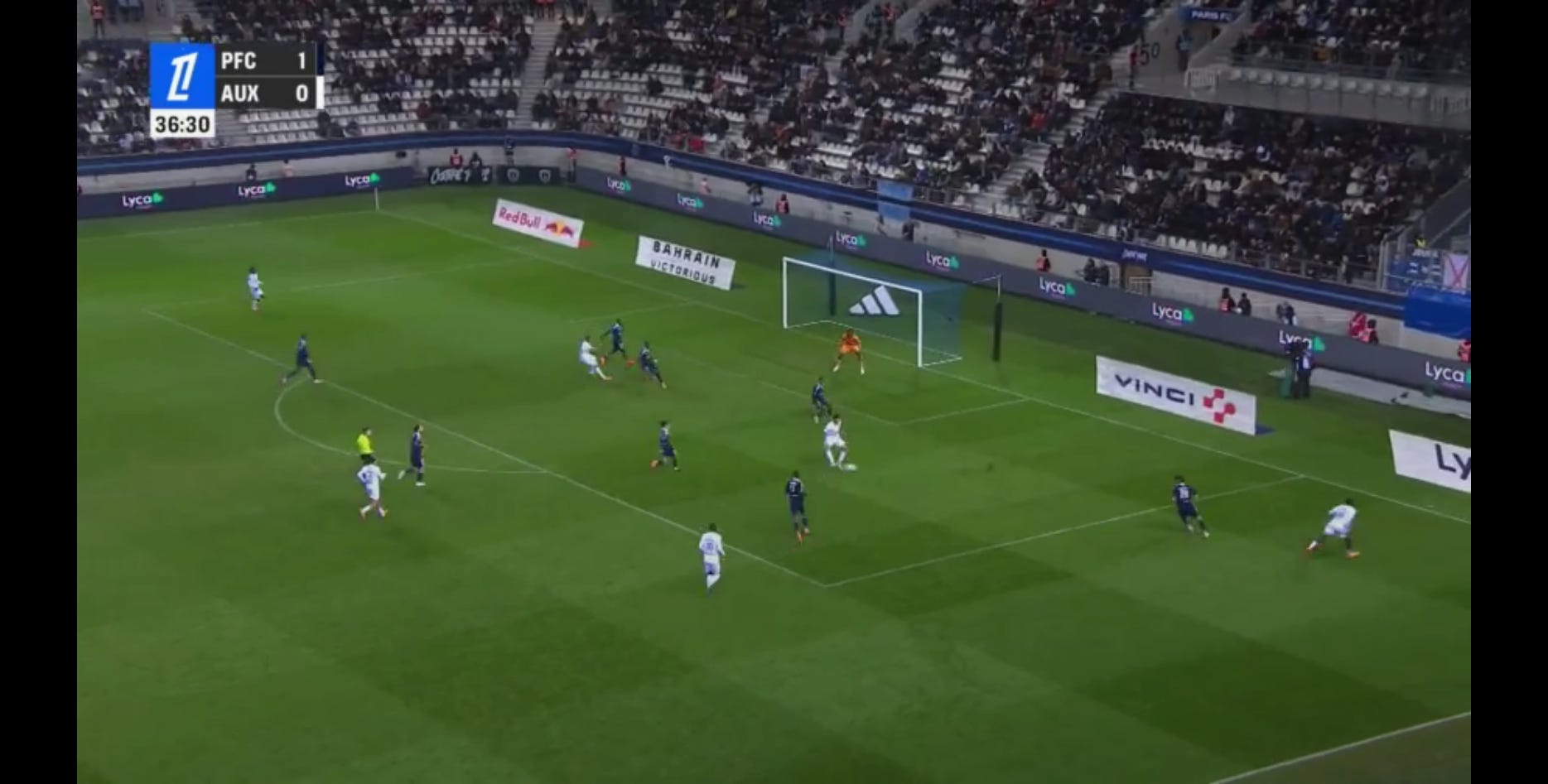
I am not sure yet if Matondo is seen as a CM shunted wide, or a winger trusted to play inside when it comes to the way people perceive his ability.
But that’s certainly worthwhile, in the Ramires tradition.


Force the backpass
Some decent detail
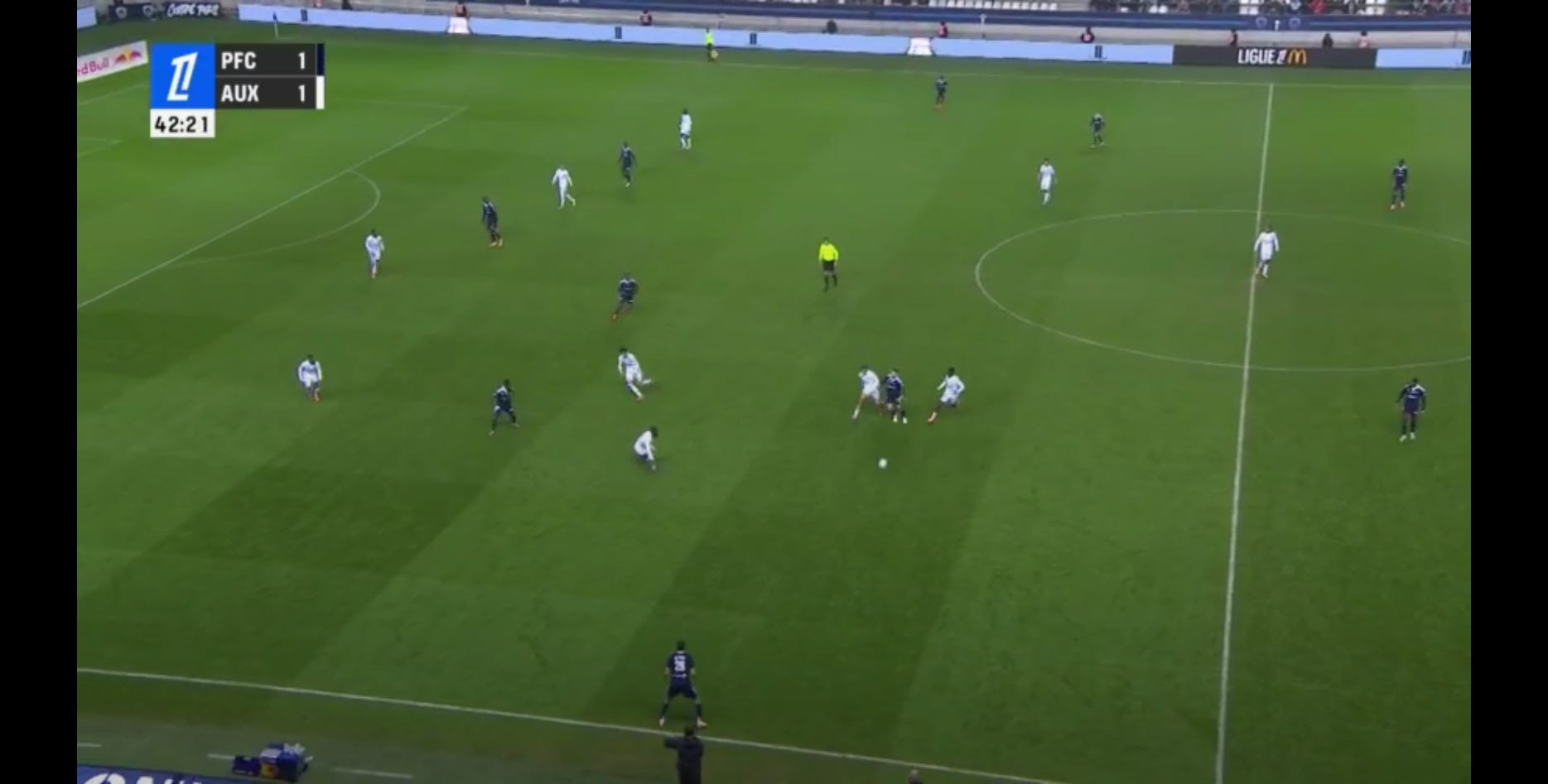
Situational adaptation to avoid getting split and force the backpass
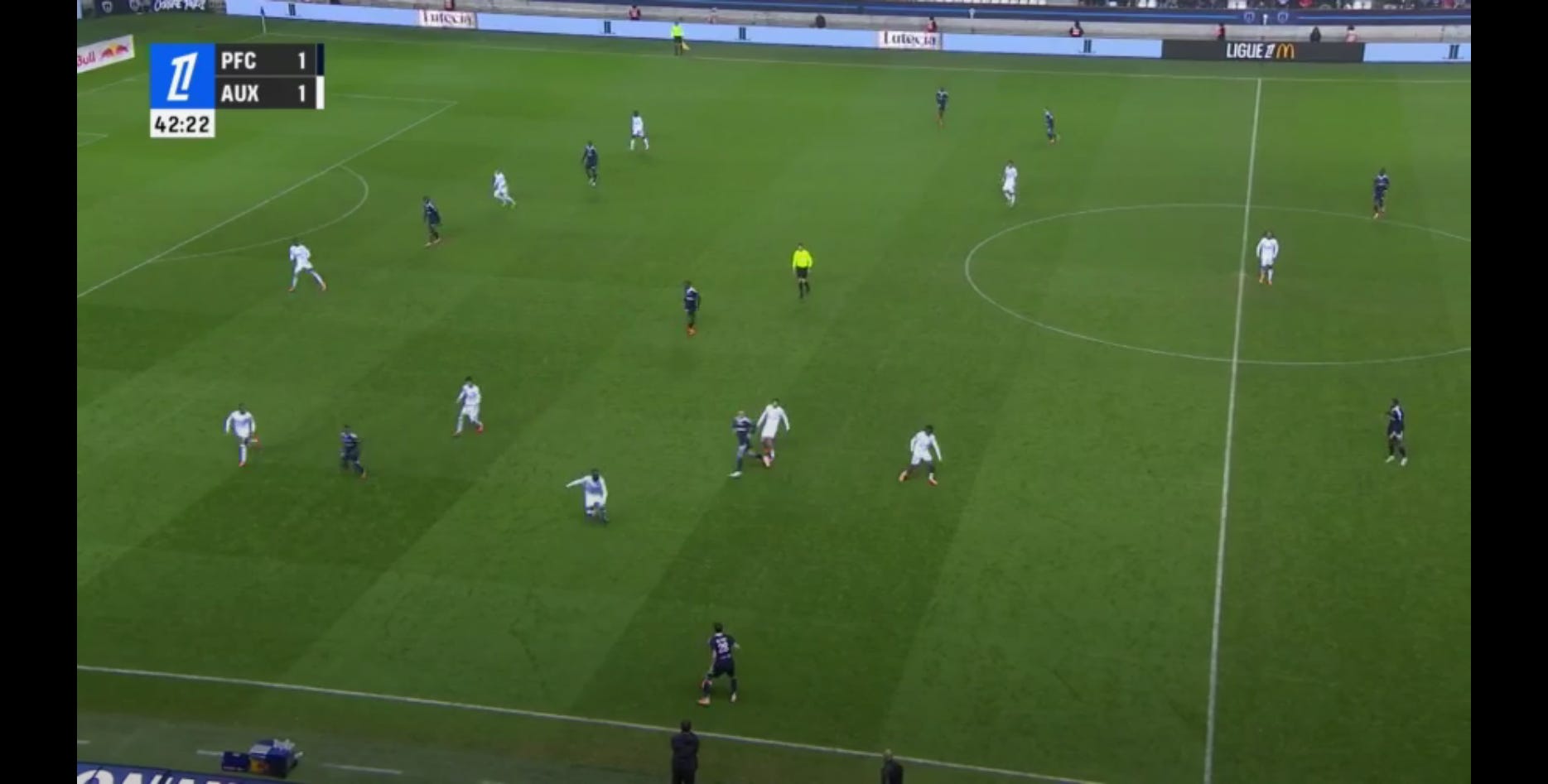
with shoulder angles, so that the team can squeeze up behind him
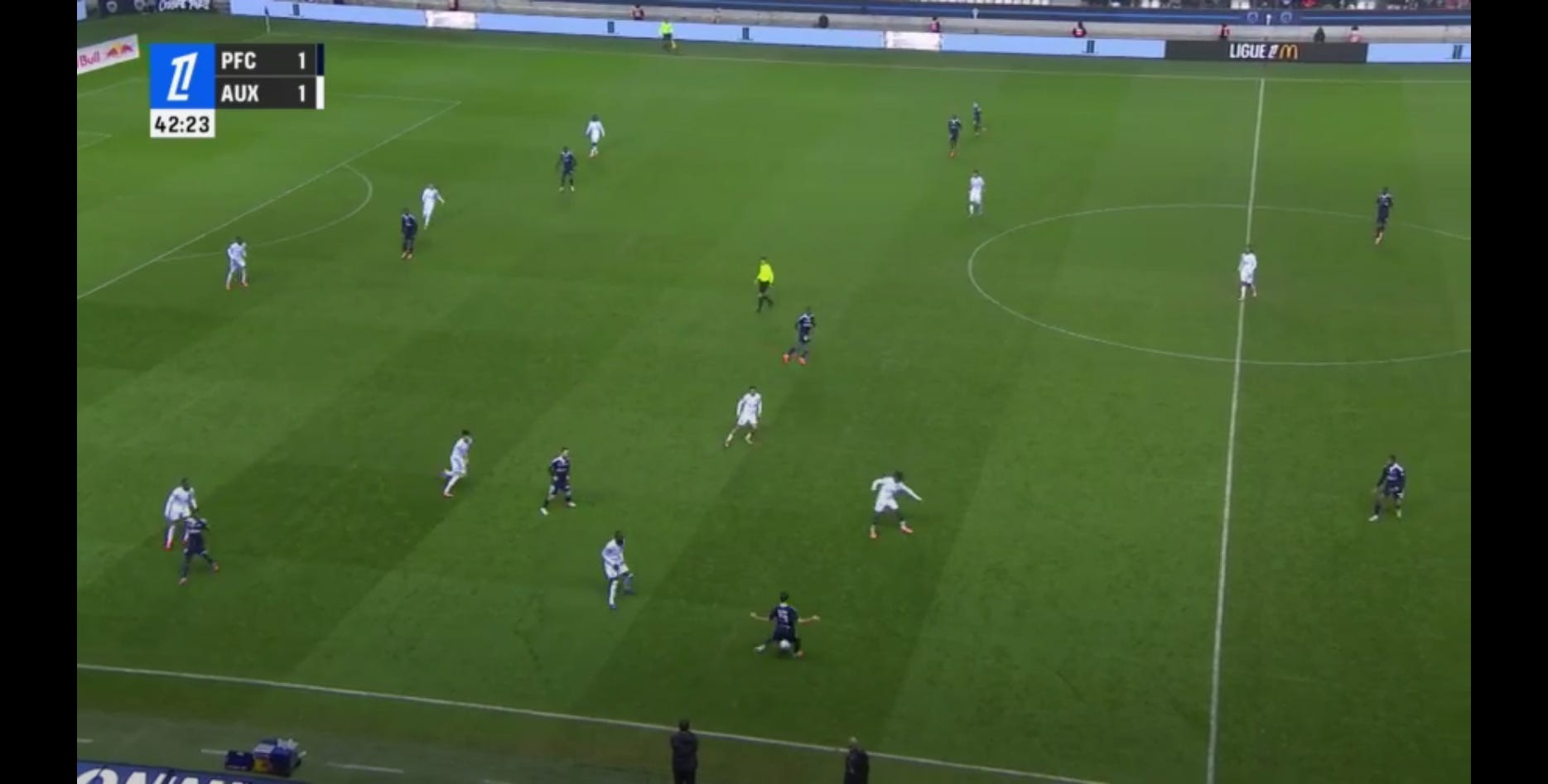
Quick CM
I’m a sucker for speed,
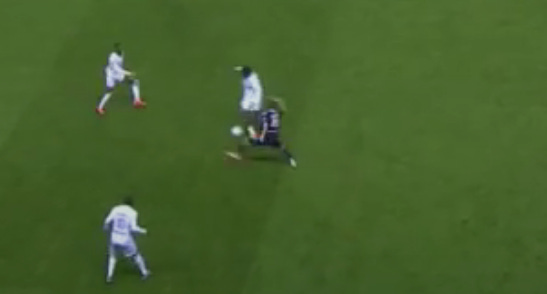
Matondo gets to the ball first, with a double contact
Clip for himself
then chop directly on the rebound.
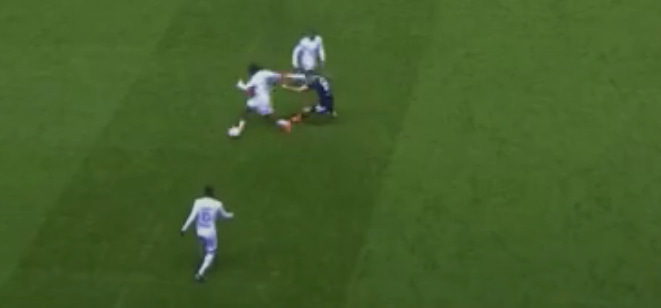
Proper, proper baller’s stuff.
I saw a number of extraordinary players do it, regardless of suface, even gravel football fields.
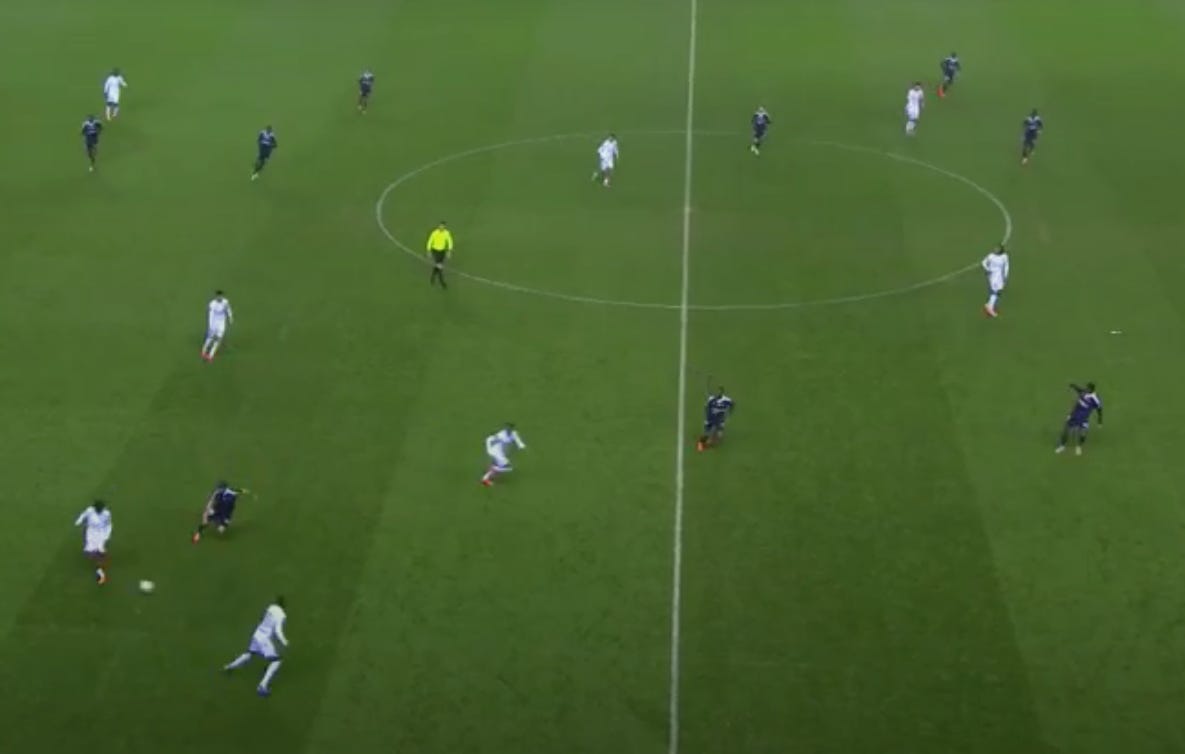
Still not sure about these shafted passes with the backend of the foot, almost the ankle but style meets function and it finds Sinayoko in his path.
And Matondo is left footed, and seamlessly uses his right.
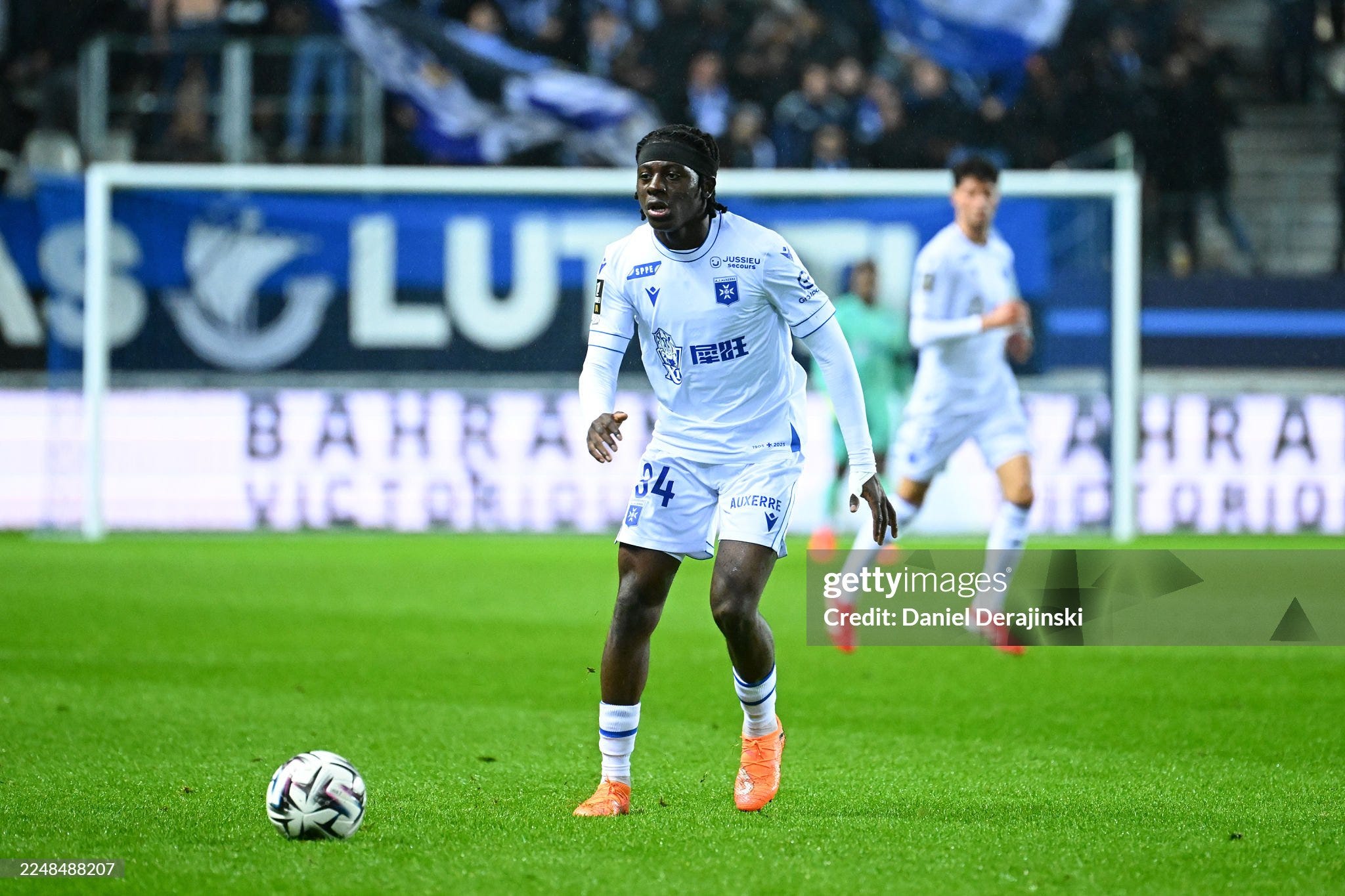
Speaking of,
J+1 was one of the most creative shows I can remember covering any league, and it was created on CANAL+ by the same producer who also liked my work there and also RMC Sport where he moved when RMC Sport had the broadcasting rights to English football.
There was a number of sequences and insight, creating narratives without promoting the clubs, but also expert insight with a Ligue 1 coach as a seasonal pundit. Frederic Antonetti was one of them, and he’d deliver a two or three minute sequence analysing a recent performance from the guest - an active Ligue 1 player


Form meets function : complex doesn’t mean complicated, and genius lies in simplicity. No one talks like tacticos, because the key was to get a message across through three prisms.
The Ligue 1 coach would re-shape his image - Corsican Fred Antonetti was often seen as the epidermic fireman, yet lasted longer than many others at OGC Nice but also Stade Rennais, and coached Gana Gueye in the mid 2010s, then Pape Matar Sarr in the 2020s after being the man behind Michael Essien’s rise at SC Bastia in the early 2000s. His years on TV changed his perception, and recently was in charge of RC Strasbourg where he coached Habib Diarra.
The player would need to grasp the key idea from a video sequence
And the TV audience, obviously niche since the show was at 10pm on Mondays ; couldn’t be walked through an unwatchable buzzword filled masquerade of video analysis session.
It might have been Morgan Guilavogui at Saint Etienne over a decade ago now

One of the points mentioned was a straightforward : “if there’s space to attack in front of you, fill it”
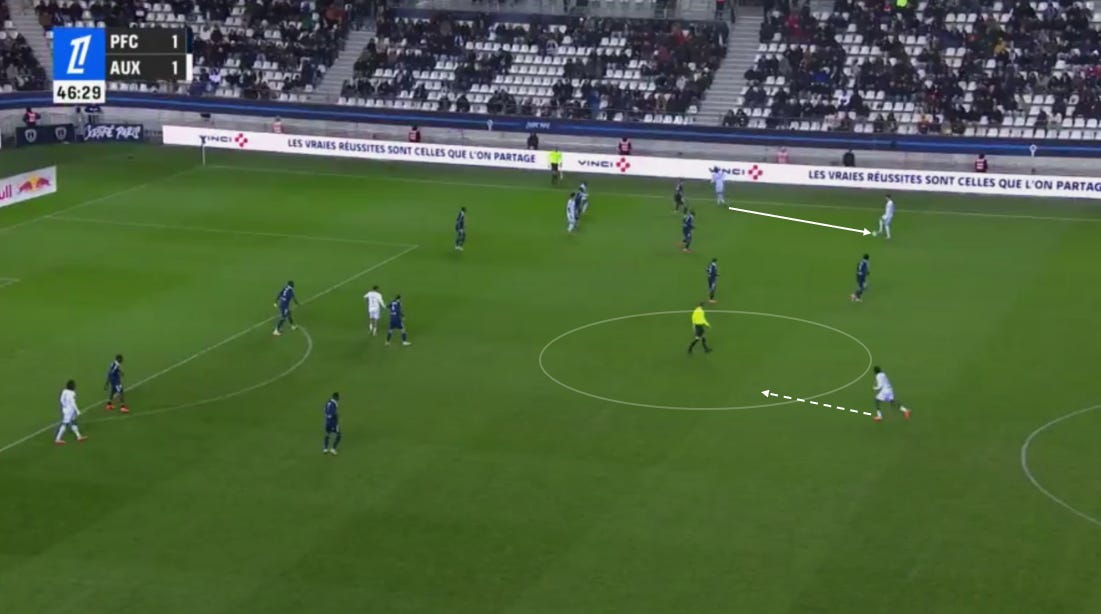
RM spreads the ball wide since he’s left footed.
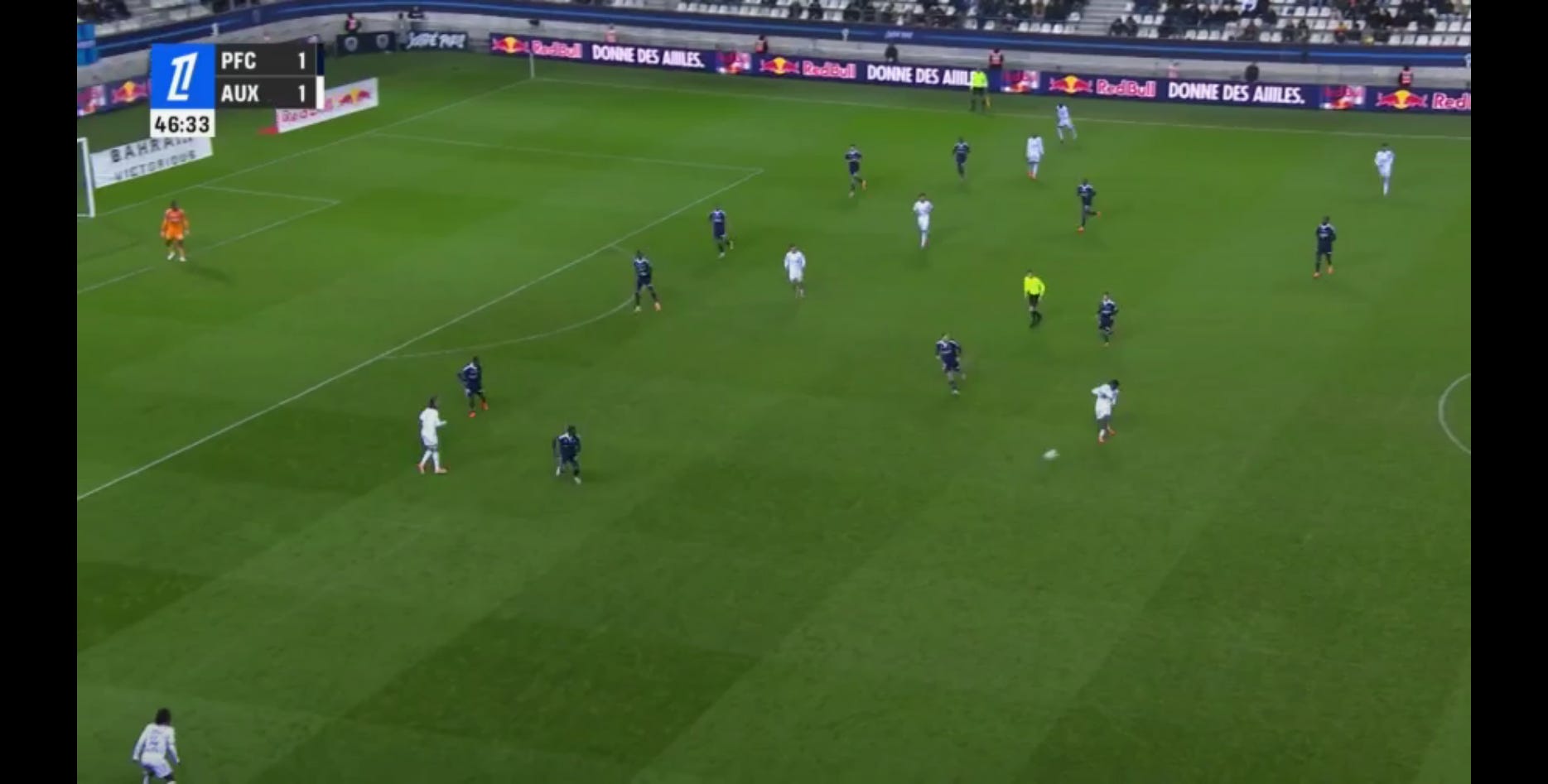
The organic nature of the game won’t change, there’s lots at stake, meaning players who are under pressure will often treat the ball like a hot potato and get it closer to the opposition’s goal.
PFC’s defender volleying the ball back (ideally you aim at the space between CBs and CMs)
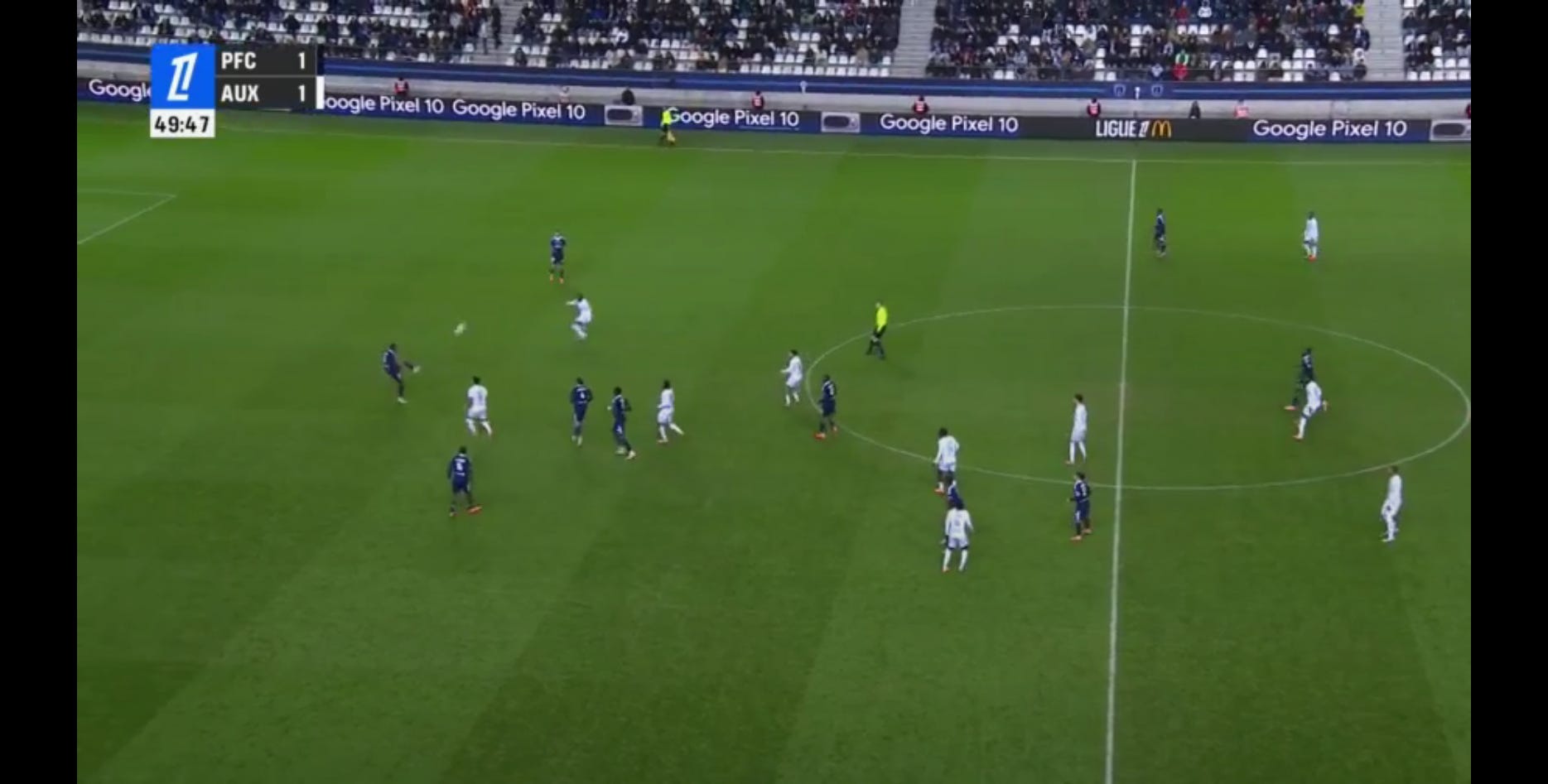
RM is on the move when the ball is in the air, seems straightforward but two caveats
Academy players often don’t do it, unless they played in open pro/rel league systems
Ballers can’t be bothered, because they’ll wait for the ball to reach their feet
usually it’s a mental switch I’ve noticed, that at some point ballers will conform and chase up second balls because that’s their chance to get on the ball more
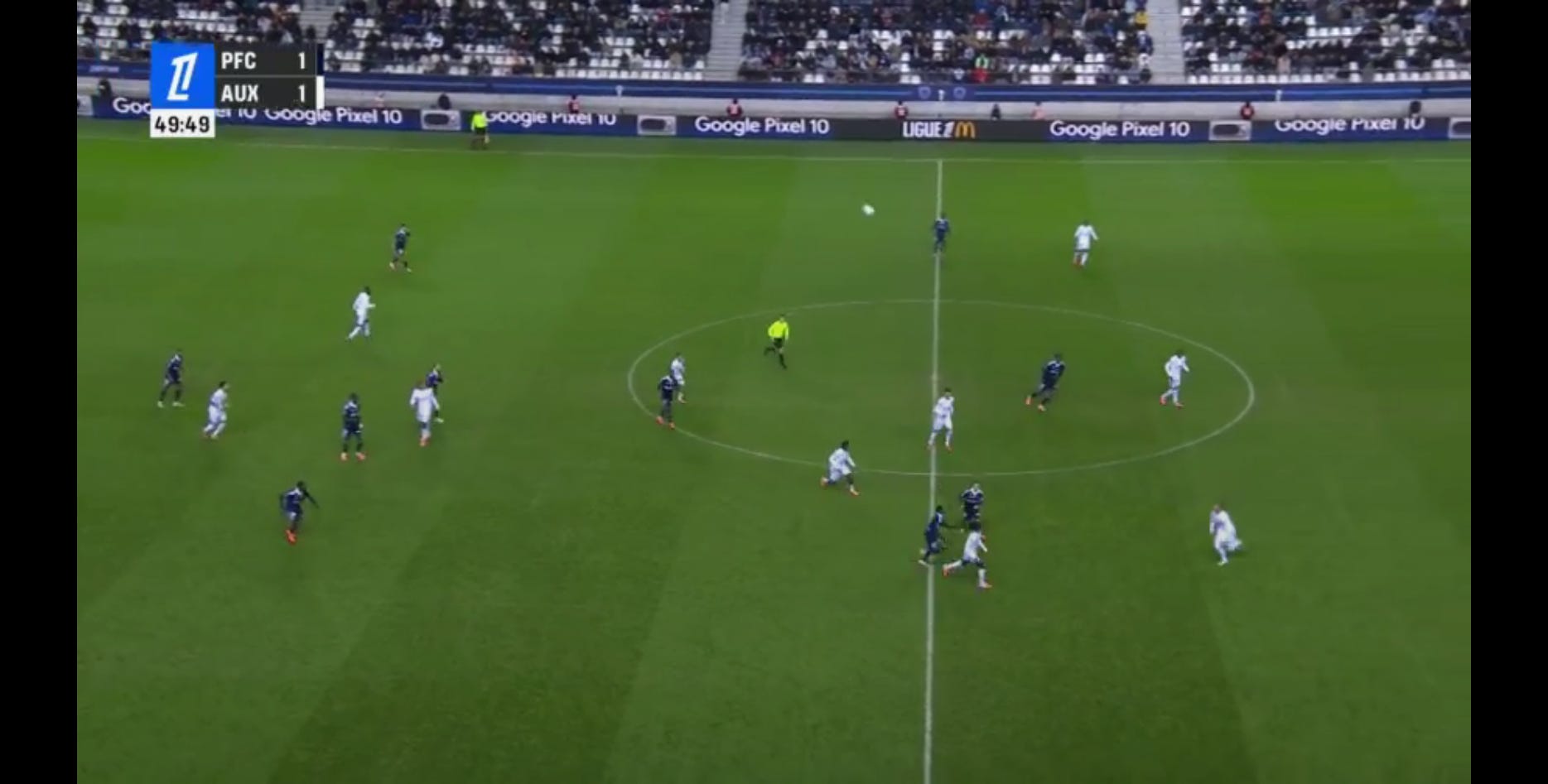
The ball is somewhat booted (or hit with the soles)
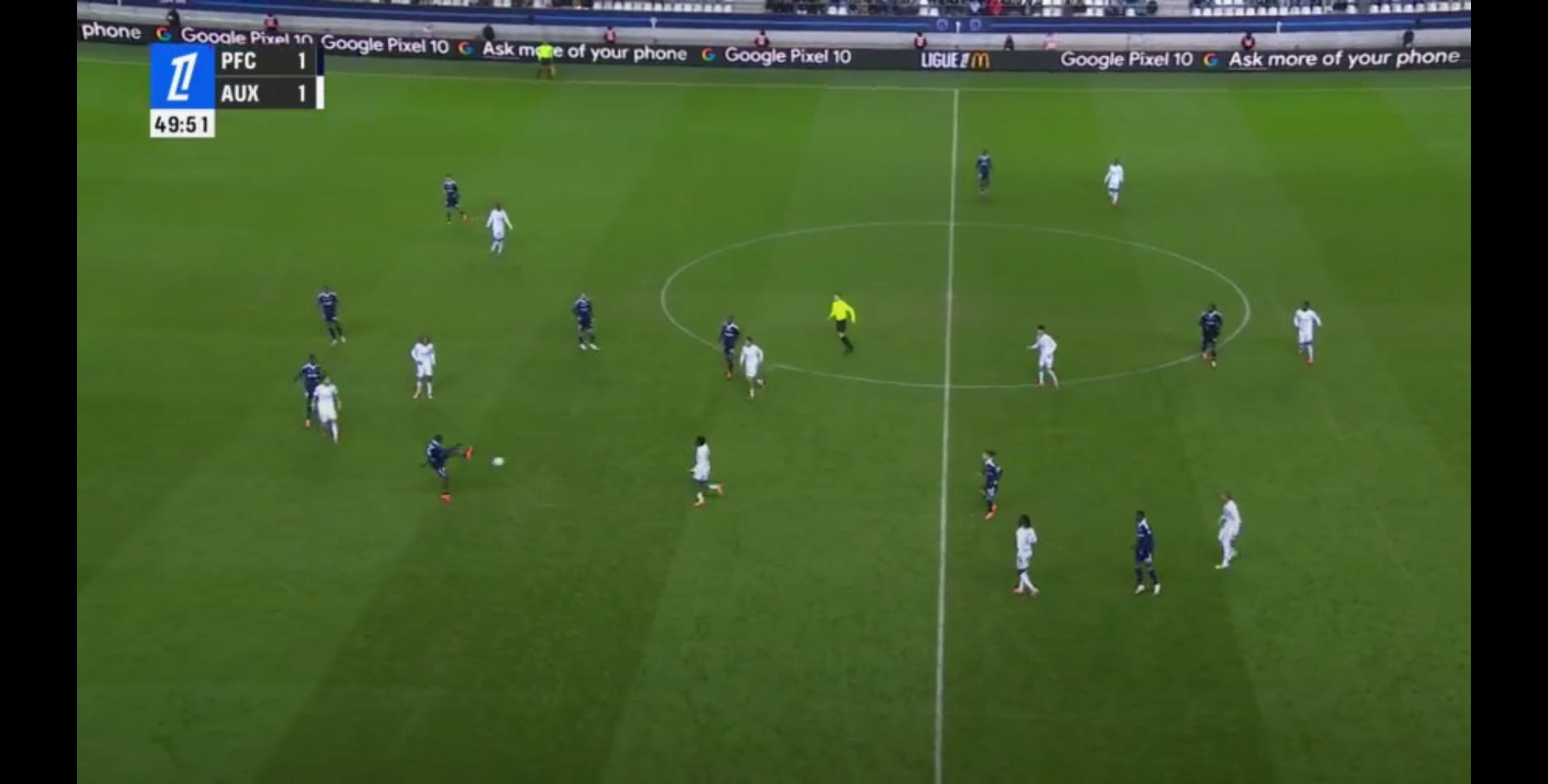
Matondo reaches first
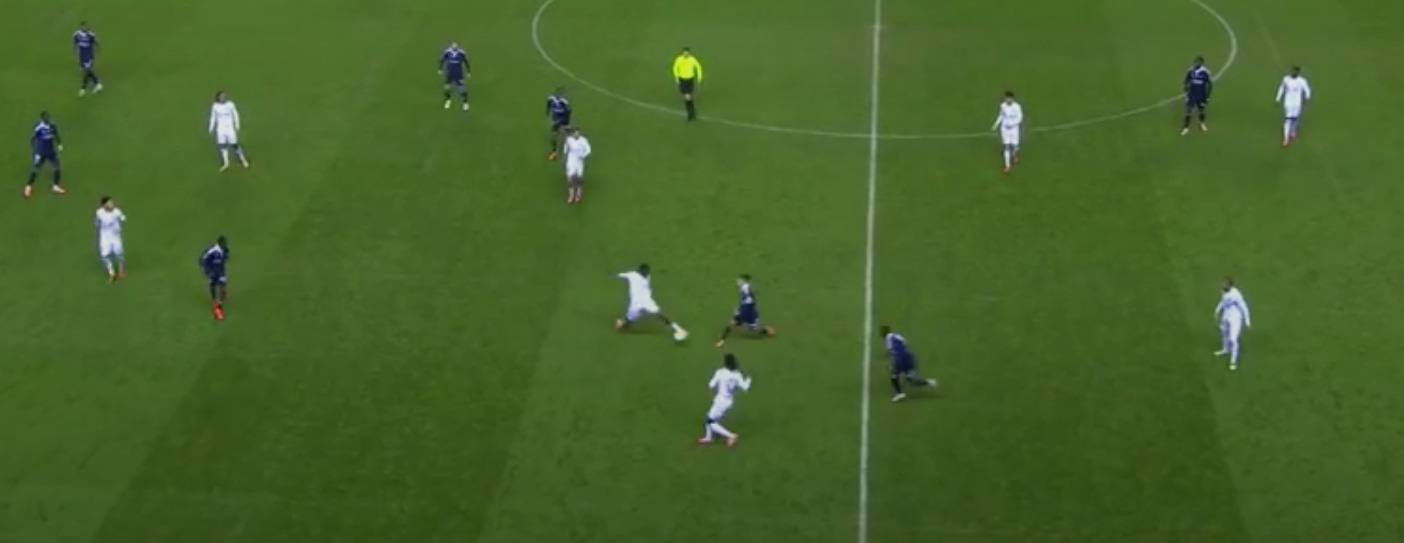
Then chops again with his right
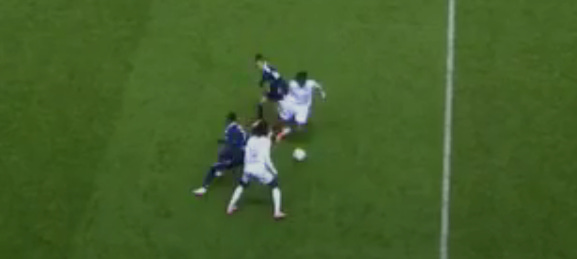
To get out of pressure
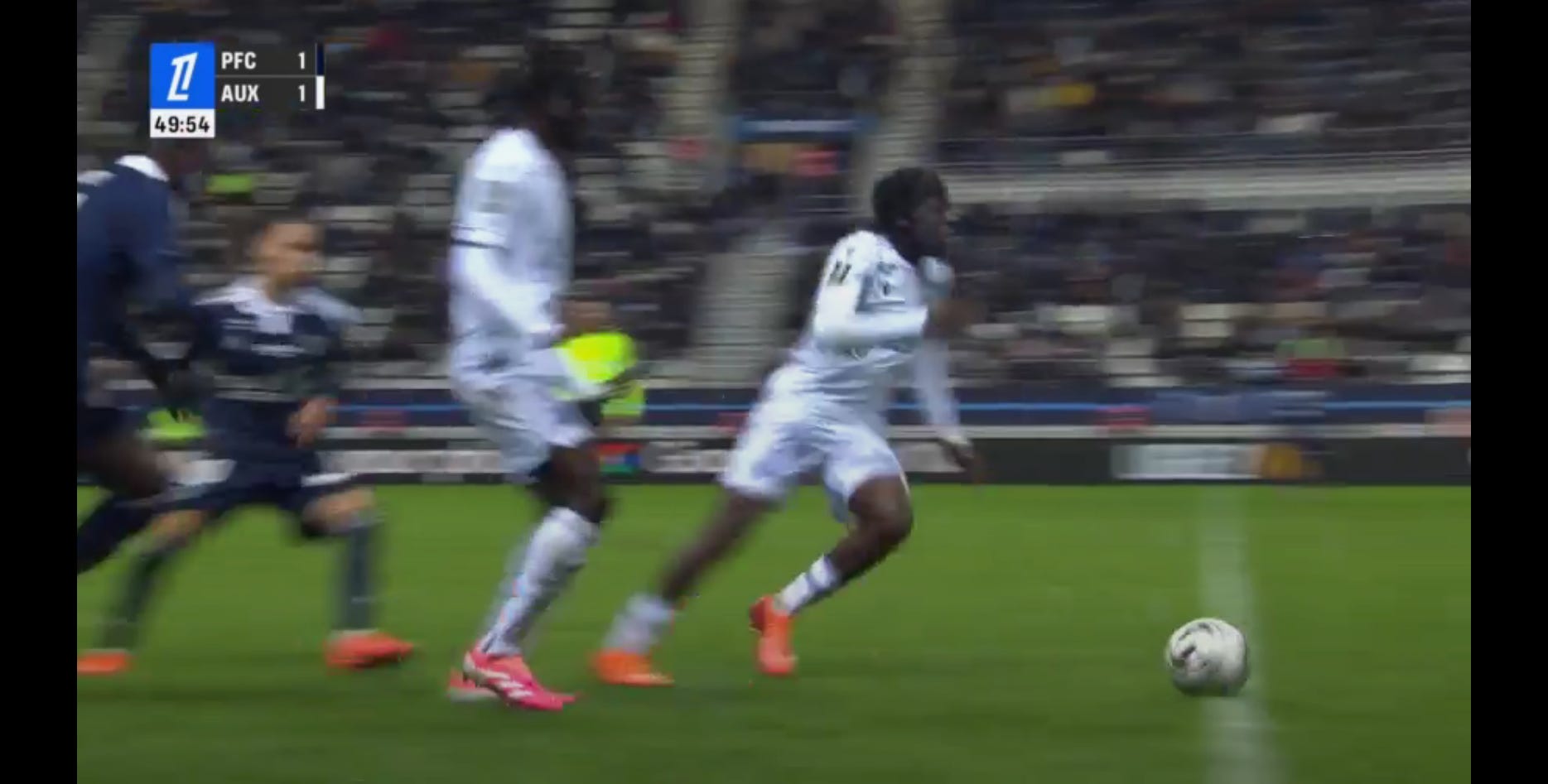
These players are called “washing machines” for their ability to clean up uncontested possession to give a good pass.
They’re valuable transition players, in any team in the world.
That’s one of the things I like with wingers / wide players inside, they can feel there’s gonna be an opportunity to overlap and provide support.
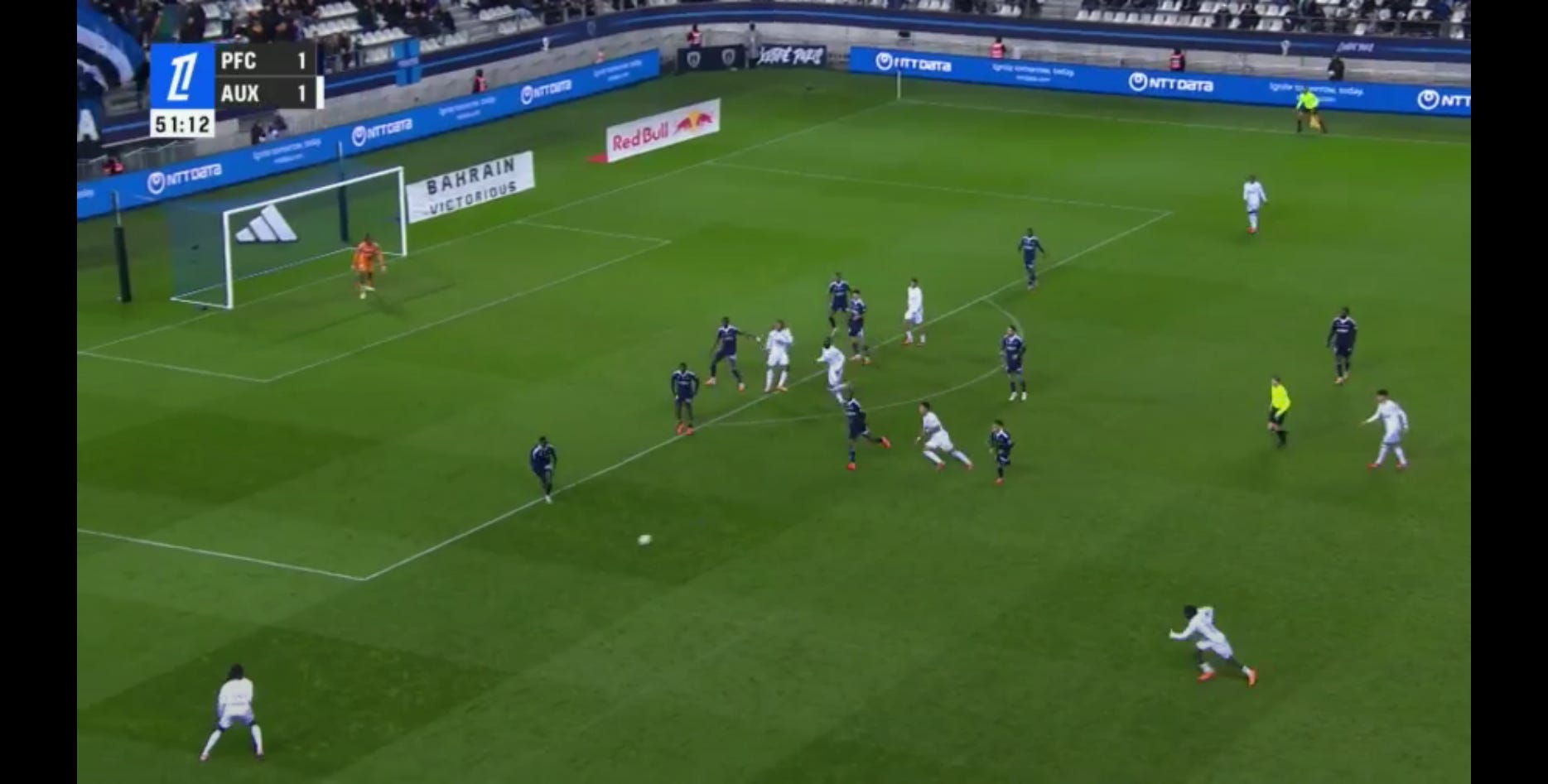
Closer to the edge
What if … same thing … inside ?
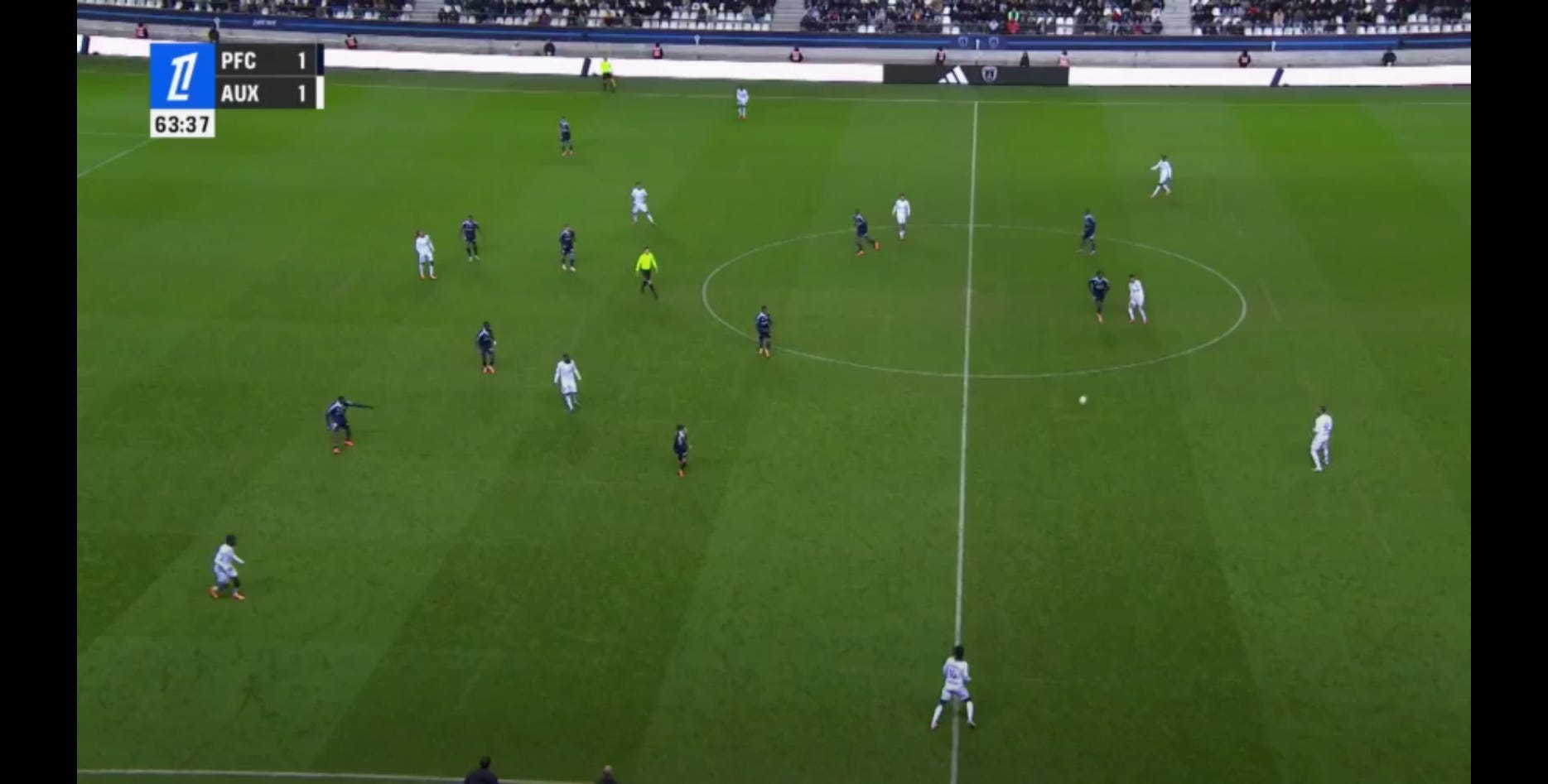
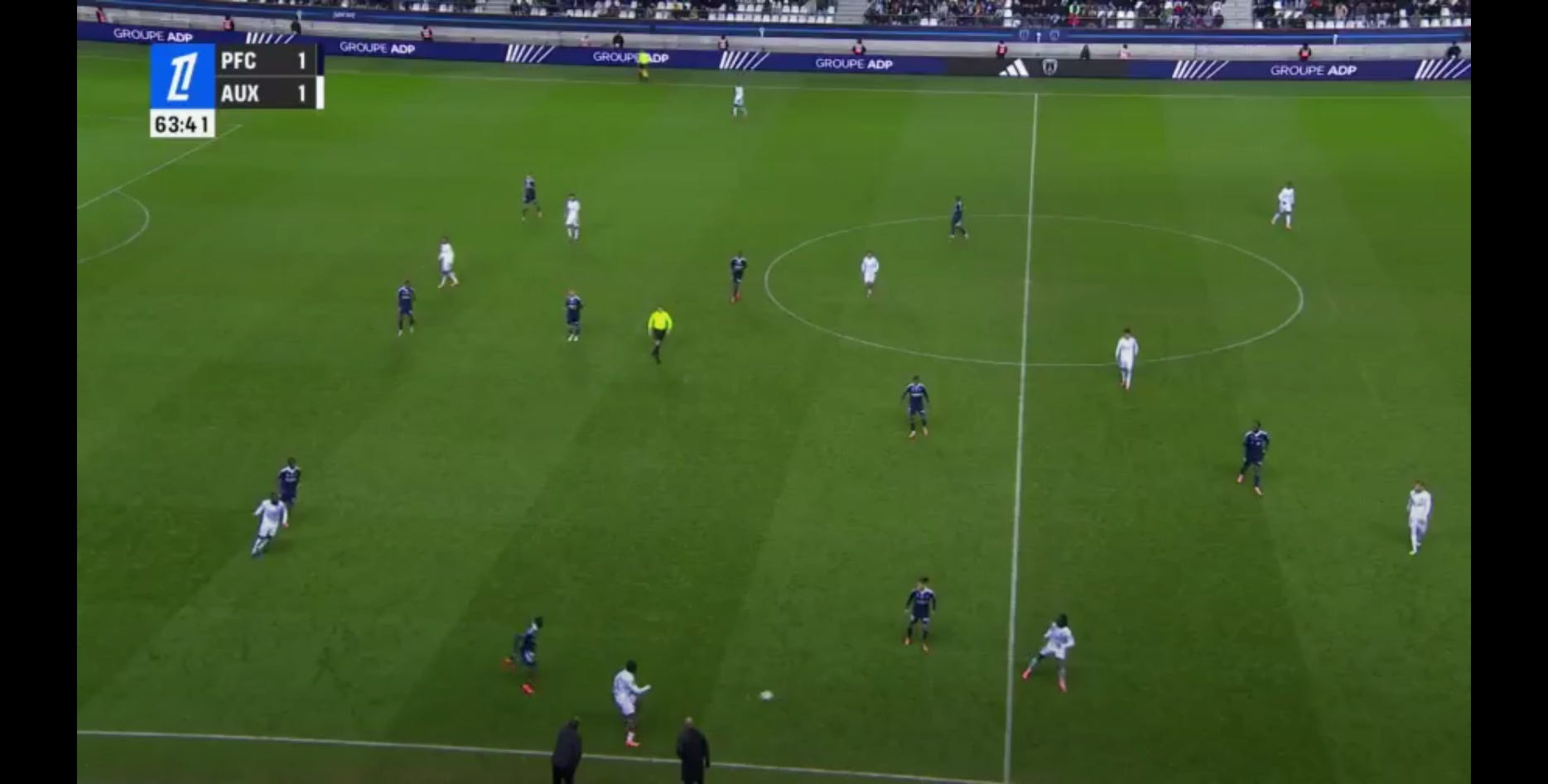
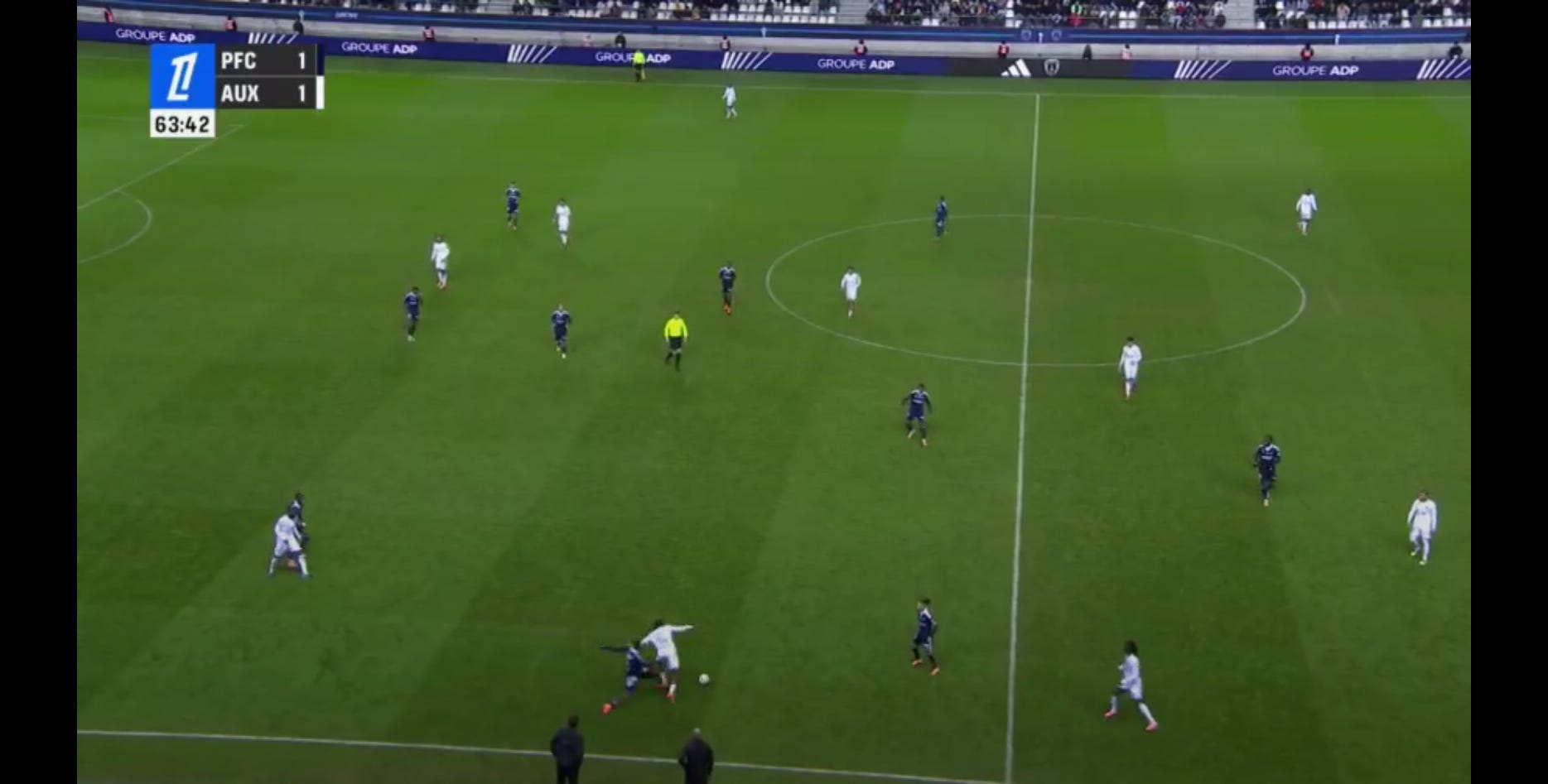
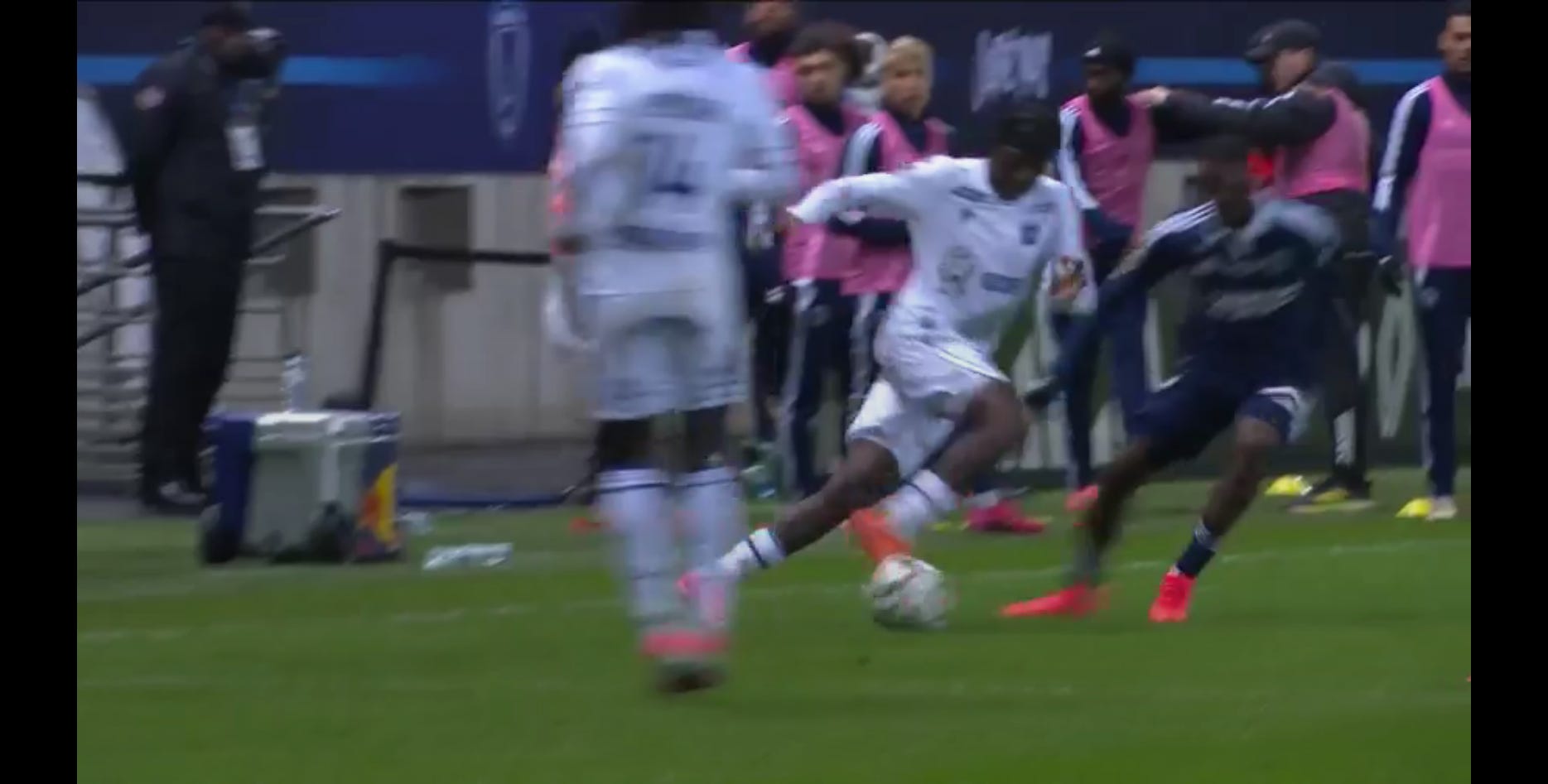
Rolling out as a decoy
Not every instance of “rolling out” = starting from central position, and opening up towards the touchline aims at receiving, but sometimes create a problem for the other team caught in two minds.
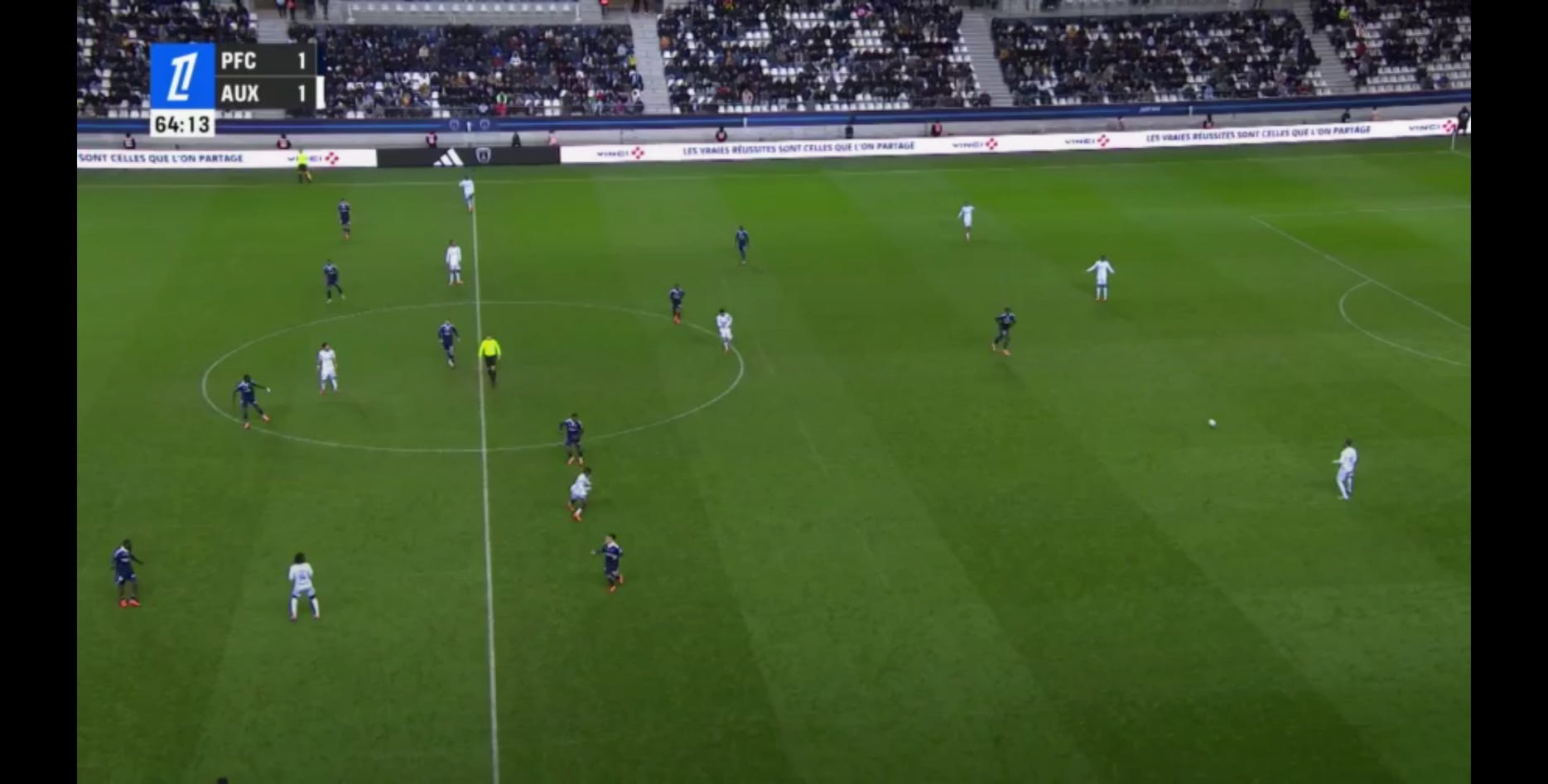
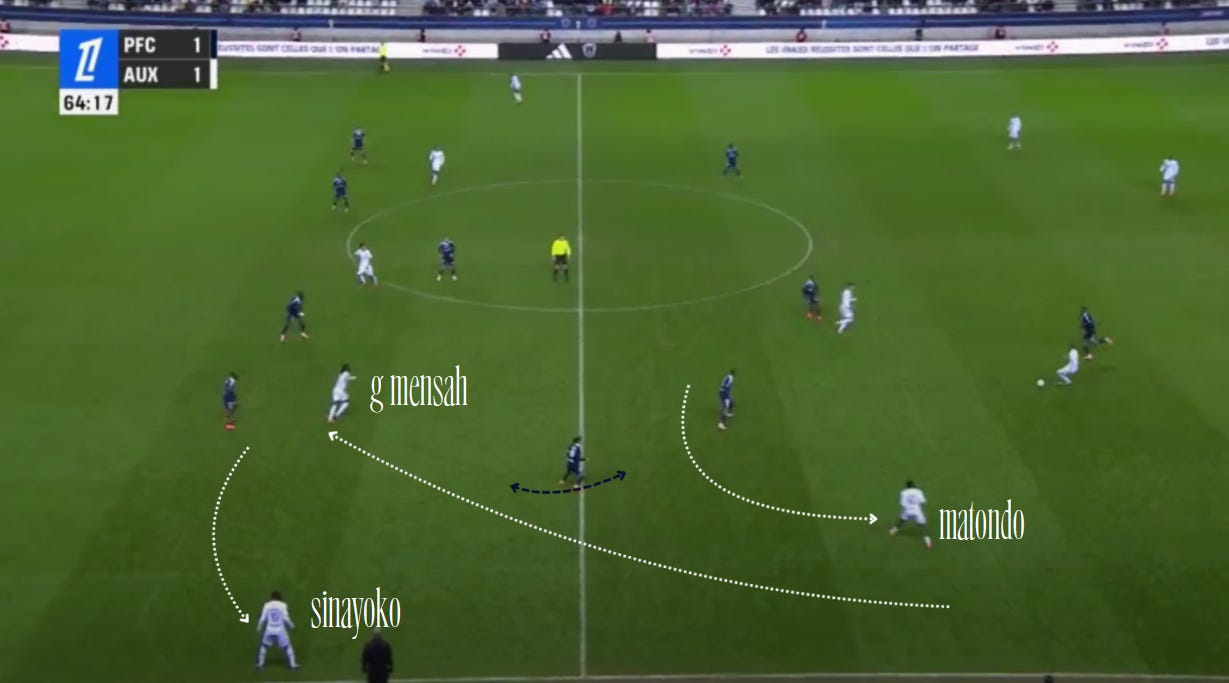
Duh, what now - he stayed behind
Right, with LW LB in final third and Namaso (Michael Olise’s mate from Reading U21s), Matondo controls the channel to prevent the transition to unfold here.
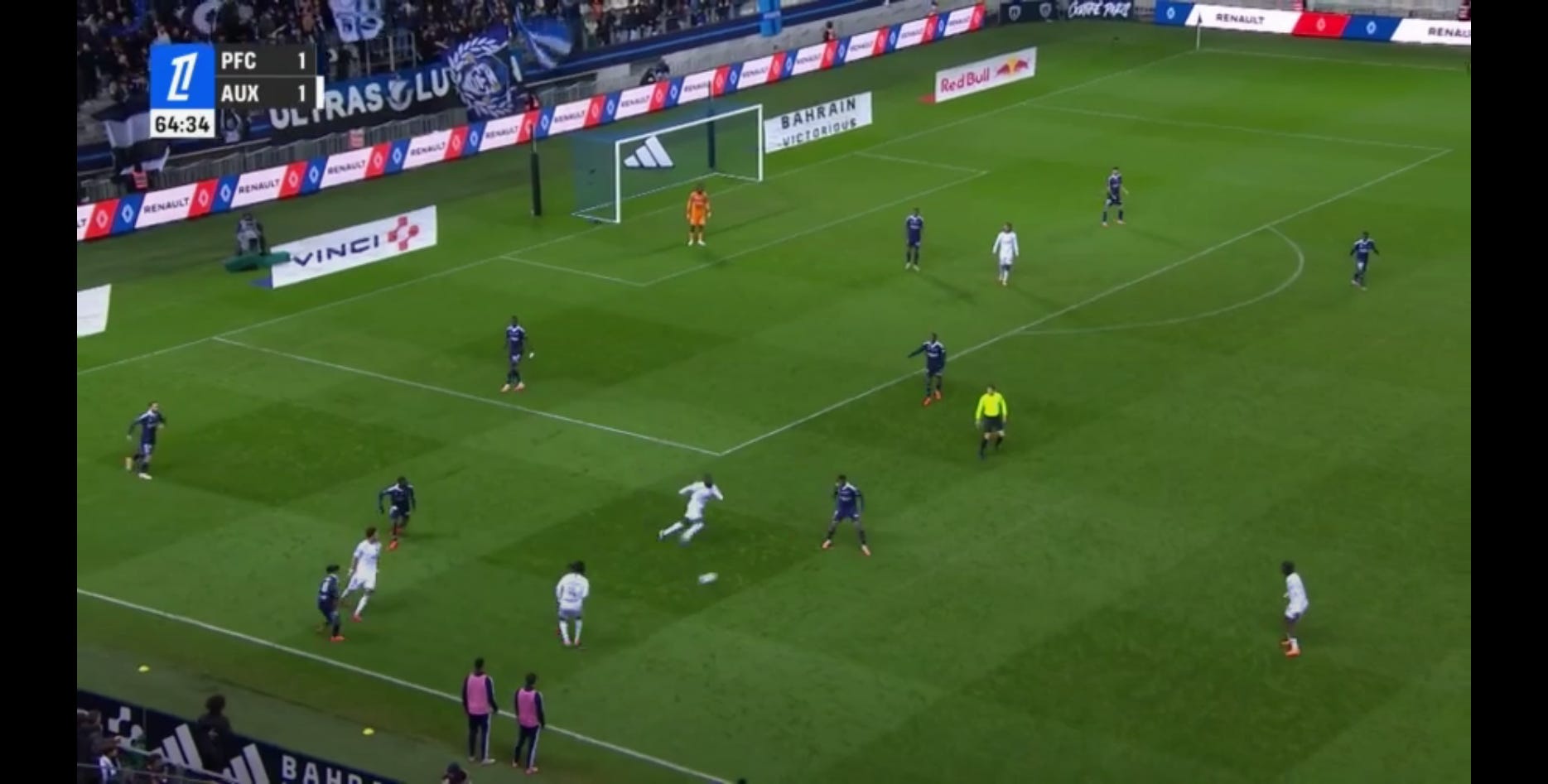
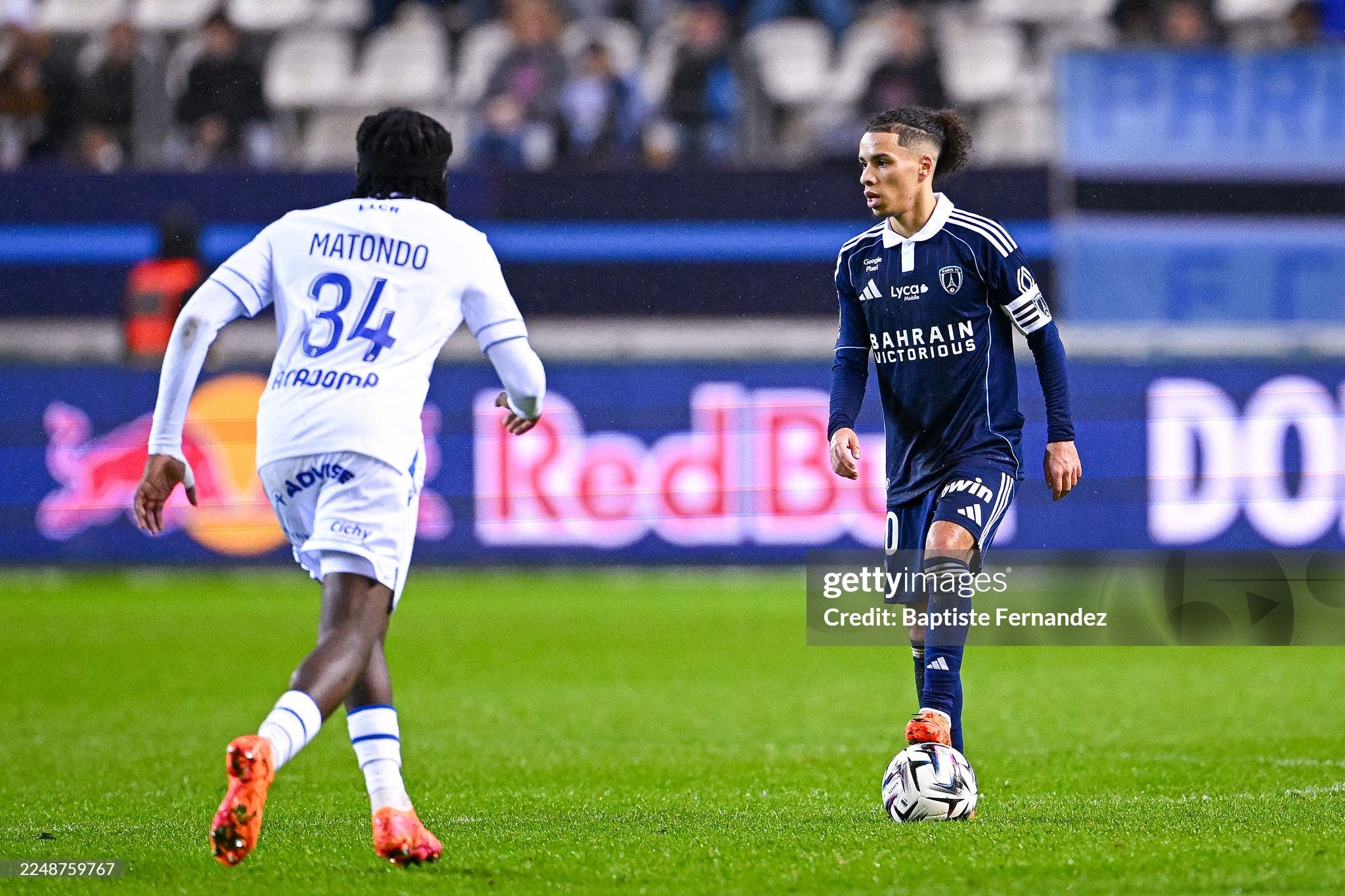
How to improve central midfielders
Seb if you’re so good, why don’t you walk the talk.
Yes I will, but making sure I get goalside first.
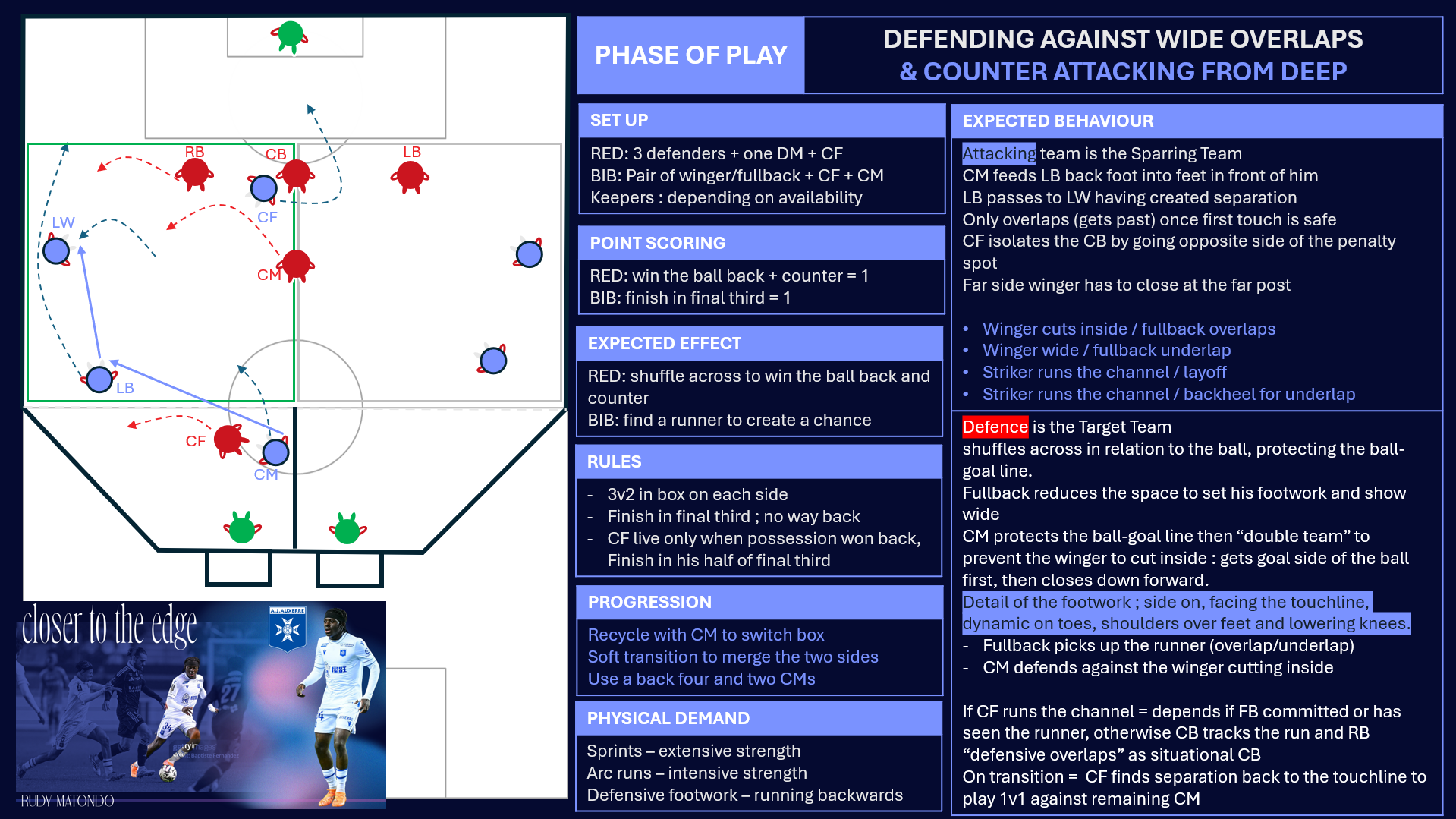
The drill is symmetrical, and can be adapted.
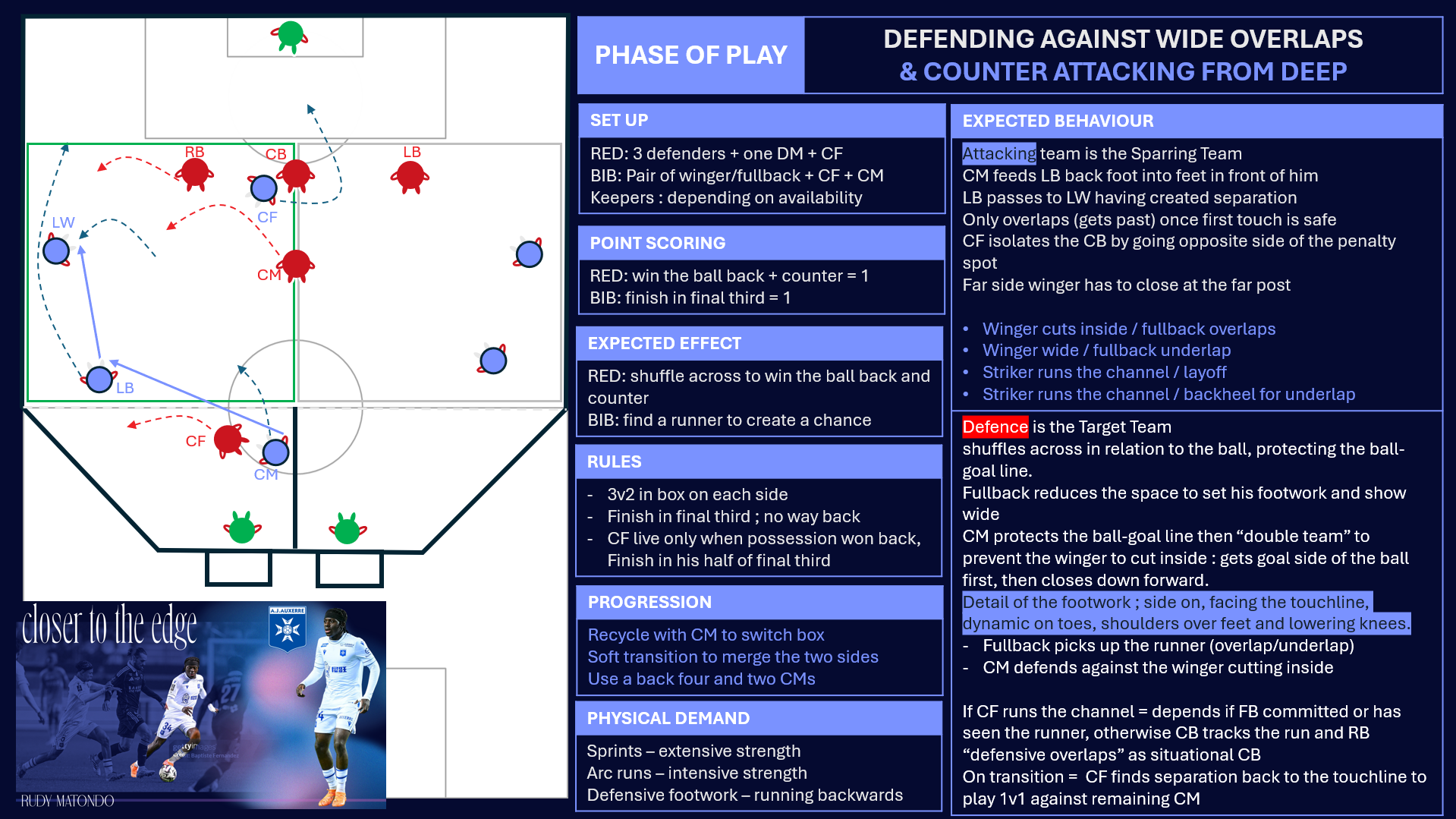
The base here is 12 + keepers ; which is relevant to every level.
Then obviously, you can add more CBs, more CMs, more people to break away. Can, also have two wingers per station to make sure they get relevant recovery time.
Can organise having enough coaches to make sure every start happens with no delay.
The general idea of these practices are “phase of play”; therefore you play an identical start to make similar situations occur.
Here, I want the defensive shape (the target team) to find solutiuons to defend the attacking team’s rotation (they’re the sparring team)
The target team shall not be constrained beside by the laws of the game (and gravity) - the sparring team however can be incentivised or encouraged to create different kind of problems, they’re listed in blue, exploring every type of underlap / overlap and combinations with 3 players they can think of.
Ideally, you don’t tell the sparring team to create Problem A then Problem B then Problem C ; but rather let them produce them in a random order
This is how you implement non linear pedagogy and learning : and how you create long lasting neuronal connections.
This is presented as a coaching course didactic drill, this is how you work on it. The art of coaching isn’t to know the didactics, or session design.
A fraction of coaching courses cover learning theory, and session design. Any qualified UEFA A license or UEFA Pro License can design a learning situation.
The key is how you empower players to find the solutuions without handing them over (there’s a good chance the bag of goodies you were given on campus in the first day at University is somewhere in your drawer - they give you laundry, a can of redbull, a bag of dry nuts, a pizza voucher and whatnot - thought as a “start pack” but there’s a good chance you didn’t use any of it yet. Will do tho)
Then also generate identifiedn learning moments, whilst guaranteeing the intensity. Players can’t stand the game being stopped every two seconds for the coach to listen to himself.
ideally, there’s two coaches ; and the two sequences run back to back, and the coaching feedback is given during the recovery time. If two are co-lead coaches, they can do the same thing, or one can guarantee the sequence runs, the other one moves to the other vertical half
"Finishing in end zones” guarantees players get on, with it and shoot at goal
What if I have 3 ; 2 ; 1 ; or 0 goalkeeper.
Here, there’s an opportunity to use 3 GKs with one goal and two mobile goals
3 : as presented here
2 : two goals
1 : the trick is to not give too much to one team, and nothing to the other.
Attackers attack, they can attack an empty goal. Finish off a volley, first time, back of the net, hit a bib in the net etc, assist and finish one touch…
Defenders however, need an incentive. Not stop ball, eradicate that PE shit out of training. Mini goals possibly. But if you have one GK, make sure the defender transition to attack his goal, therefore they will actually defend and not cosplay holograms at the Rio Carnival.
When the session goes on as intended, you will want to remove the right/left halves, and you can do it seamlessly when it makes sense. That play doesn’t, stop and start again ; walk if you score, run back if you didn’t.
Obviously use flat markets
And when it makes sense to switch play, allow it. lllllllow it
Final third is merged, so that the winger crashes the back post whatsoever.
S&C and physical conditioning meeds game demand.
The target player is obviously the red CM here, who has to make sure to stay on toes, close down in the right timing
And do the U run to get goalside and manufacture space to close down in front, whilst preventing the winger to cut inside.
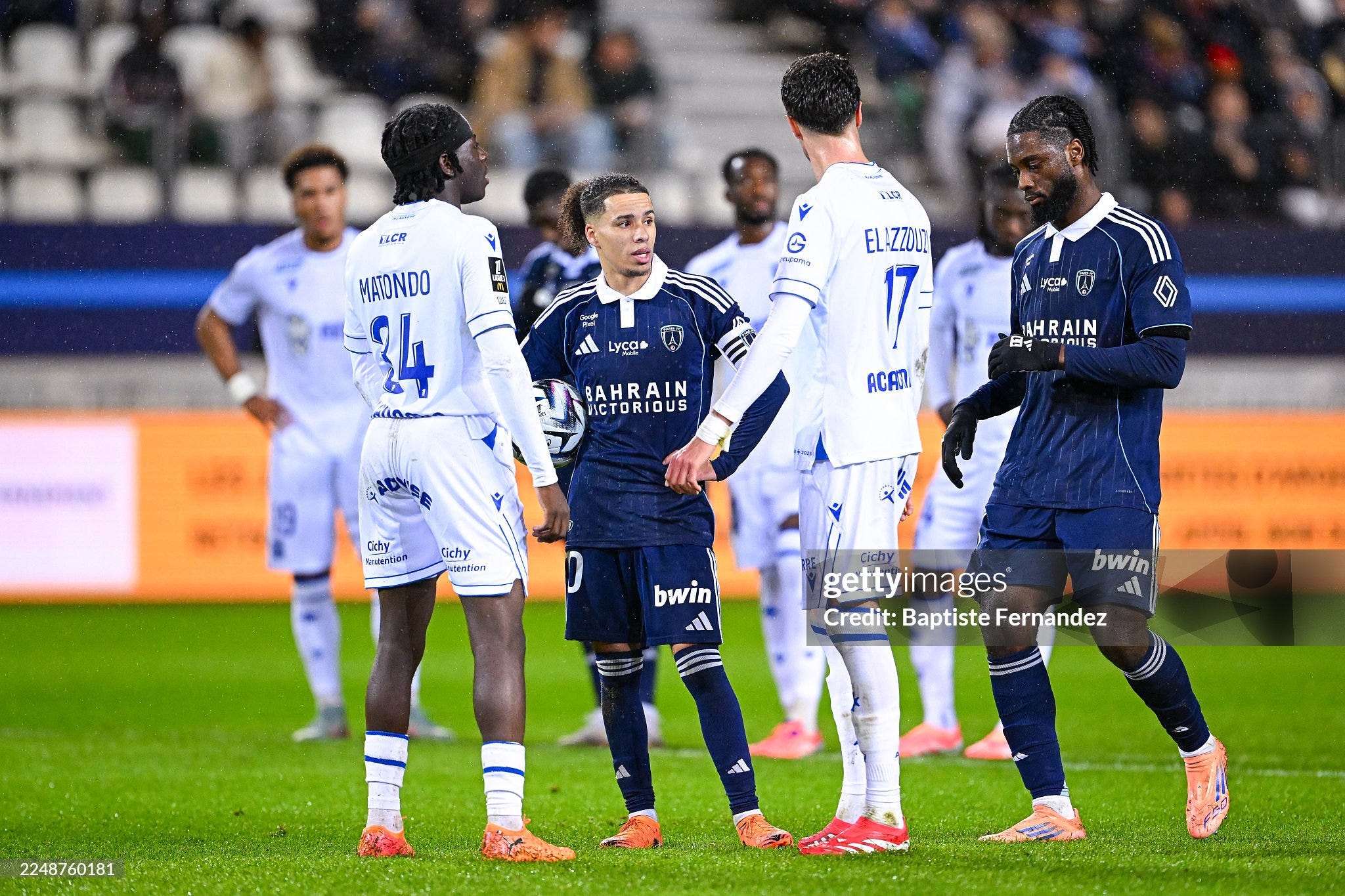
Now I'm closer to the edge
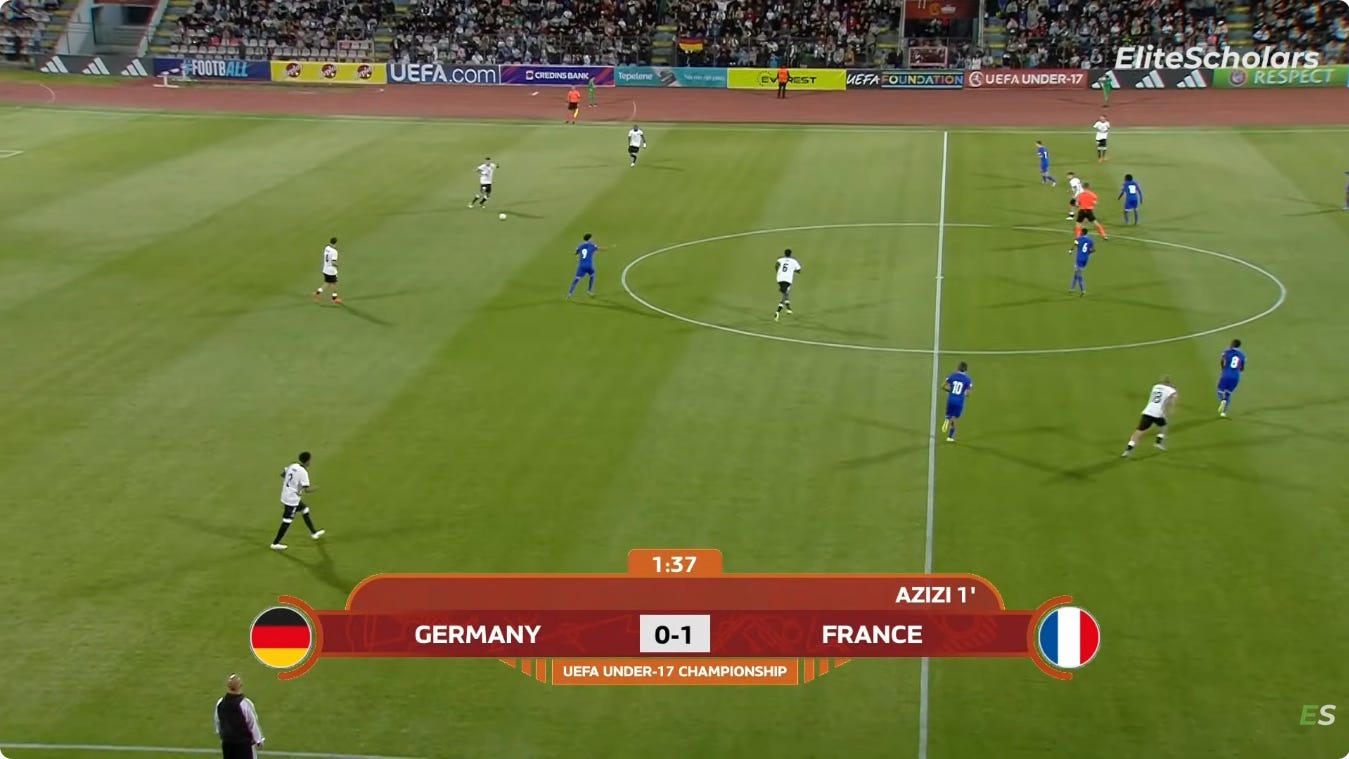
Matondo played the UEFA European U17 Championship with France
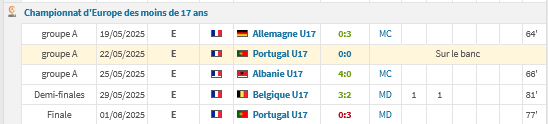
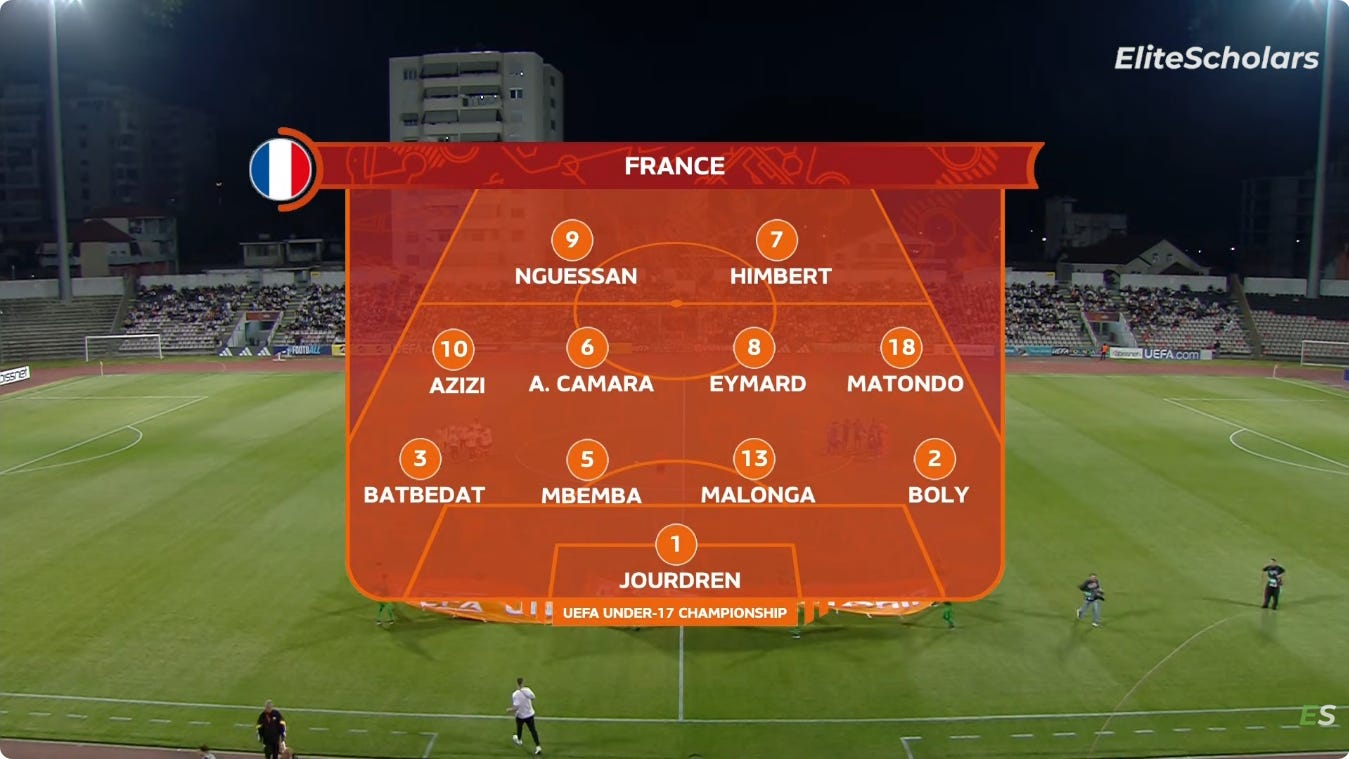
More like, as part of a 433 ; with Camara (6) base midfield, flanked with ASSE Bomb Squad captain Paul Eymard and Matondo
Midfield 3 in a pyramid
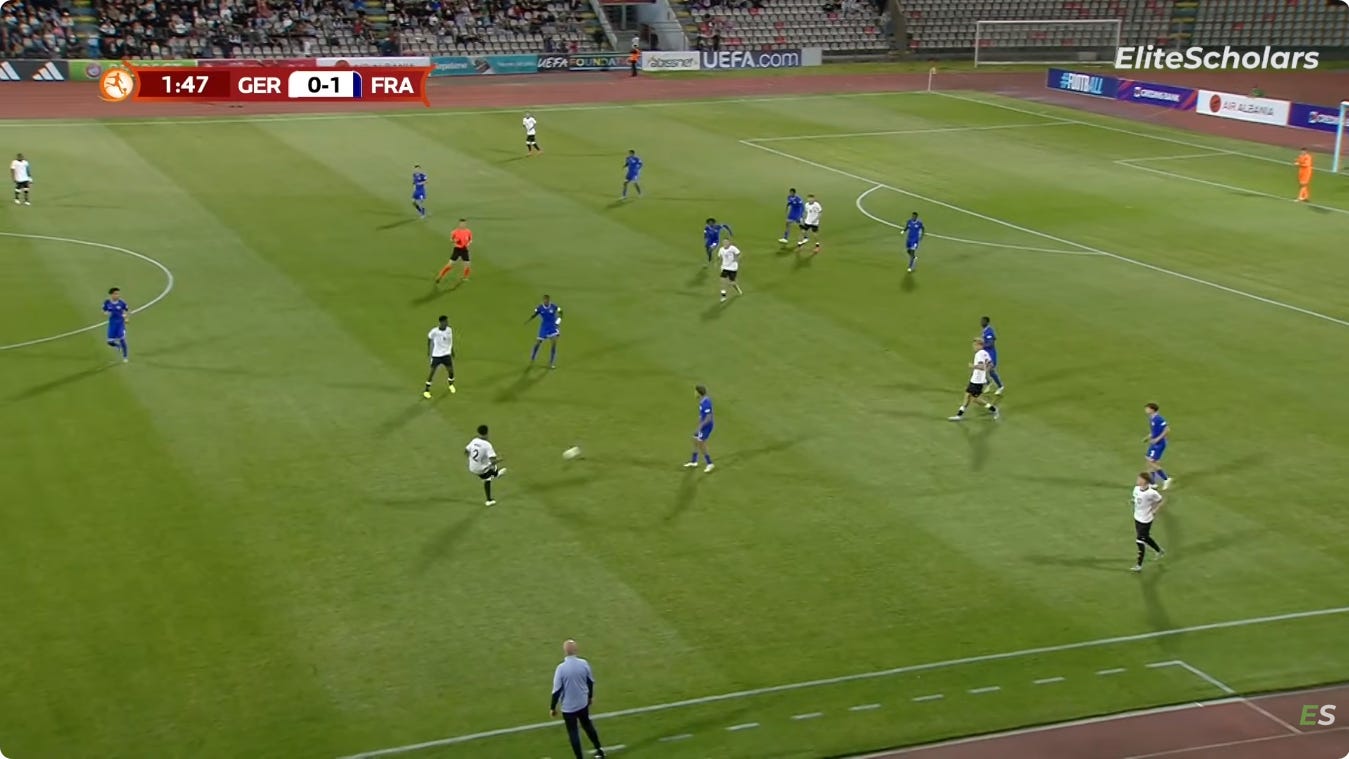
Get goal side
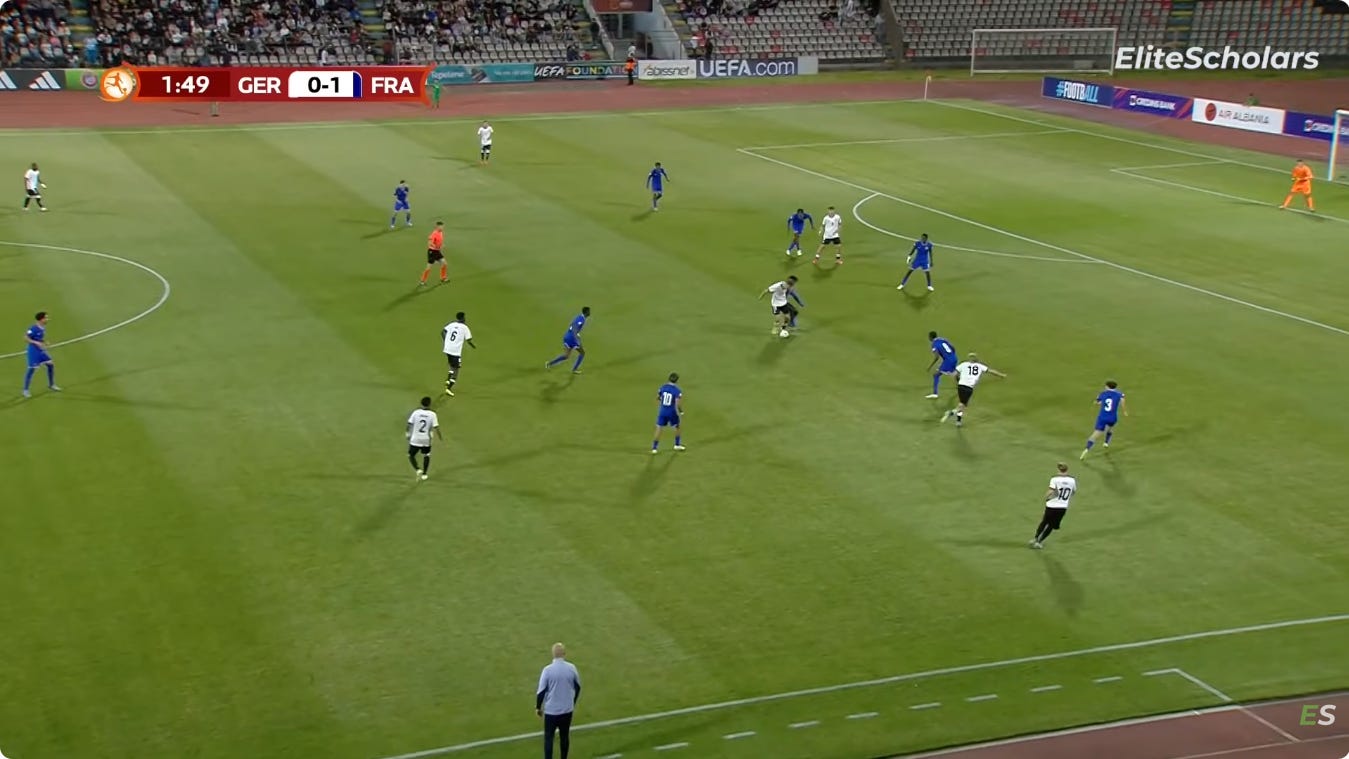
And drive at pace post recovery : long touches with open space
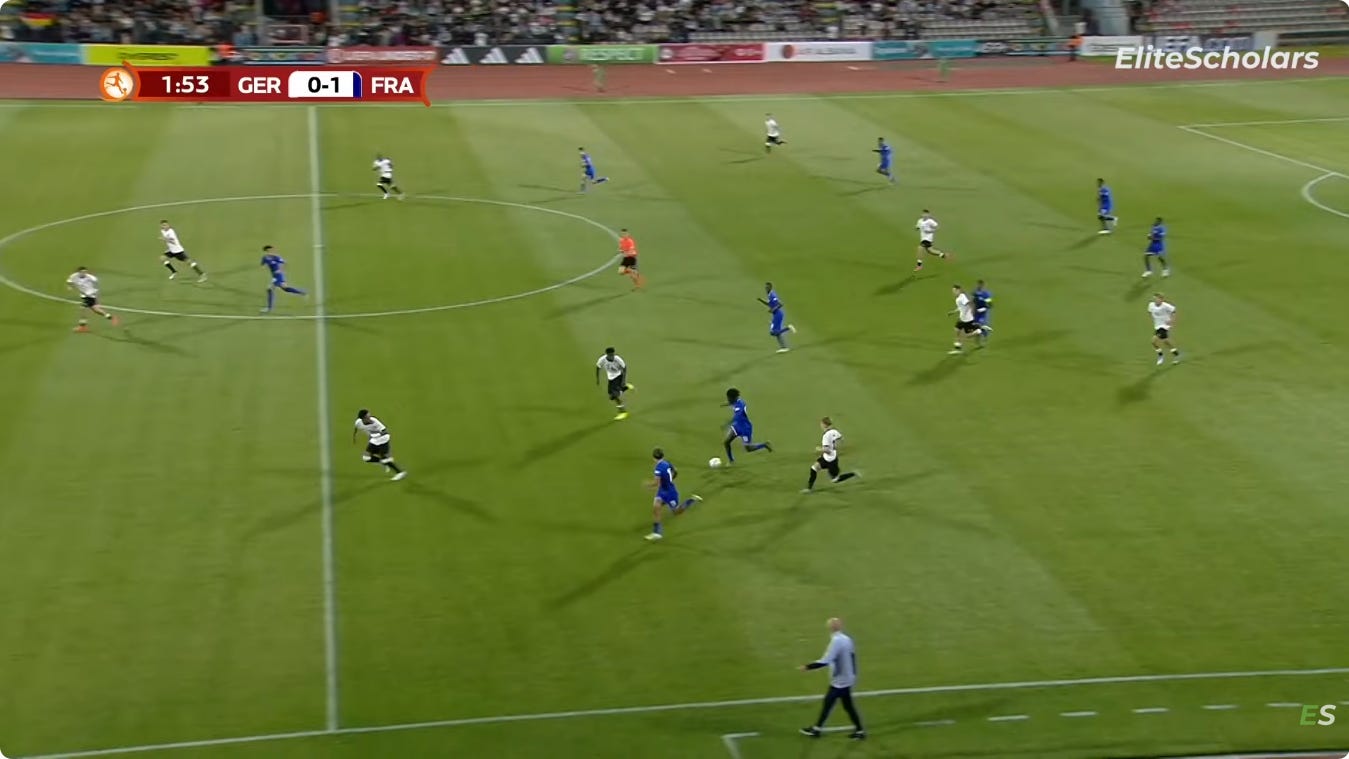
Shorter touches with closer opponents
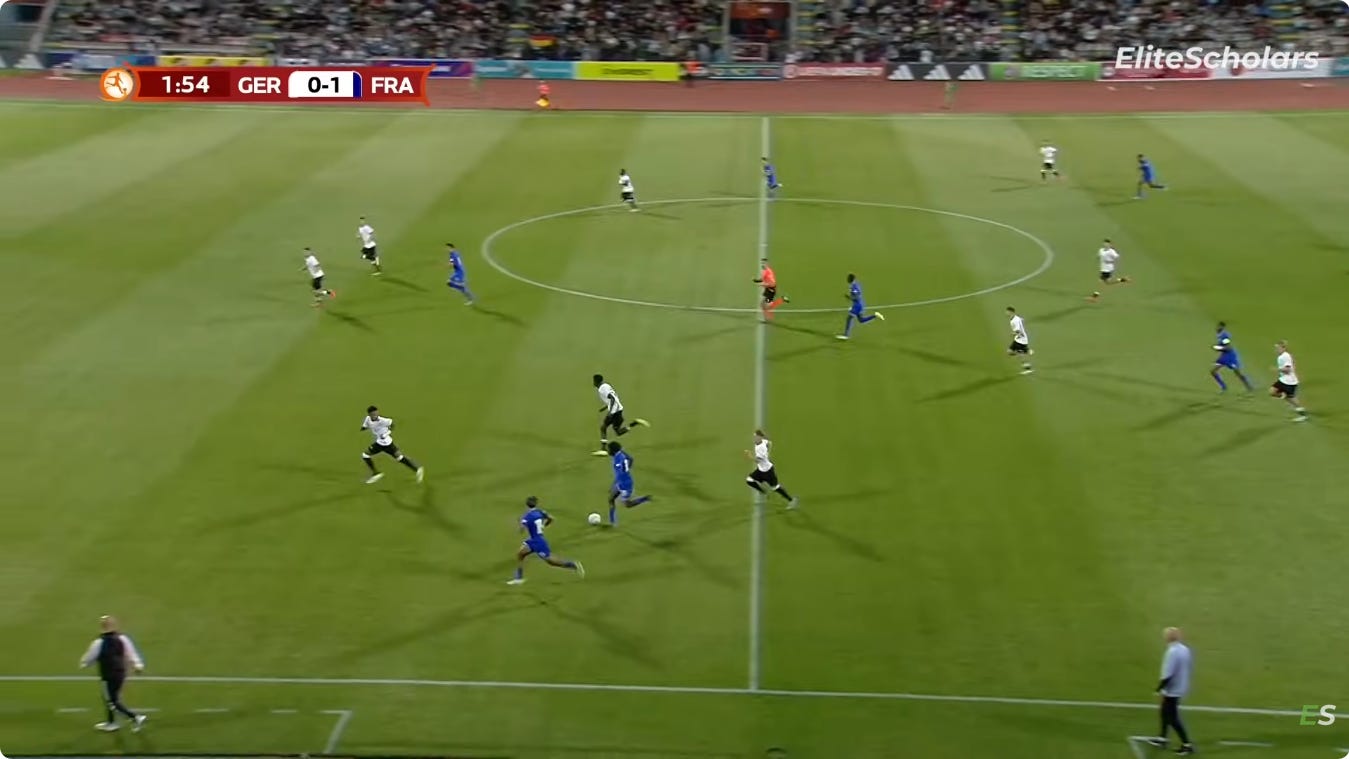
Change the tempo, not the speed.
I also liked that carry : wait in the blind side,
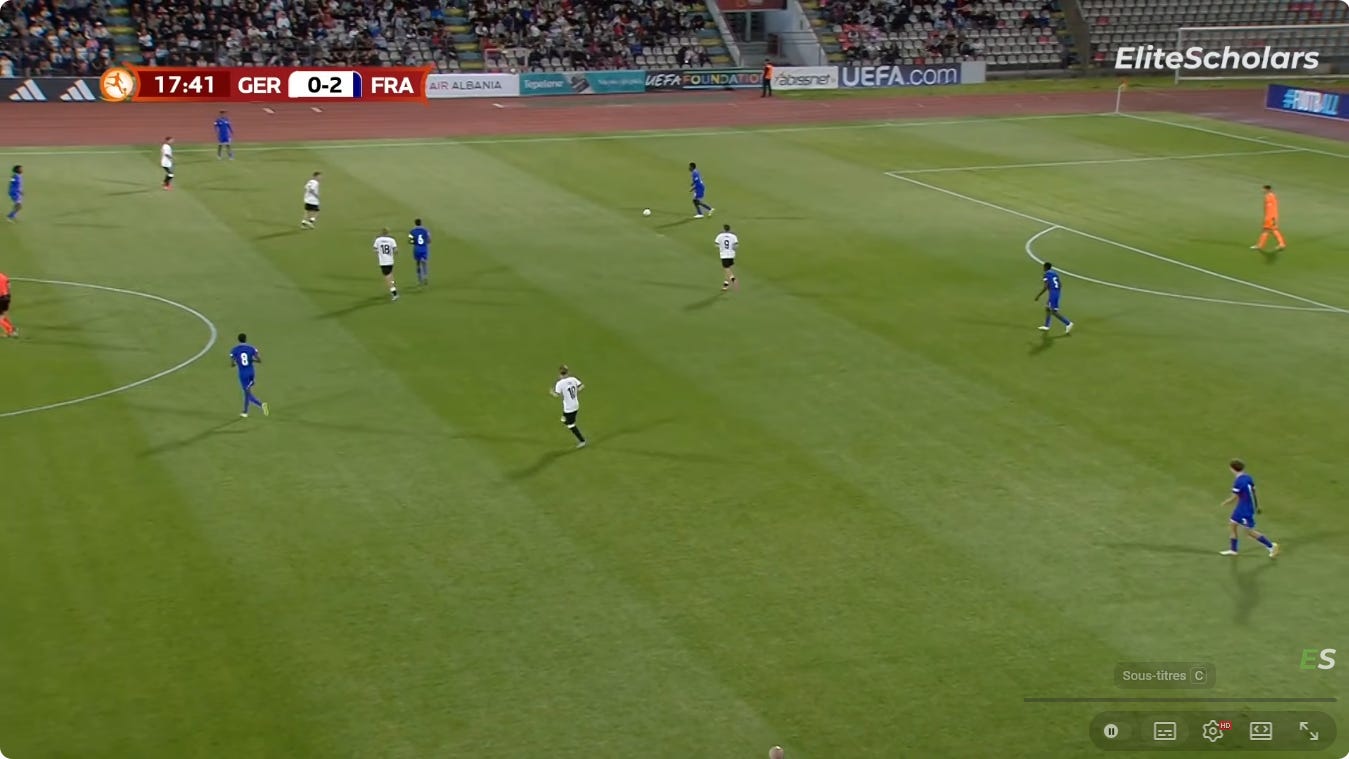
receive on the half turn and spin
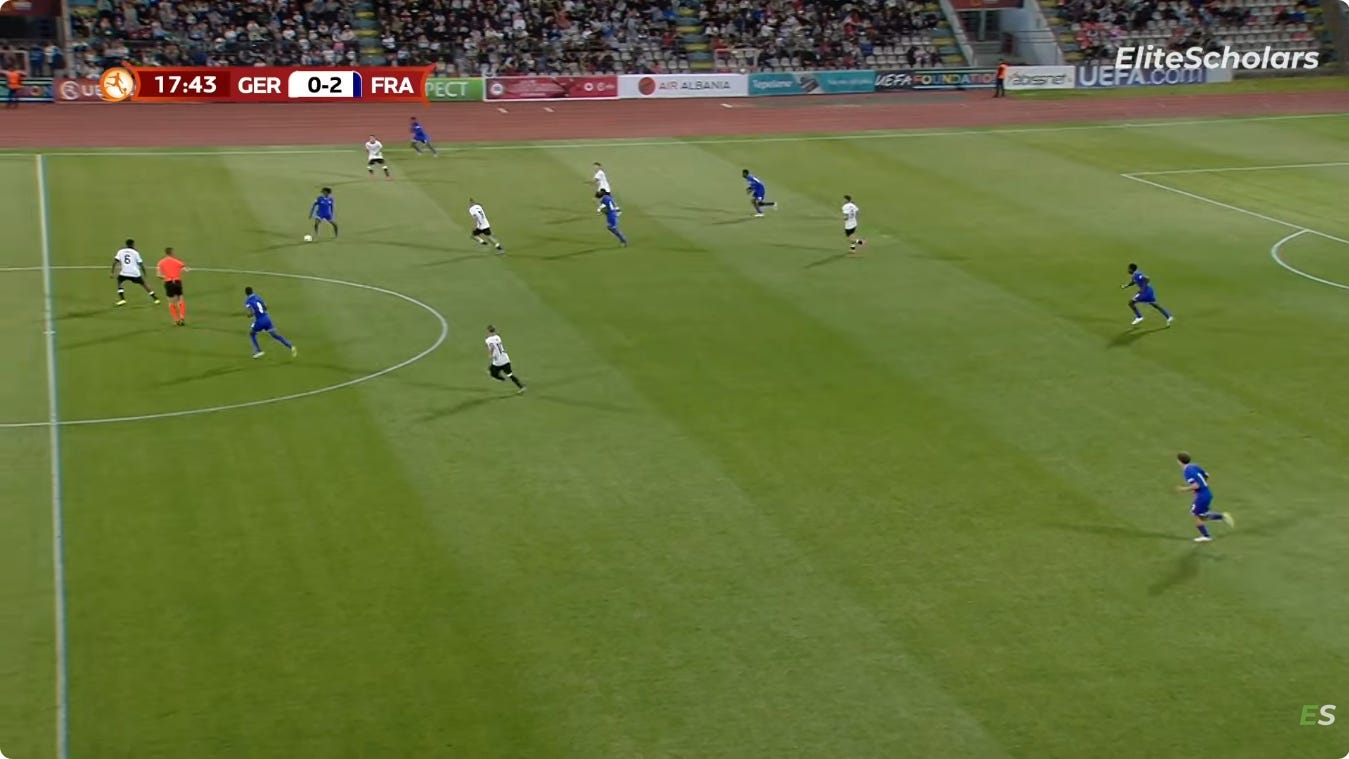
Controlled acceleration, not just kick and hope for the best, to chase it, actually pushing the ground
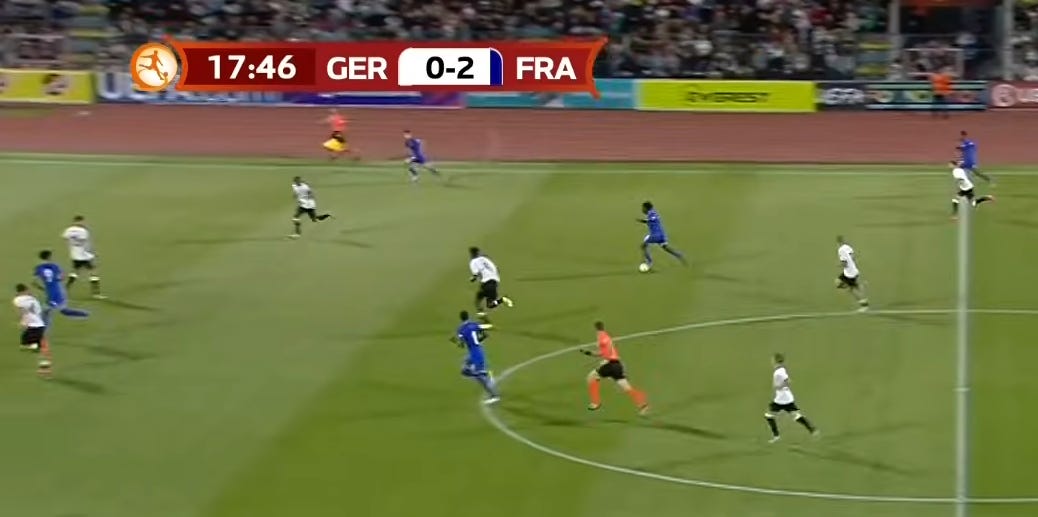
Keeping the ball in control
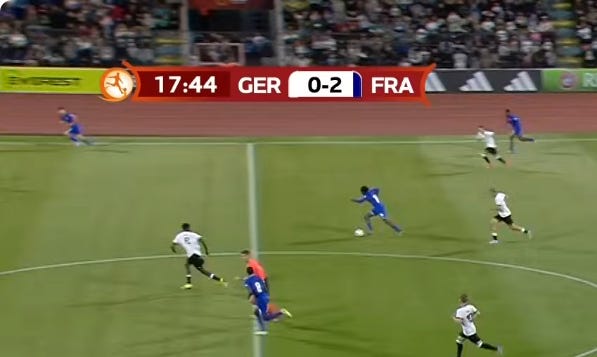
That my was first watching : this is my journal, documenting why “I liked that player”
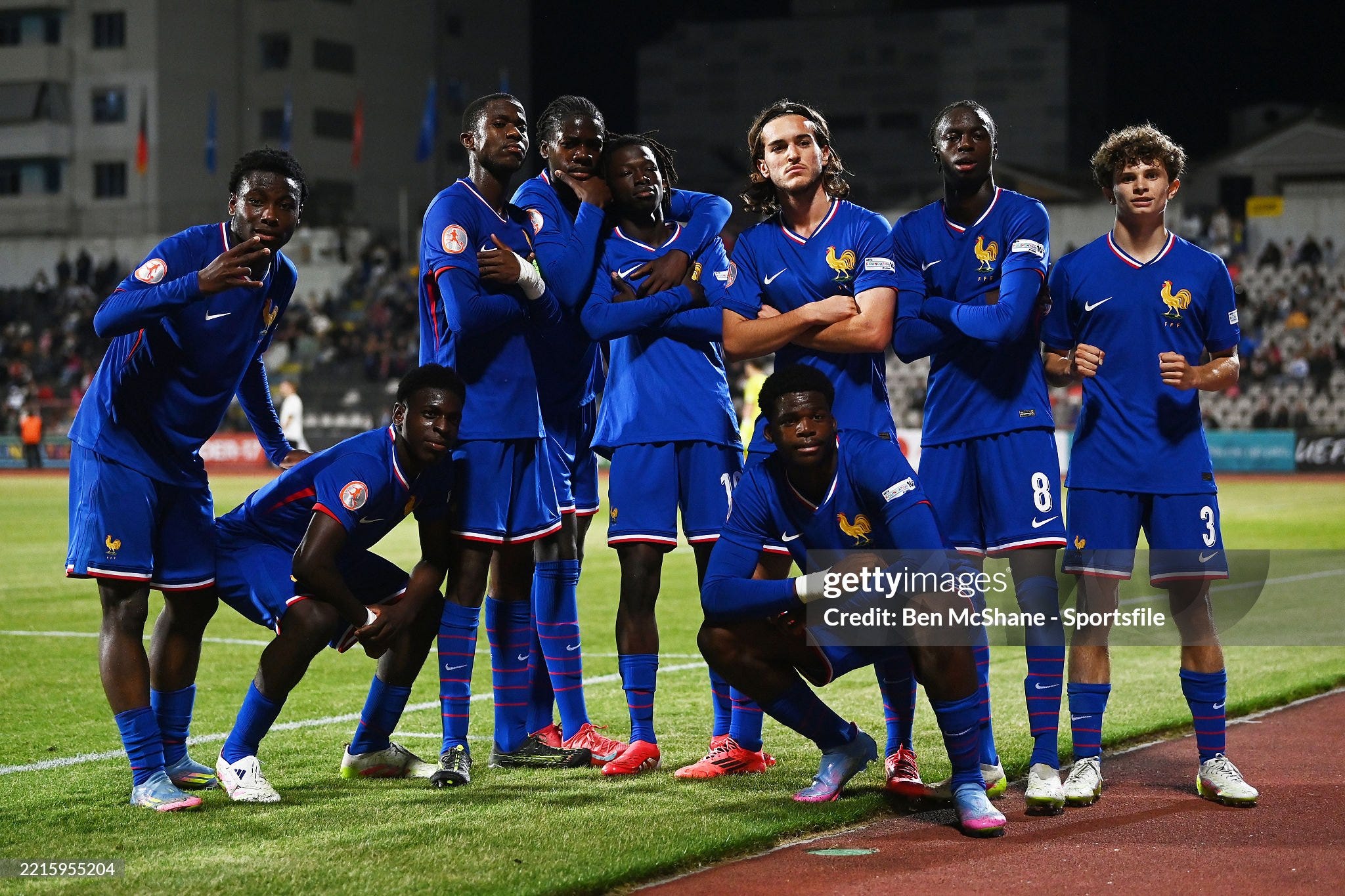
France had a weird group stage, with a spectacular win over Germany with a goal in the opening minute, followed by a second goal by N’Guessan to cruise toward a 3-0 win
A drab draw vs future finalists Portugal where nothing happened (maybe because Matondo didn’t play), and a 4-0 win to Albania with three late goals. Narratives. Since these competitions involve 8 teams, it’s frequent to face the same team twice from group stage to semi finals (the round to qualify for the World Cup).


France was as good as their results suggested ; with some flashes of real quality, an organic brand of football (as always) but showing some elements of being able to shape the momentum of the games the way they wanted to. In attack obviously with 7 goals scored, none conceded and top of the league with 7 points
I don’t like to say “controlling games”, but their second half vs Germany and first half vs Albania were not disjointed despite not creating much. It’s neither an end nor a goal to blank halves, but it’s still notable to see youth teams being able to stay cohesive, and not just sacking off OR play chaosball (and nothing in between).
France always platform end to end midfielders, they’re doing the box to box thingy as well as English ones : at the difference French ones are more creative, and possibly inventive in small spaces. Sometimes with an edge and quicker, but not as strong and disciplined as English counterparts (where their 4 and 8 are often told to look after the ball).
French midfielders will have a haughty bearing, a swagger and basically look in the distance with casual disdain - and you’d see English midfielders sight on their opponents’ feet, heads down. This is a societal fabric tendency which I find absolutely fascinating.
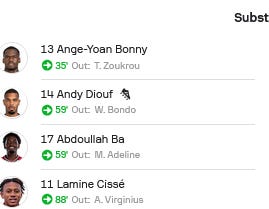
And flair French CMs can be absolutely non existent in duels, to an extent that English academies wouldn’t tolerate. As a result, an unbothered French midfield 3 (whatever the shape, they’ll go where they want - Le Fée, Caqueret, Andy Diouf, Bondo, Aouchiche, Agoume, Abline, Abdoullah Ba etc) can truly look absolute chaos especially on defensive transition.
That’s U19 but France was really carved through regardless of personel in 2022. It would’ve been a France-England in the final ; the one Lee Carsley’s England won.
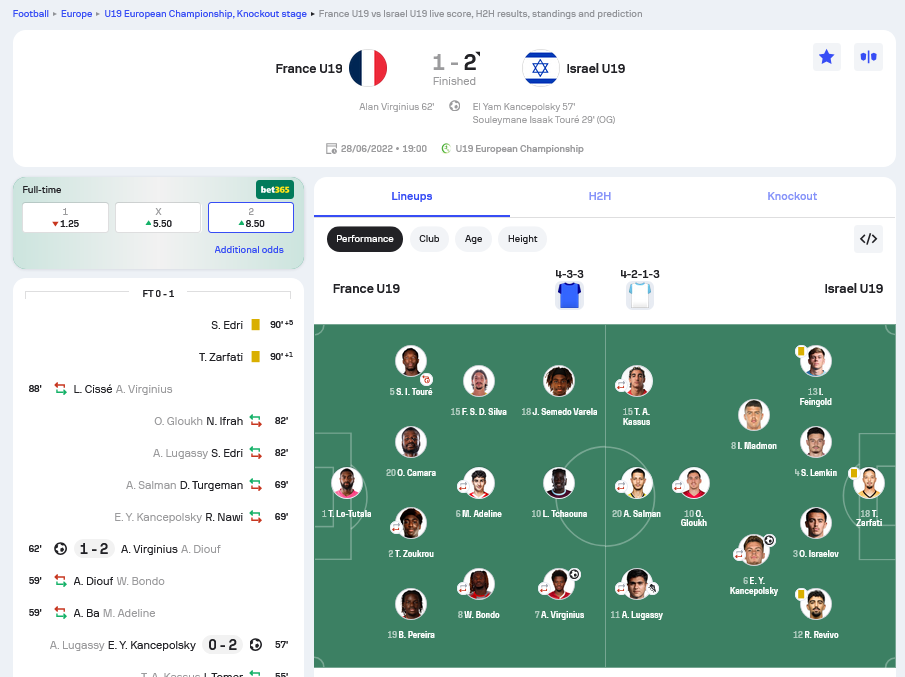
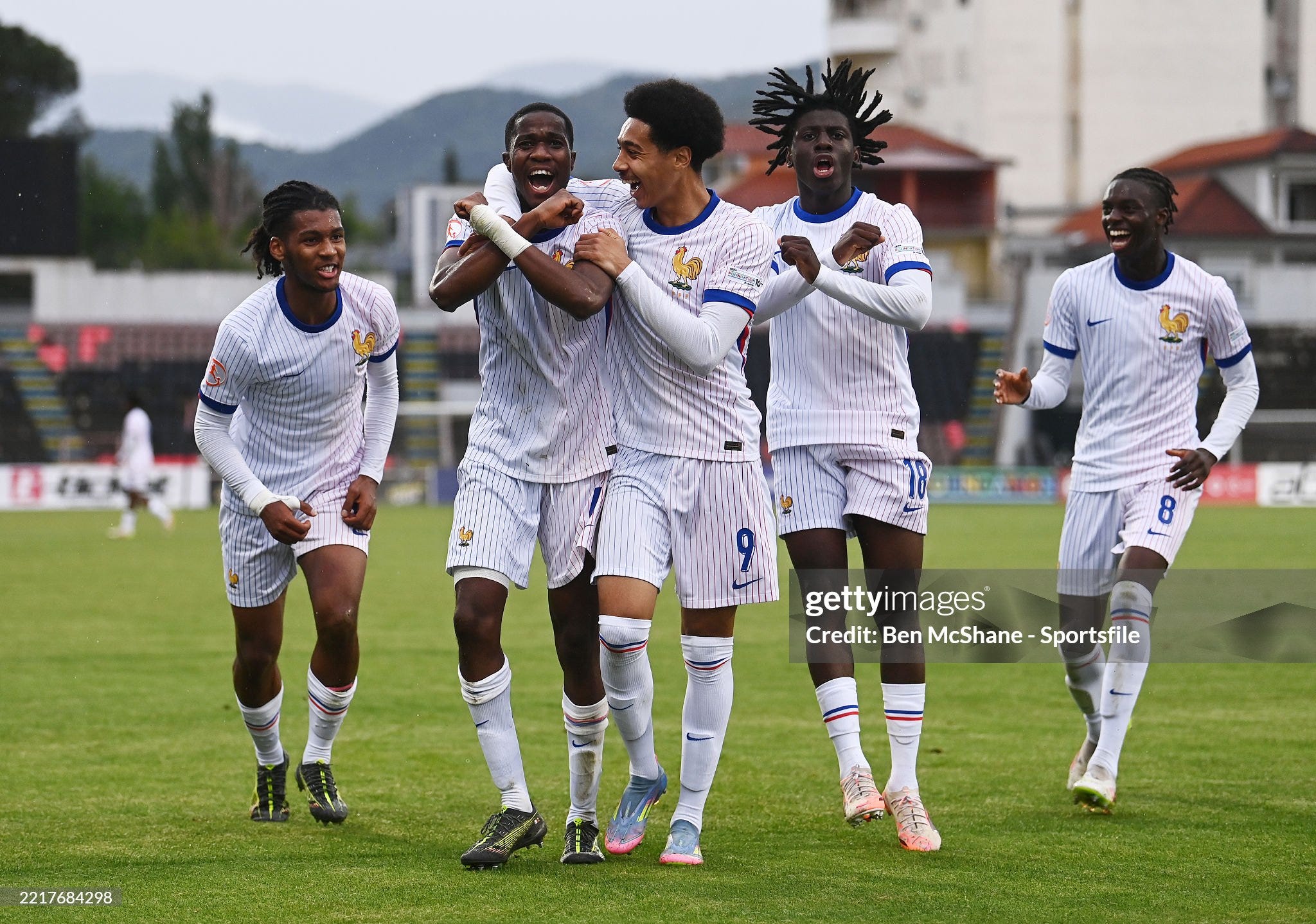
Matondo had a purple patch in the middle of the eventful semi-final and stole the spotlight
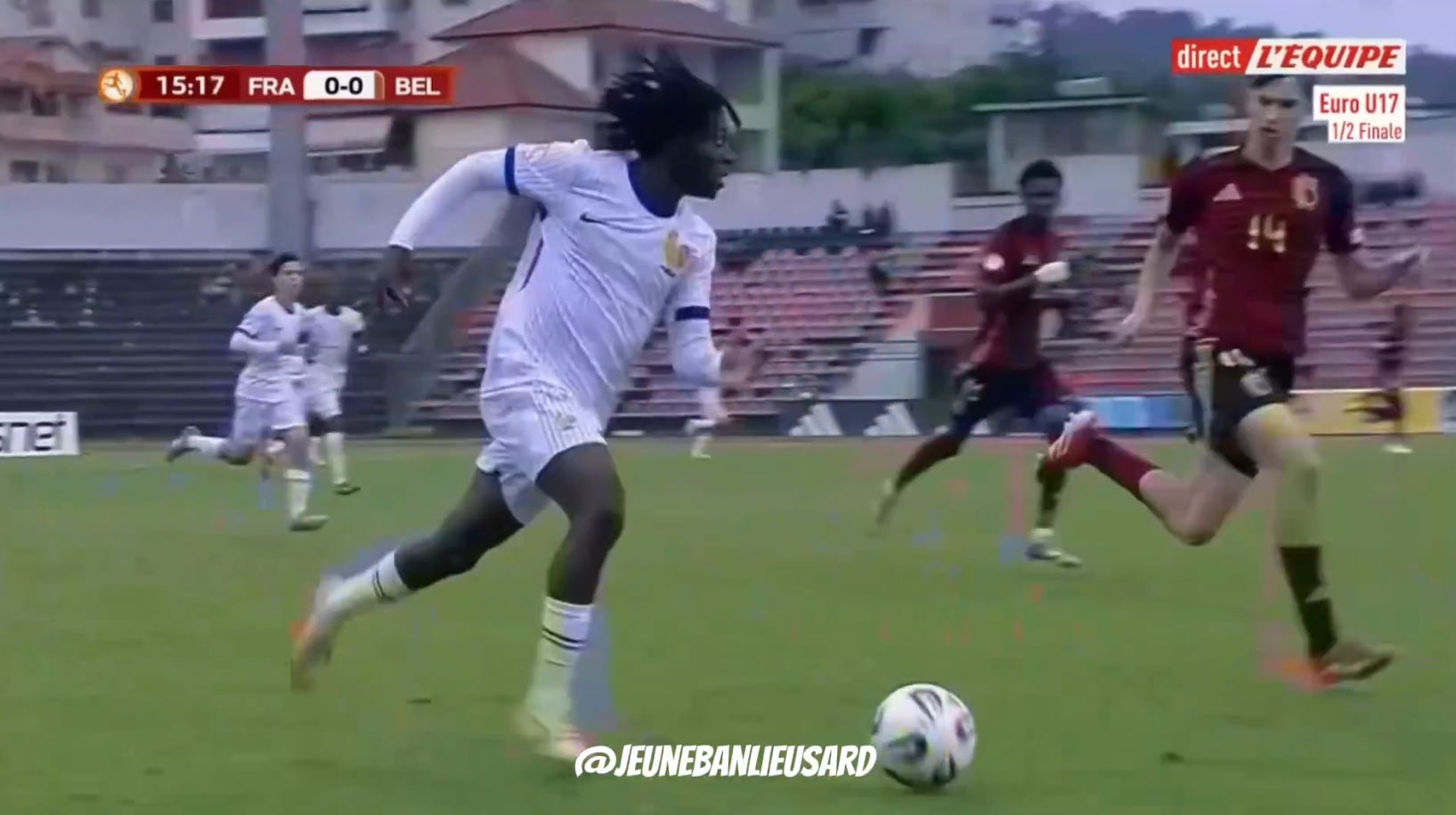


England say “drop the shoulder” to send the opponent for a hot dog - watching the wrong body cues
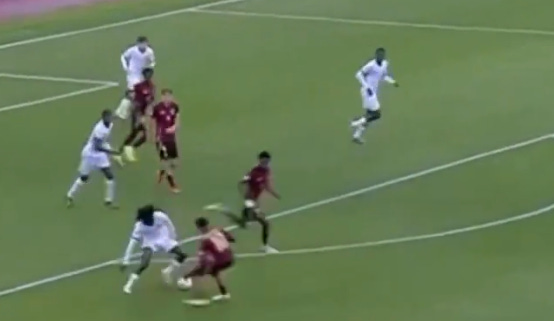
French say “Le Grand Pont” (the big bridge) for knocking the ball and running past the other side. “Ze big bridge” maybe
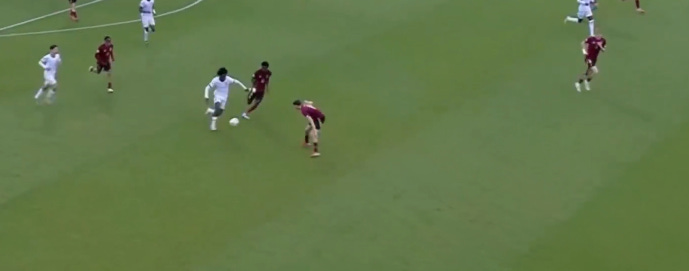
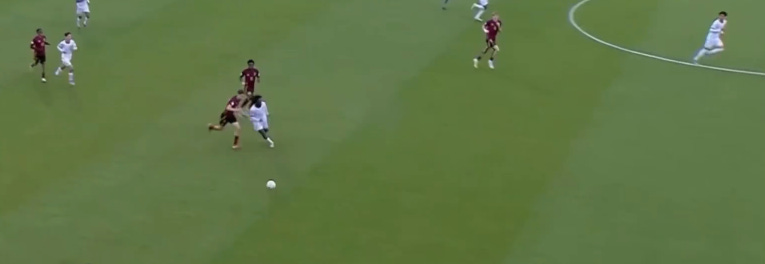
What’s open? Striker isn’t on
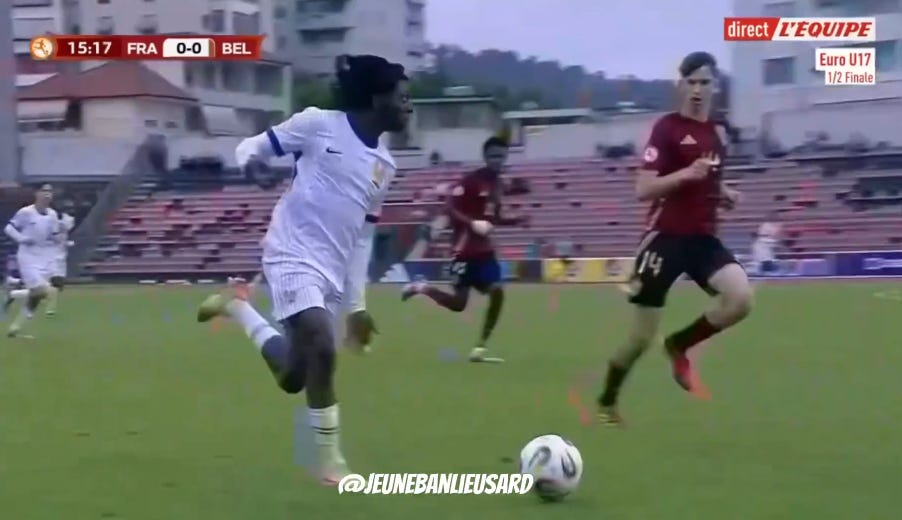
Speed isn’t the truther at top level, but deceleration
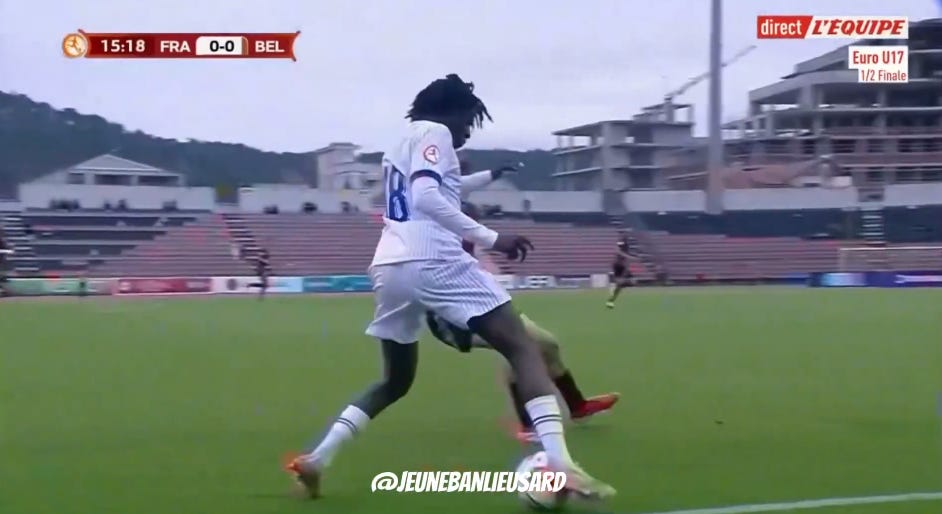
Closer to the edge, block then kick to run past
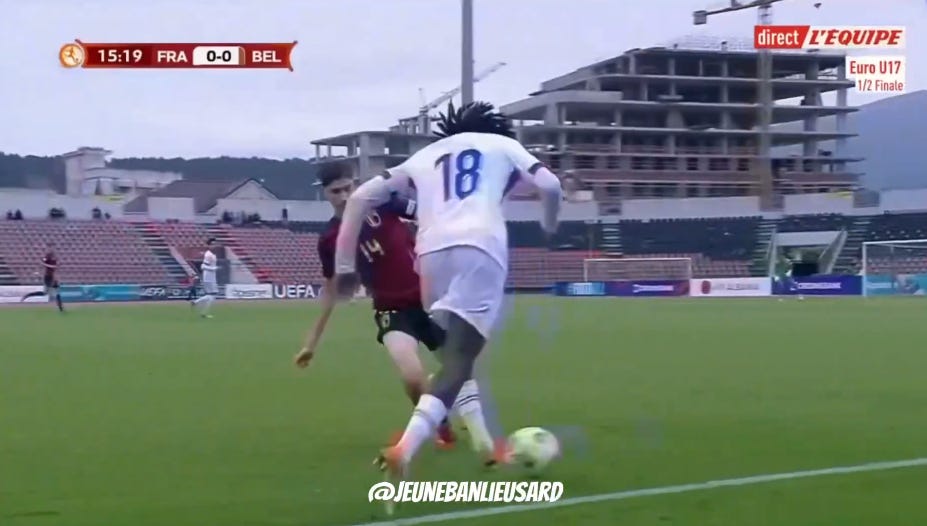
then attacking the box diagonally
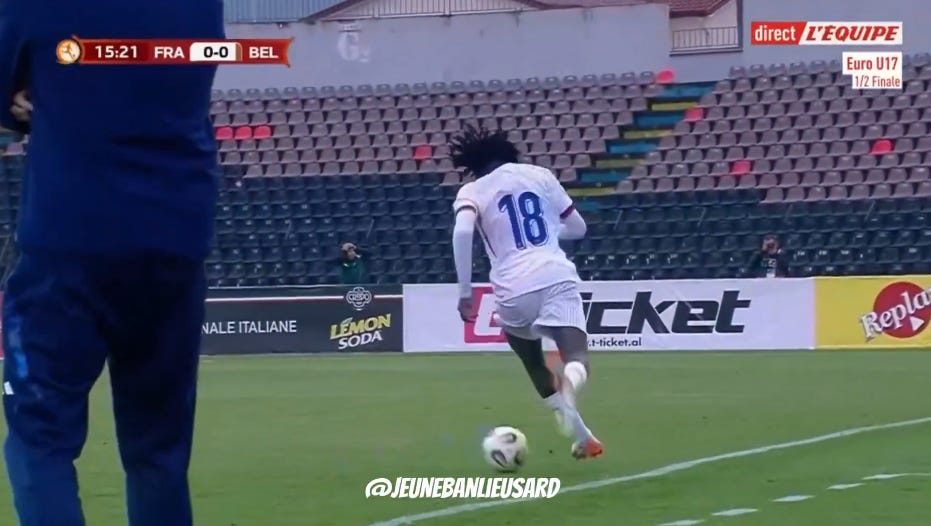
Winger or CM ? Who cares
I care about this, Matondo is left footed
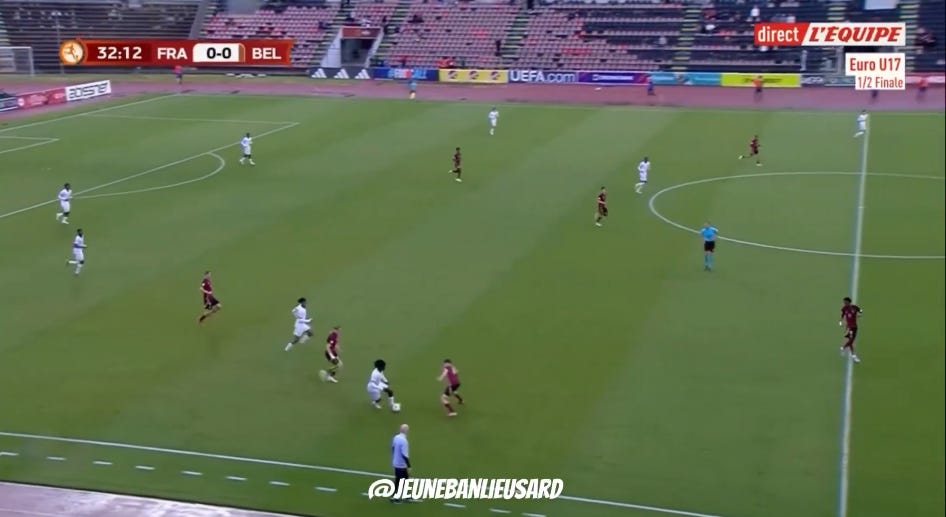
Shift and pass down the line,
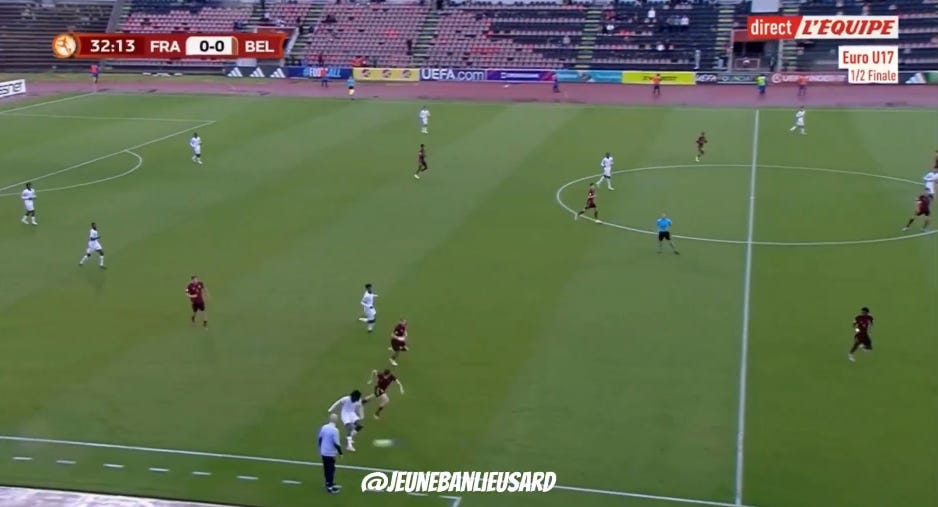
inch perfect wrong foot for a lefty - try it
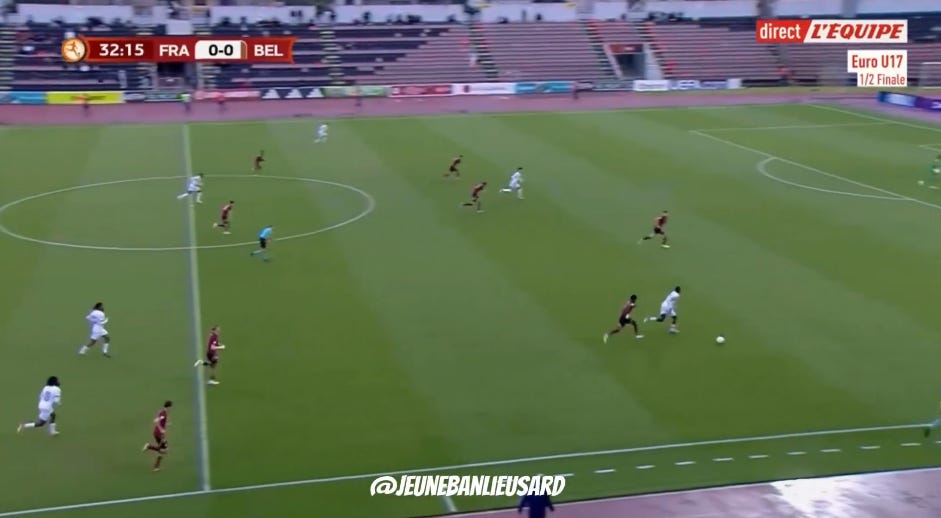
There’s a lot of instances of Matondo’s electric ball manipulation : quick feet, but also changing tempo over speed, with creative twists and turns.
Sometimes, the difference is made by teasing the edge and delaying the touch :
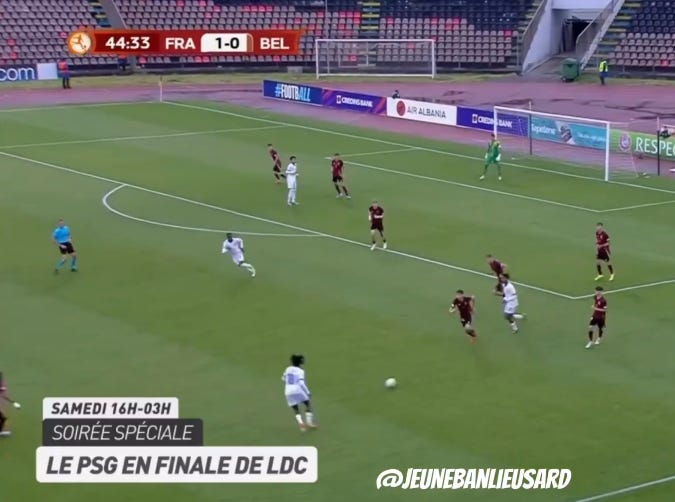
So Matondo keeps control on proceedings - the defender bombs on, but has no idea where to aim for to set his footwork
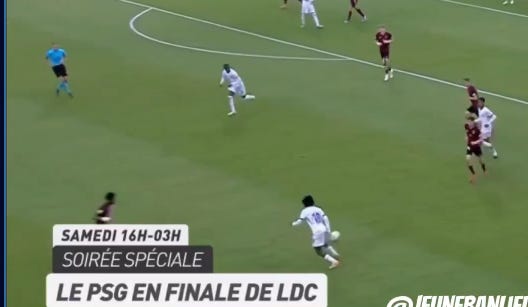
And gets done because Matondo walked the edge to release at the last instant
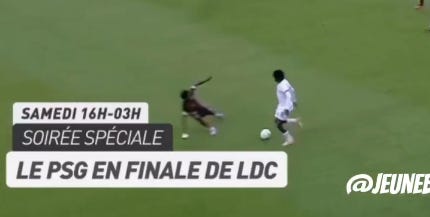
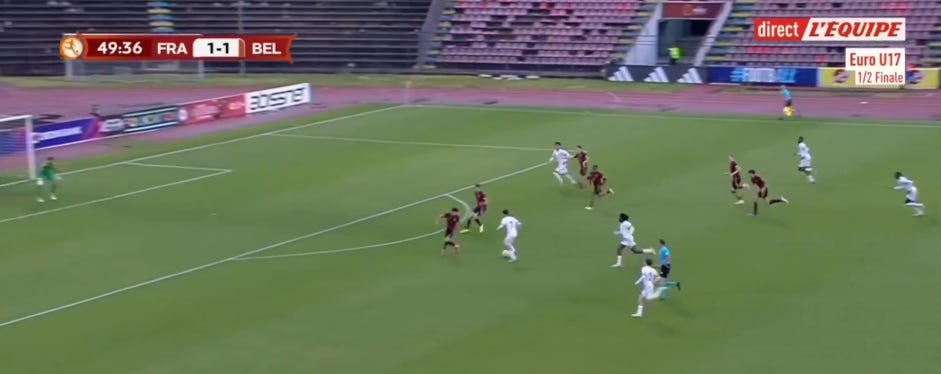
Total football ; CM overlapping
Large steps, but sorting out the support foot, to leather the ball in
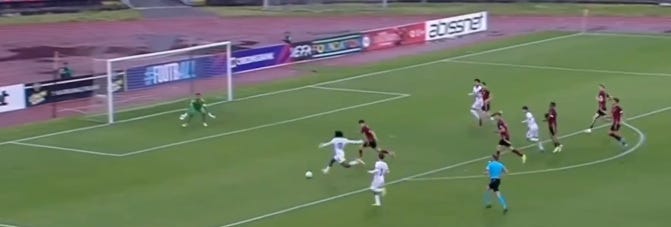
Look where the space is
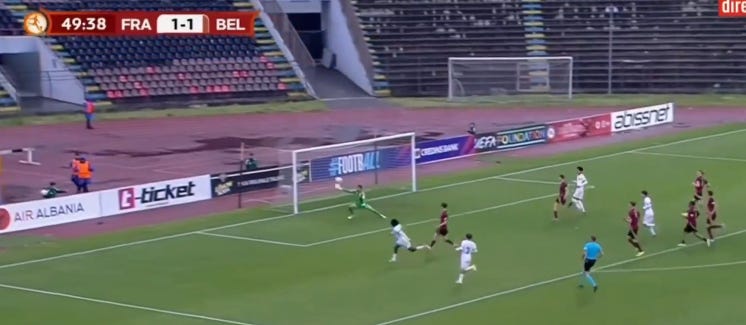
No chance to miss the target if the right foot points at the right direction
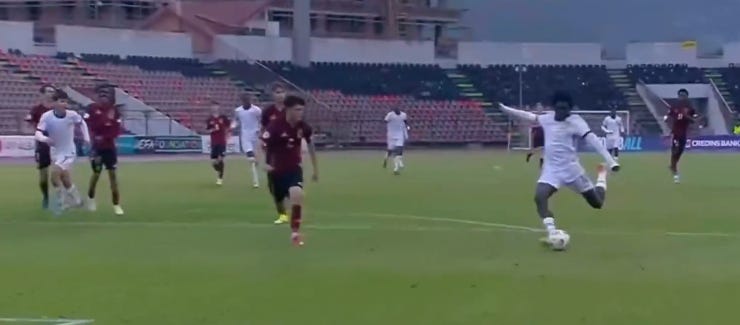
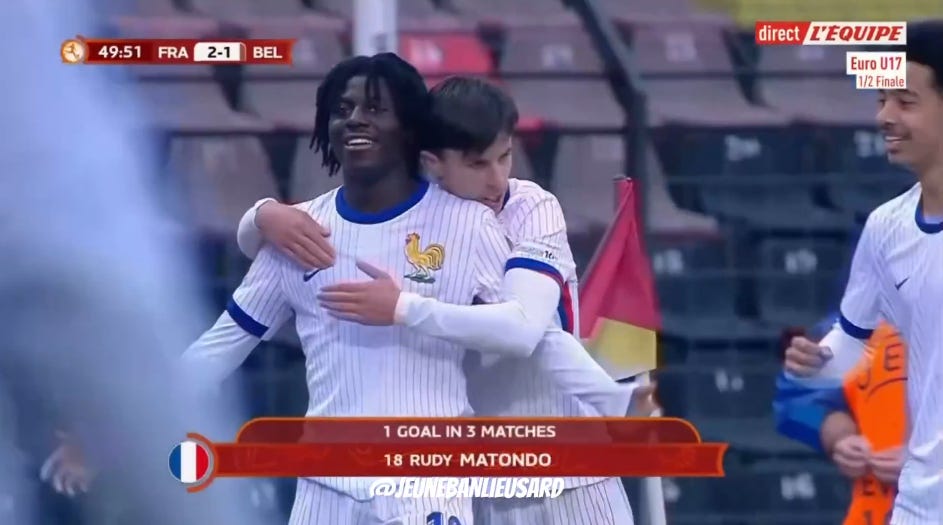
A minute later, Matondo peels out towards the right (as a left footer)
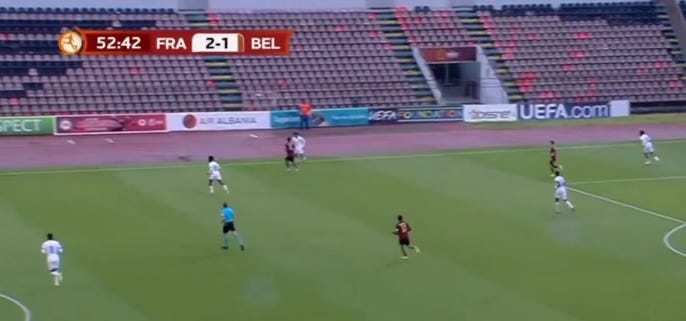
A bit of whatever wide play, and a pigeon wing backwards
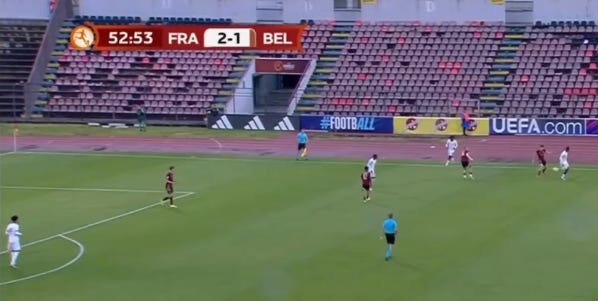
allow Matondo to kick and run,
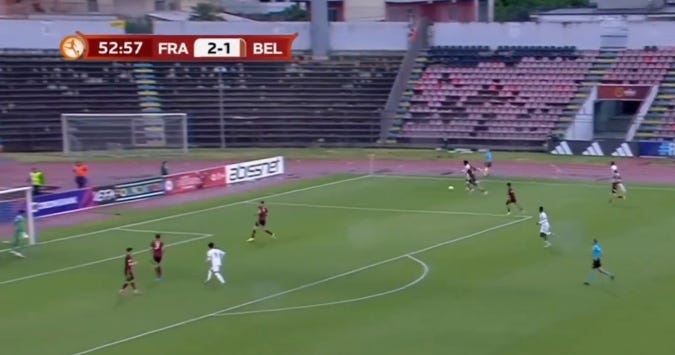
See N’Guessan in the box ; opposite side of the penalty spot, attacking the near post when the cross is hit
to score the second goal
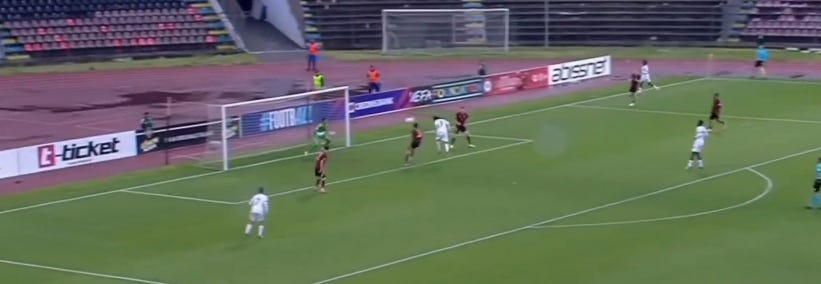
Four minutes later, Matondo isn’t daydreaming
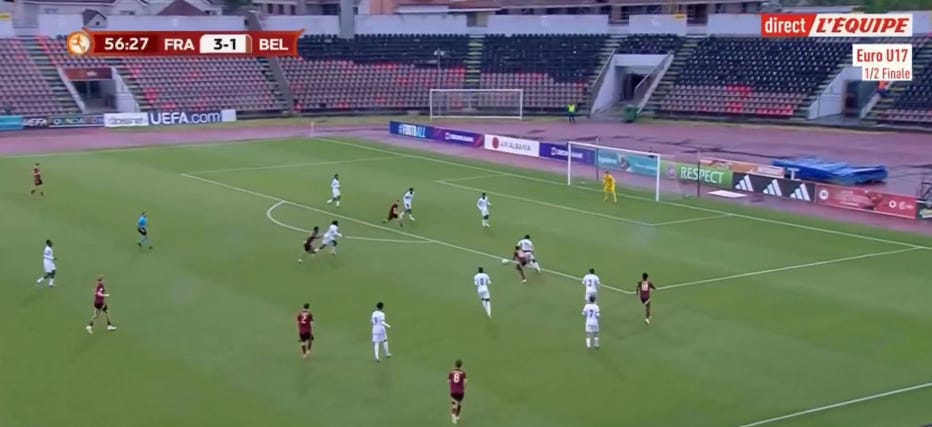
Don’t let anyone out-run and out-work you
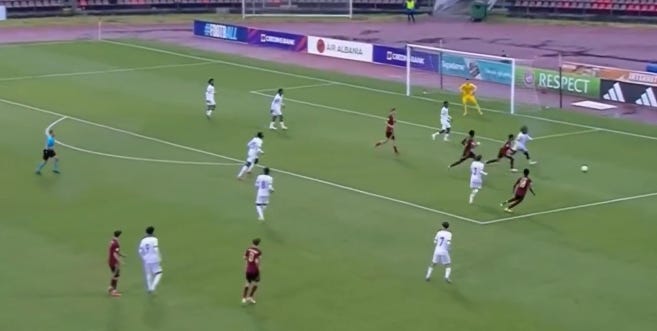
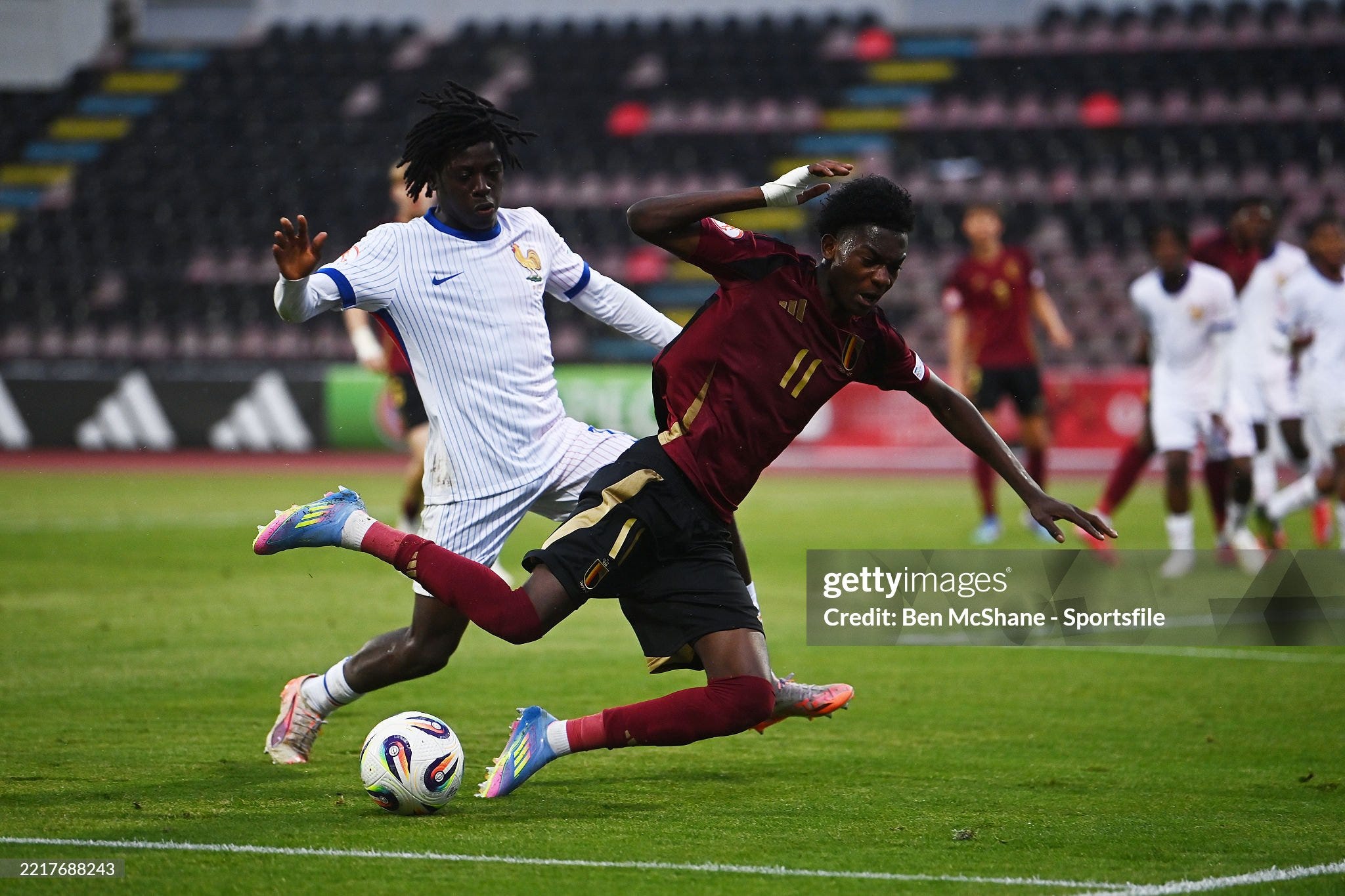
The birth of a sun, the death of a dream


Are you a winger?
Are you an inverted winger?
Are you a CM?
As we navigate closer to the edge, we keep in mind that players are skillsets, not positions.
I believe there’s a metaphysical discusion to establish so we keep discussing the core of what makes a team ticking between both boxes, as opposed to limit the expression to stacking players in categories.
Regardless of the position or side of the pitch; defending a 2v2 demands urgency and know-how. Here’s an idea of how to train it
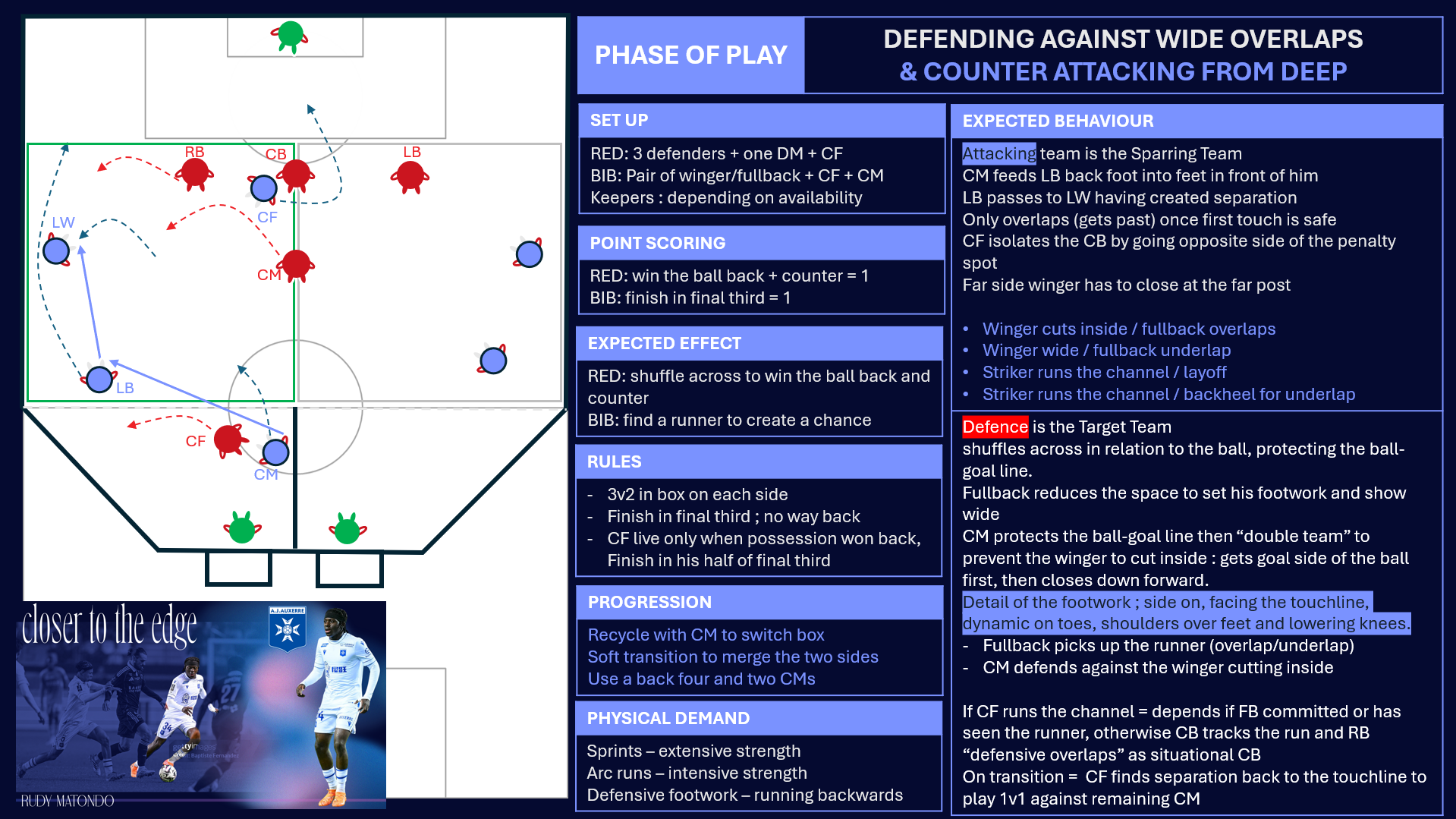
Problem solving in small spaces, when paired with a start-stop ability can change the picture and shape the outlook based on what the player does, not what the role demands. Football isn’t a performative sport, otherwise Football Manager gamers would automatically make good coaches.
The optics are such that gamers and coaches should find a ground to meet in the middle, so that the software accurately reflects how they see the game.
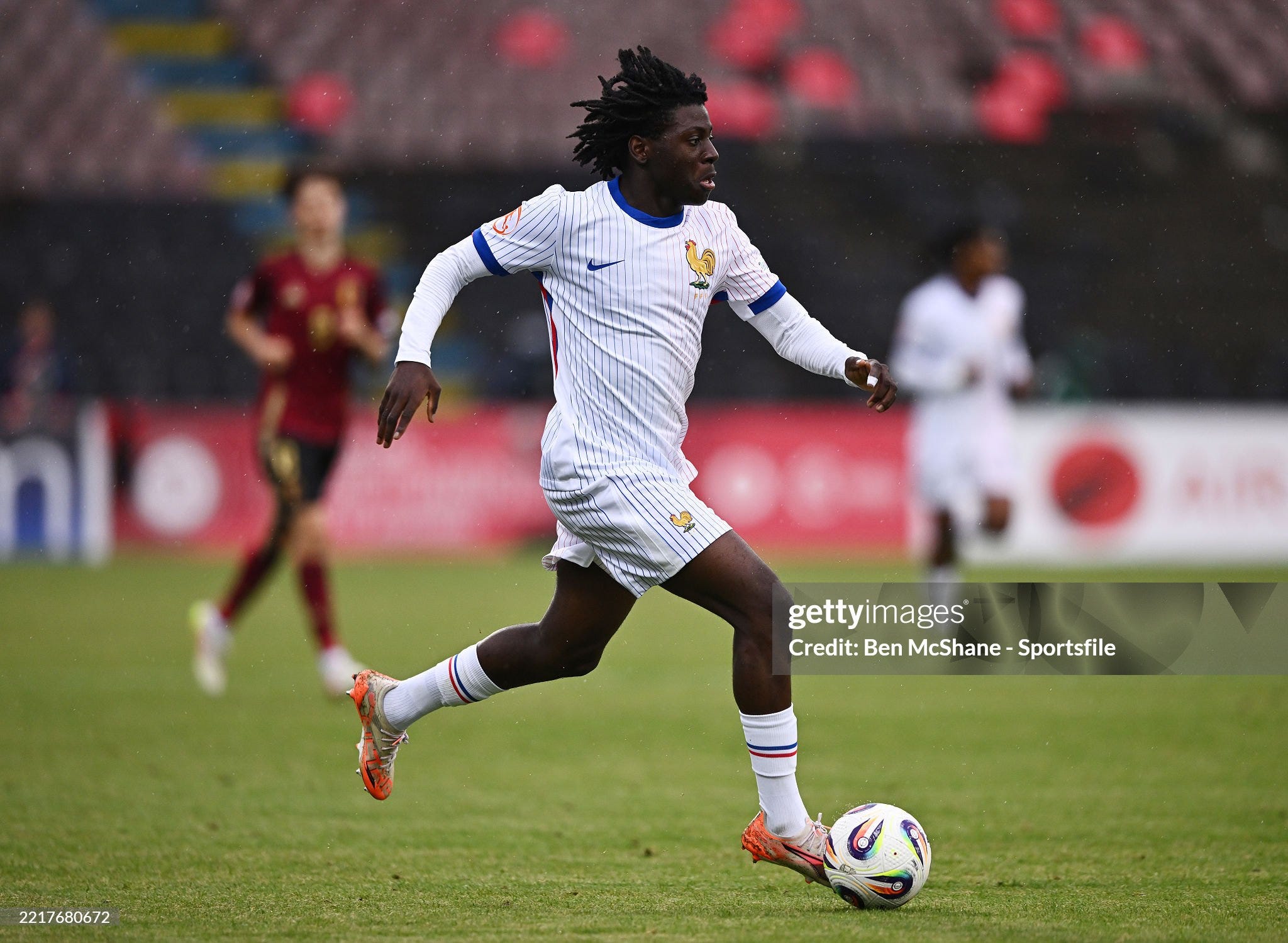


Initially identified by Auxerre’s Academy Director Jean Sébastien Jaures at the end of 2022-23 in their U15 Talent ID game as part of the scouting process.
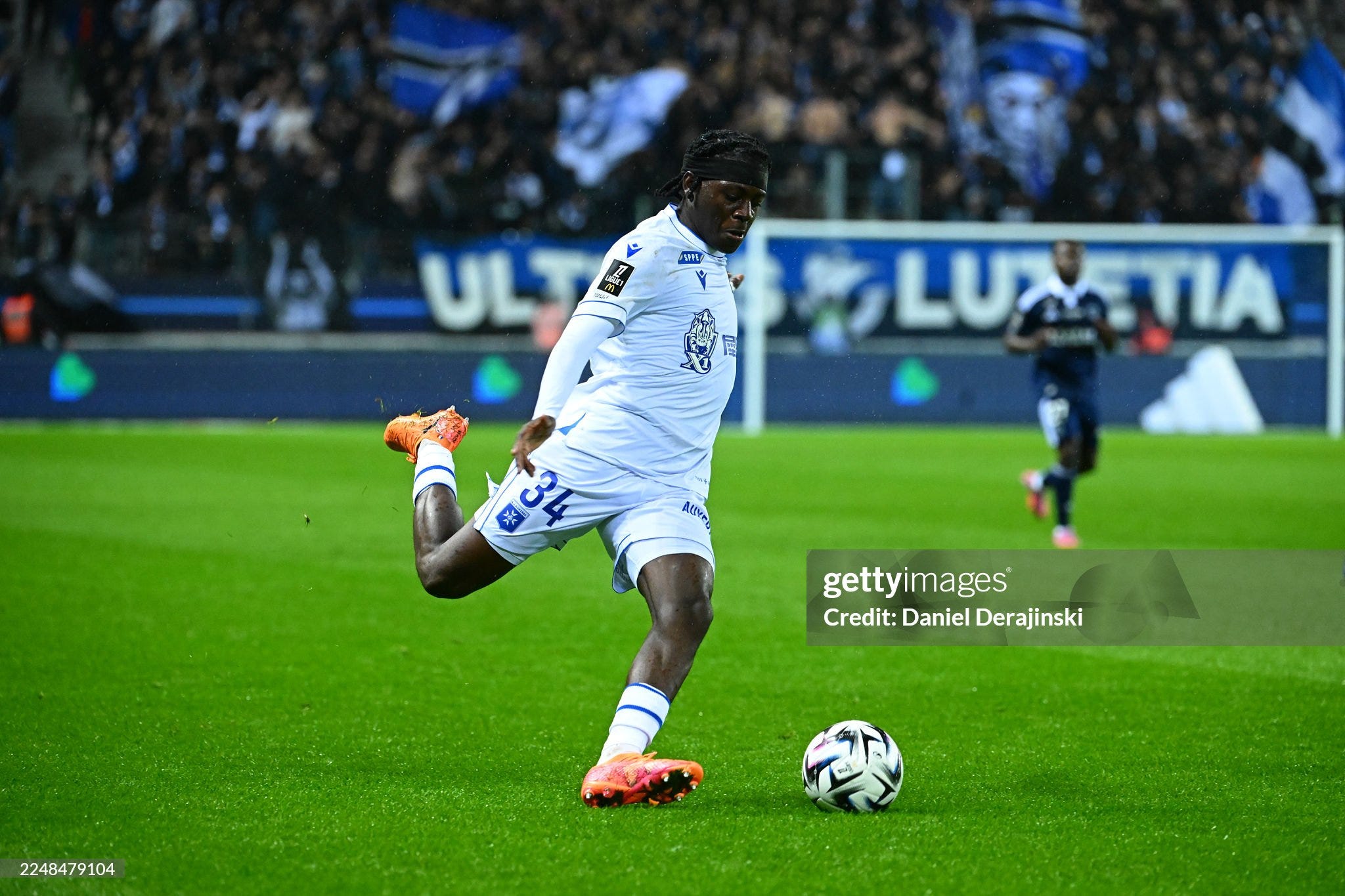
Matondo featured for AJ Auxerre in the UEFA Youth League aged 16 ; just like Lesley Ugochkwu and many more.

Paris FC decided to invest 17 million on Rudy Matondo in January 2026, which creates a vertiginous outlook for a player who joined AJ Auxerre from US Grigny in 2023 - the regular talent pathway.
This is very much down the road from Paris FC ; 25 minutes by car.


Sure, nouveau-riches will want new players, but that’s how a club like AJ Auxerre can rack up half of their club’s budget (40 million) with a top academy graduate being given a platform.
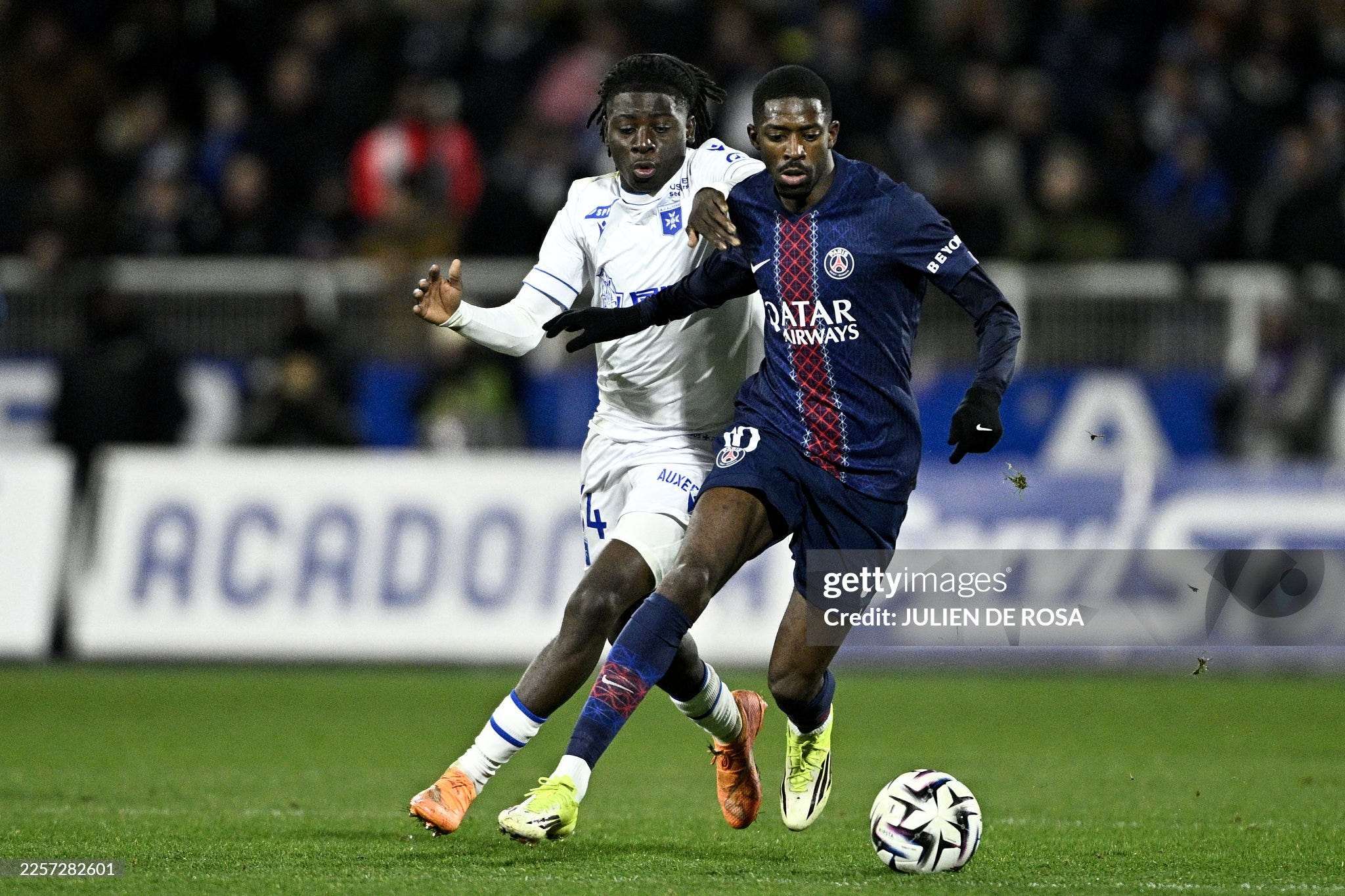
Matondo is also two footed, covers so much ground whilst keeping his composure and generally able to play any shirt number above 6 with visible tactical acumen on familiar defensive situations - paired with a “je ne sais quoi” creative impact to solve problems.